


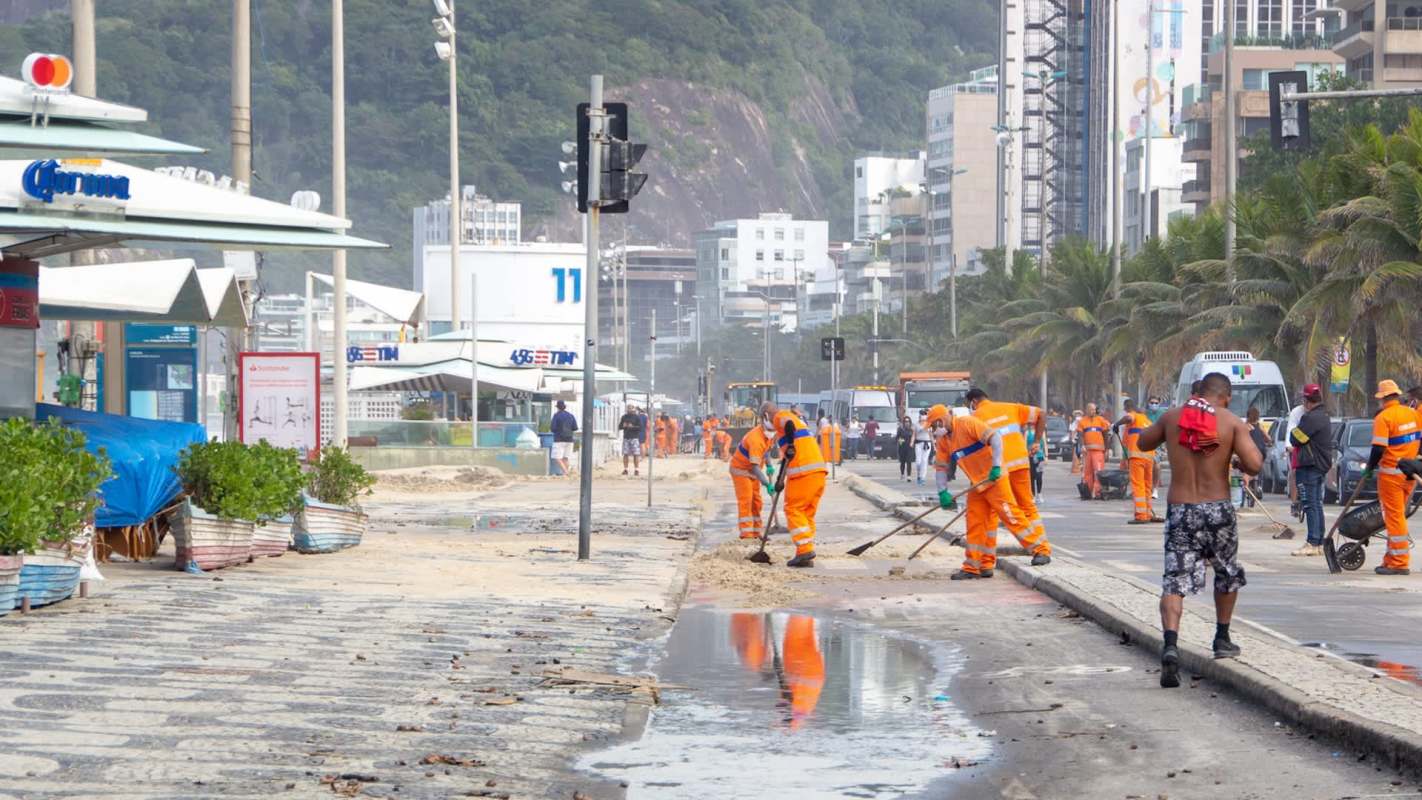
Researchers from Brazil studying the impacts of rising global temperatures on workers have found that extreme heat could severely reduce productivity across the country's major labor sectors. Losses could exceed hundreds of millions of dollars per day, not to mention the serious health risks of exposure to these dangerous conditions.
What's happening?
The study, published in November in the journal Scientific Reports, estimates how increases in global temperature could affect workers' ability to safely perform physical labor in Brazil throughout the 21st century. Using projections of daytime Wet Bulb Globe Temperature (a measure of heat stress in direct sunlight) and climate models, the co-authors developed two scenarios — a moderate-emissions pathway and a high-emissions pathway — to forecast related productivity losses across key industries.
Their findings paint a brutal picture of the future of outdoor work.
Under the high-emissions scenario, several regions of Brazil could see daytime WBGT frequently exceed 34 degrees Celsius (or 93 degrees Fahrenheit), a threshold associated with dangerous working conditions. According to the study, productivity in agriculture and civil construction could fall by as much as 90 percent.
Why are these findings concerning?
"We are living in the hottest decade in recorded history," the co-authors wrote. Current working practices may no longer be sustainable under the conditions their study has projected.
Extreme heat directly affects human health and our ability to work safely and function as a society. When temperatures spike, the body can struggle to cool, increasing risks of heat exhaustion and dehydration with long-term health implications, not to mention potential workplace accidents or injuries from extreme conditions as the body goes into survival mode. Pregnant workers face additional threats.
But the potential impacts don't stop there. Researchers also estimate that daily productivity losses from heat stress could reach $228 million per day under the moderate scenario and $353 million under the high-emissions scenario.
And these numbers reflect only regulated labor losses. Including informal work in these calculations would mean even greater losses, with even fewer worker protections.
"Climate change could represent an imminent crisis for Brazil's production capacity, with serious long-term social and economic repercussions," the co-authors wrote. "The relationship between heat discomfort and economic losses is increasingly evident and requires immediate action from decision-makers."
How could these findings help?
Just by presenting multiple outcomes, we can see how much our cooling actions now and in the future could matter — and the millions of dollars they could mean. The study also outlines several steps that could help shield workers and the economy from the worst heat-related impacts.
TCD Picks » Quince Spotlight
💡These best-sellers from Quince deliver affordable, sustainable luxury for all




|
How hot does your town get during the summer? Click your choice to see results and speak your mind. |
 Highs in the 80s or below 😎
 Formalizing work and "investing in resilient infrastructure and low carbon policies are examples of the action required for a more sustainable and equitable future," the co-authors wrote.
Addressing rising temperatures will require upfront investments in sustainable infrastructure and resilient systems, but failing to face the heat could lead to much higher costs in the future — costs that go beyond productivity and wages to health care costs and extreme weather disruptions.
For Brazil, projected productivity losses in the hundreds of millions a day could be far more than the cost of investing in green spaces, shading, cooling breaks, adjusted work hours, personal cooling technology, and fully leaning into a renewable energy infrastructure. So there are hundreds of millions of reasons to advance cooling strategies and workplace protections, but there's also this, as professor Andreas Flouris recently posted on social media: "Behind every 'lost hour' is a worker doing their best in conditions increasingly incompatible with human physiology."

Get TCD's free newsletters for easy tips to save more, waste less, and make smarter choices — and earn up to $5,000 toward clean upgrades in TCD's exclusive Rewards Club.
Cool Picks





