


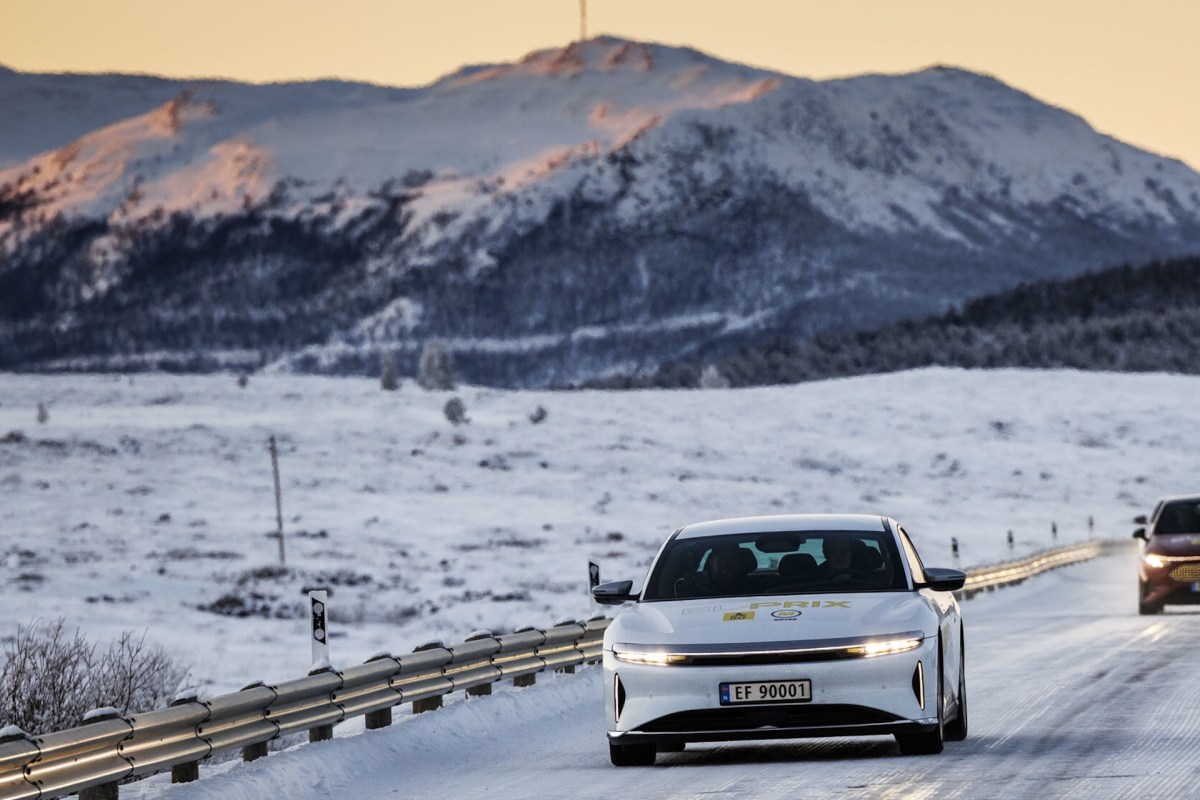
Electric vehicles were put through a real-world winter driving test on snowy roads and in frigid temperatures — and one car beat all others by a huge margin.
The Lucid Air Grand Touring went the farthest among 24 EVs that participated in the El Prix Winter Test, Electrek reported.
The event, conducted by the Norwegian Automobile Federation and Motor Magazine, had cars travel as far as they could until their fully charged batteries ran out of power. The EVs were driven in true winter conditions in Oslo, Norway, with temperatures dropping as low as minus-31 degrees Celsius (minus-24 Fahrenheit).
Though it fell short of the 531-kilometer (330-mile) record held by the Polestar 3, the Lucid Air still covered an impressive 519 kilometers (322 miles) — almost 100 kilometers (62 miles) more than the second-place Mercedes-Benz CLA. The result reinforces Lucid's focus on long-range efficiency, as it has outperformed competitors in both summer and winter testing.
For drivers, the test shows how EV technology is improving, especially as automakers continue introducing new all-electric and hybrid vehicles. Longer driving ranges, faster charging times, and more comfortable rides can ease the concerns of those who are still wary of ditching gas-guzzlers in favor of less-polluting transportation. Innovations such as THK's LSR-05 prototype and Nissan's solid-state battery hint at even more efficient, user-friendly EVs ahead.
After switching to an EV, the next step is to install an EV charger at home, which can save you hundreds of dollars annually compared with using public chargers. Qmerit can help you gain these savings by installing a Level 2 EV charger configured to specific panels and charging requirements.
TCD Picks » Quince Spotlight
💡These best-sellers from Quince deliver affordable, sustainable luxury for all




Pairing EV chargers with home solar and battery storage can further increase savings by cutting down charging costs and reliance on the grid. You can use TCD's Solar Explorer to find vetted local service providers that can install reliable solar panel systems.
Solar Explorer connects you with partner tools that can help you save up to $10,000 on a solar installation. EnergySage, for one, makes it easy to compare quotes and find incentives available in specific regions.
The winter test results may have sparked a debate about fairness and actual efficiency. But regardless of which EV came out on top, what matters is that drivers — and the planet — are winning the race toward a cleaner future.
Besides helping drivers save on fuel and maintenance, EVs also offer quieter rides and don't produce tailpipe pollution. Though concerns remain about the environmental impacts of EV battery production, its footprint is minimal compared with the massive scale of mining required to extract coal, oil, and gas.
|
Which of these savings plans for rooftop solar panels would be most appealing for you?
Click your choice to see results and speak your mind. |
 Save $1,000 this year 💸
 Comments from readers provided more perspective for those considering making their next car an EV.
"To see what these vehicles achieve for miles per kWh would be much more helpful," one reader wrote.
"While Lucid's result may be praiseworthy, I believe the winners here may be the likes of the Kia or Hyundai, which have much smaller batteries," another commented.

Get TCD's free newsletters for easy tips to save more, waste less, and make smarter choices — and earn up to $5,000 toward clean upgrades in TCD's exclusive Rewards Club.






