


If you've ever witnessed a confused Waymo or an overturned food delivery robot, you can understand how fragile robotic technology is.
But researchers at Northwestern University are innovating the robotics field with the first modular robots with "athletic intelligence."
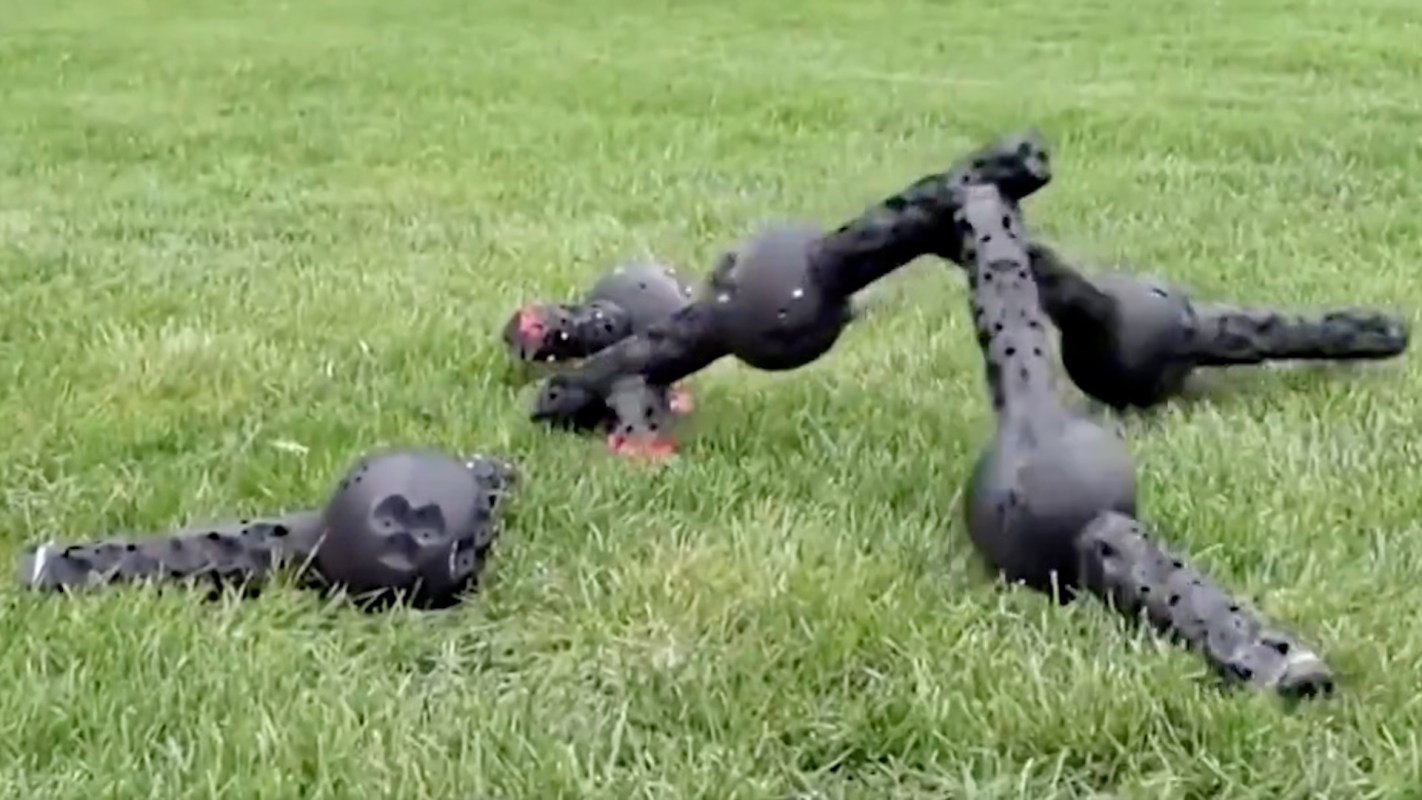
These "legged metamachines" are made from autonomous, Lego-like modules that are powered by independent motors and connect together into countless configurations. When these modules combine, they create an agile and seemingly indestructible robot.
Sam Kriegman, who led a study on these robots that was published in the Proceedings of the National Academy of Sciences journal, described the metamachines as mechanically simple: "They only rotate about a single joint, but they are surprisingly very athletic and smart."
He goes on to explain that combinations of these modules enable dynamic activities like climbing, limping, and flipping.
The team of researchers used artificial intelligence to design the novel modular configurations, deviating from the typical four-legged or human-like robots we've seen in the past.
They are capable of righting themselves if they are turned over, hopping over obstacles, and navigating difficult terrains.
Arguably, one of the most impressive aspects of these metamachines is that damaged parts do not become non-functional; they continue moving and can reconnect with the group. Kriegman stated the metamachines "can move freely in the wild and easily recover from major injuries that would be fatal to every other wild robot."
Most robots today cannot adapt to new tasks, environments, or physical damage. Kriegman's team used AI to move past those limitations, using an evolutionary algorithm that mimics natural selection to simulate each design, keeping the best performers and discarding the weakest.
Putting the metamachines to the real-world test, they ran across rough terrain, including gravel, grass, tree roots, leaves, sand, mud, and uneven bricks. Jumping, spinning, and righting themselves when flipped, these machines were capable of adapting and recovering during the difficult terrain tests.
TCD Picks » Quince Spotlight
💡These best-sellers from Quince deliver affordable, sustainable luxury for all




The technology is still in its earliest stages, and the researchers acknowledge that the robot is not yet particularly useful.
At present, the machine has no outward-facing sensing capabilities. It can't see obstacles or map its surroundings, and it doesn't know where it is going.
Most of its intelligence is focused internally. The robot can detect its own orientation and the positions of the modules. And that was the research team's main focus: to change the way engineers think about robots. These machines suggest a future where robots resemble not just rigid tools but more fluid, evolving entities.
This robotic advancement is one example of the benefits of artificial intelligence. Despite other advancements in weather forecasting and waste management, critics of artificial intelligence are sounding alarms on the technology's egregious resource requirements and societal repercussions, from promoting nonconsensual nude deepfakes to replacing artists.

Get TCD's free newsletters for easy tips to save more, waste less, and make smarter choices — and earn up to $5,000 toward clean upgrades in TCD's exclusive Rewards Club.
Cool Picks





