


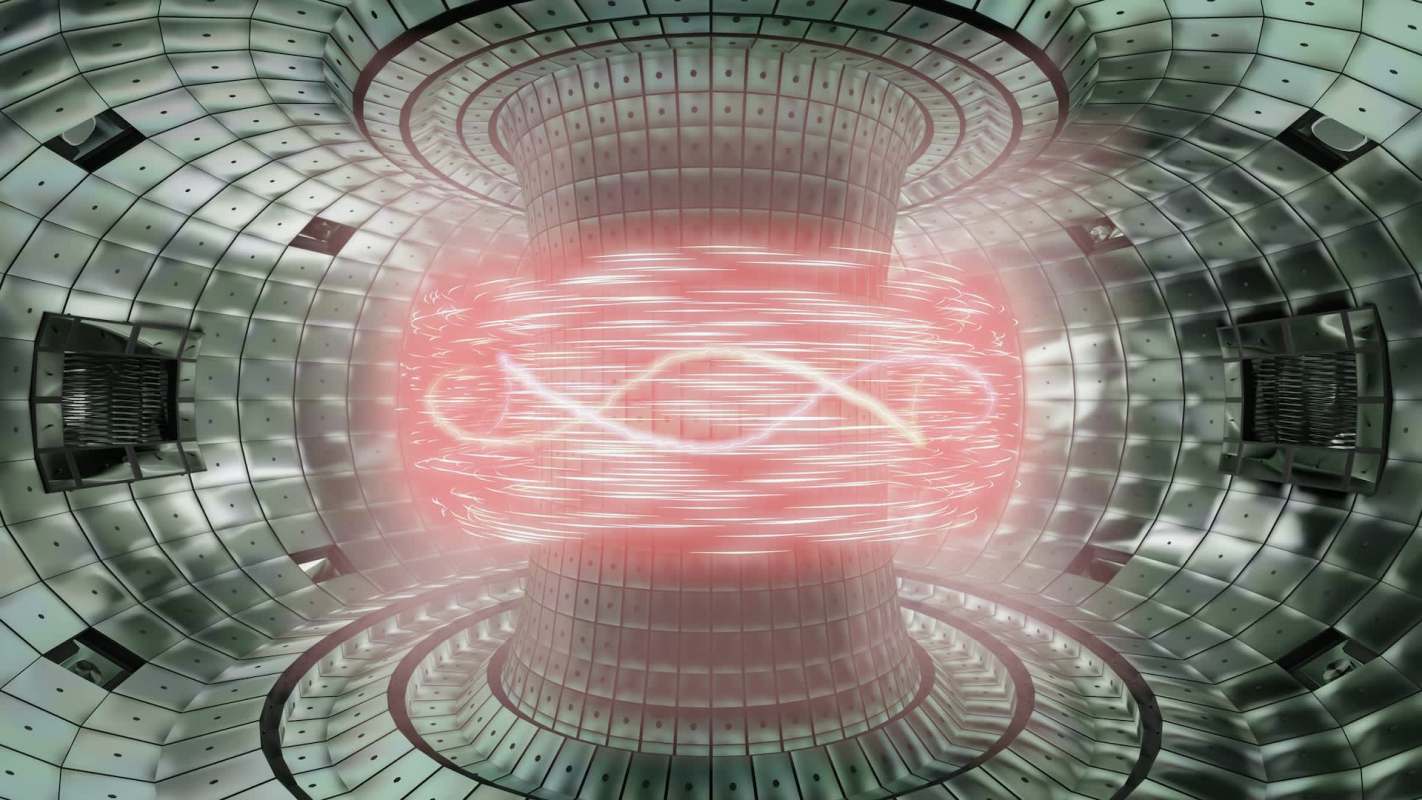
Researchers from the United Kingdom and Austria have developed an artificial intelligence tool that can speed up the modeling process for plasma turbulence in fusion reactors, helping them improve future designs in the quest for low-carbon energy.
The new machine-learning-based tool, GyroSwin, was developed by the U.K. Atomic Energy Authority, Johannes Kepler University in Linz, Austria, and an Austrian spinout firm, Emmi AI, according to a report by The Times.
"Designing, developing, and operating a fusion power plant will involve millions of plasma simulations," Rob Akers, director of computing programs at the UKAEA, told the outlet.
GyroSwin can help reduce computational times from days down to seconds.
Fusion has long been the holy grail of the energy sector, promising safe, low-carbon energy that can run 24/7 using hydrogen fuels such as deuterium and tritium that can be sourced from abundant seawater supplies.
The fuel is so efficient that the energy from just 1 gram of deuterium-tritium fuel is equivalent to the energy from 2,400 gallons of oil, without the environmental pollution caused by petroleum products.
Unlike nuclear fission, fusion reactors won't generate long-lived radioactive waste and don't carry the same risk of catastrophic runaway chain reactions that haunt nuclear projects, The Times explained.
The fusion process is relatively simple to understand but complex to achieve. When atomic nuclei are fused together, they lose mass and release enormous amounts of energy, similar to the process that occurs naturally in stars.
However, temperatures in excess of 100 million degrees are required to create a plasma to host these reactions, and powerful magnetic fields are needed to contain it since most solid shielding materials are not resilient enough to handle the task on their own.
Complex computer simulations track plasma's turbulent activity across five dimensions, describing where the particles are in space and their direction and speed relative to the magnetic field.
TCD Picks » Quince Spotlight
💡These best-sellers from Quince deliver affordable, sustainable luxury for all




|
Should we be pouring money into nuclear fusion technology? Click your choice to see results and speak your mind. |
 Yes — it'll pay off 👍
 However, a single simulation can take hours or days to run, even on powerful supercomputers, according to The Times.
Not only does the GyroSwin AI tool reduce runtimes "from hours or days to minutes or seconds while preserving sufficient accuracy," but it's also capable of handling more complexity than other AI models.
"It turns an almost intractable problem into something that feels within reach — which, to me, is very exciting," said Akers.
"We still need supercomputers to generate the training data and to push the physics frontier. But once you've trained a good surrogate, you can amortize that cost and answer many more 'what if' questions quickly," he added.
Fusion could be the key to helping humanity achieve net-zero carbon pollution by 2050, and tools like GyroSwin could help guide researchers in building efficient reactor designs.
In this case, it could help Britain's fusion investments pay off, both financially and in clean, renewable energy.

Get TCD's free newsletters for easy tips to save more, waste less, and make smarter choices — and earn up to $5,000 toward clean upgrades in TCD's exclusive Rewards Club.
Cool Picks





