


Christmas has been commercialized for over a century, and at this point, it's fair to say that social media influencer marketing has significantly worsened holiday overconsumption.
Constant pressure to spend money can make excessive consumption nearly invisible to even savvy shoppers over time — but a recent post on Reddit's r/Anticonsumption deftly shattered the illusion that it was worth screenshotting as a reminder for next year.
What's happening?
A user visited their local supermarket on the day after Christmas, and what they saw enraged them.
The store, whose signage indicated that it was in Lithuania, didn't toss out unsold trees.
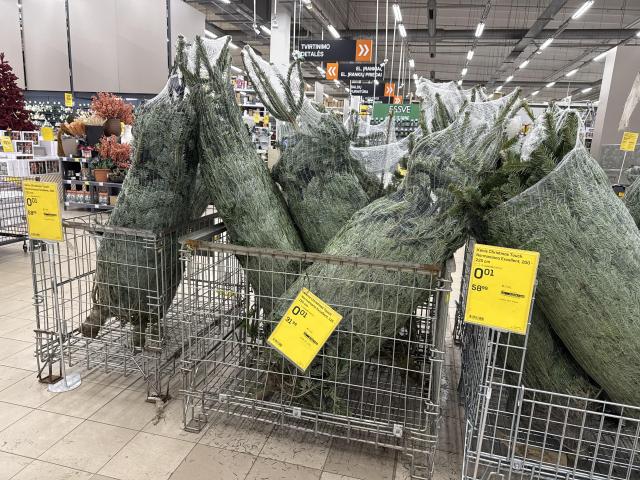
Rather, the Christmas trees were marked down heavily — to €0.01, or roughly 1 cent.
"Local Supermarket sells off Christmas trees day after Christmas, how quickly it turns to trash," the original poster's title lamented. As other commenters observed, simply offloading the unsold trees likely reduced the chance they'd be properly dealt with.
TCD Picks » Quince Spotlight
💡These best-sellers from Quince deliver affordable, sustainable luxury for all




"I have a hunch these trees are bound for a landfill," one predicted glumly, correctly adding that landfilled material releases planet-warming gases in a follow-up comment.
"They should donate them to the local conservation departments. Ours will take old Christmas trees and sink them for fish habitat," another replied.
"There are a lot of good things you can do with leftover Christmas trees. Wildlife places often have a use for them," a third said.
Why is seasonal retail waste concerning?
Retail waste is a problem, but seasonal waste is arguably more insidious — in part due to its predictable, recurring nature.
Social media dumpster divers have become ad hoc retail waste reporters, finding bins overflowing with unexpired food after Thanksgiving and other items discarded simply to make room for more merchandise — much of which will meet the same fate.
|
Which of these factors would most effectively motivate you to recycle old clothes and electronics?
Click your choice to see results and speak your mind. |
 Giving me money back 💰
 Retail food waste, which must be safe to consume, is trickier to manage than other unsold inventory, but not impossible.
However, the bulk of dumpster divers unearth products that are at little to no risk of spoiling, such as body care items and holiday trim. This endless seasonal cycle ensures our overfilled landfills remain that way.
While the waste itself is a problem, a user quoted above emphasized that landfilled waste is a major contributor to harmful emissions worldwide — and that's on top of the emissions generated in manufacturing, transporting, and discarding never-used goods.
Are retailers doing anything about this?
In the U.S., information about the fate of unsold Christmas trees was worryingly vague.
USA Today was one of the few outlets to cover the issue, reporting in 2022 that unsold trees are often converted into mulch.
Pennsylvania State University horticulture professor and expert on Christmas tree management, Richard Bates, told the paper that "there are literally thousands of established programs ... that will collect and then chip and compost them," managed by community groups.
However, a lack of specific information about what high-volume chains like Walmart and Home Depot do with Christmas trees suggests that little is known about which stores, if any, avail themselves of the option — but one Lowe's was caught trashing trees marked for composting.
What's being done about unsold Christmas trees more broadly?
At least one dumpster diver rescued an artificial Christmas tree, but live trees can benefit nature and wildlife.
In addition to mulch, a Philadelphia organization feeds Christmas trees to goats to keep them out of landfills.
On Dec. 26, WJBF advised viewers that the Army Corps of Engineers was collecting Christmas trees to improve fish habitat.

Get TCD's free newsletters for easy tips to save more, waste less, and make smarter choices — and earn up to $5,000 toward clean upgrades in TCD's exclusive Rewards Club.






