


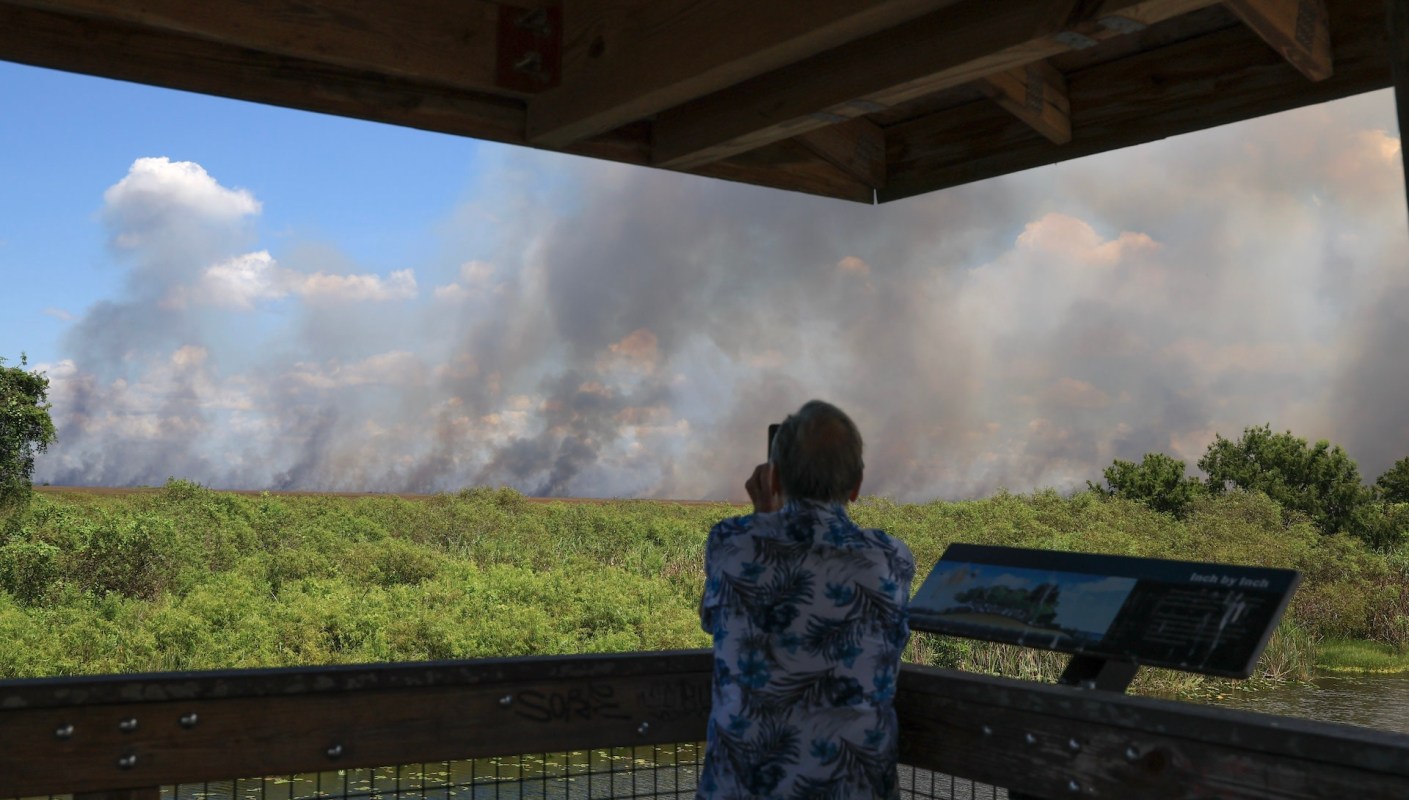
Officials in Florida have sounded the alarm after two wildfires in the Everglades combined to form one massive blaze that has now burned over 19,000 acres, NBC Miami reported.
While the fires raged through undeveloped wilderness, strong winds fueled by Hurricane Erin pushed hazardous wildfire smoke toward heavily populated areas across South Florida, according to the Miami Herald.
"The smoke from these fires will be blown to the southeast toward Broward and Miami-Dade counties," said Sammy Hadi, a meteorologist for the National Weather Service, per the Herald.
In addition to the health risks posed by wildfire smoke exposure, Hadi warned of the "potential for periods of time with reduced visibility."
What's happening?
Having started on Monday, Aug. 18, the so-called Mile Marker 39 Fire continued to rage across the Everglades, burning through dry foliage and releasing plumes of hazardous wildfire smoke into the air, according to the Miami Herald.
Although the fire was at 0% containment, officials said their biggest concern at the moment was smoke exposure, according to Newsweek.
"The current air quality forecast in Broward County is Unhealthy for particulate matter (PM2.5)," Broward County Environment posted on X, per Newsweek, with hashtags removed. "Consider shortening time outdoors to avoid inhaling."
An air quality alert will be in effect from 10 p.m. Wednesday, Aug. 20 through 9 a.m. Thursday local time, the Miami Herald reported.
Why does it matter?
The situation highlighted the danger that wildfire-smoke exposure poses to public health.
While the flames from wildfires can destroy homes, businesses, crops, and livestock, making insurance premiums and food prices go up everywhere, the toxic effects of wildfire exposure can stretch hundreds if not thousands of miles beyond the fire's reach.
TCD Picks » Quince Spotlight
💡These best-sellers from Quince deliver affordable, sustainable luxury for all




|
Do you worry about the quality of the air inside your home?
Click your choice to see results and speak your mind. |
 Yes — often 😬
 Daniela Eusse, an avid cyclist in the area, told NBC Miami that she could feel the impact of the smoke while riding her bike through the impacted area.
"It was definitely hard to ride today," Eusse said. "It was very hard to breathe this morning, like I had to come off the ride. My heart was through the roof."
"It looked like fog, but you could smell it," she continued, per NBC Miami. "It's not fog, it's fire."
A new study published in The Lancet Planetary Health recently revealed that the particulate matter contained in wildfire smoke is many times more dangerous to human health than particulate matter from other sources, such as automobile exhaust.
While scientists previously had assumed that all particulate matter was roughly the same in terms of health risk, the study authors found this to be far from true.
The study revealed that for every one extra microgram of particulate matter contained in 1 cubic meter (1.3 cubic yards) of air, risk of all-cause mortality increased by 0.7%, respiratory mortality jumped 1%, and cardiovascular mortality went up by 0.9%.
While these percentages might seem small at first glance, when multiplied across thousands or even millions of people, it can mean many additional deaths caused solely by exposure to wildfire smoke.
What's being done about wildfire smoke?
In the immediate term, the best ways to protect yourself and your family from wildfire smoke is to limit exposure by staying indoors, using an air purifier, and wearing an N95 mask when going outdoors.
Over the longer term, however, the best way to reduce wildfire risk, and the risk of exposure to wildfire smoke, is to reverse the trend of rising global temperatures.
Scientists have long warned that, as temperatures increase, extreme weather events like wildfires, flash floods, and hurricanes will become more severe.
In order to break this cycle, it is necessary to significantly reduce the amount of heat-trapping pollution entering the atmosphere.
Installing solar panels on your home is a great way to reduce planet-heating pollution while also saving money on your electric bill. Further, pairing solar panels with a home-battery system will make your home more resilient in the event of a power outage, which can happen as a result of wildfires at times — though in Florida and many other areas, hurricanes and other storms are a more likely culprit.
EnergySage makes it easy to compare quotes from vetted local installers while also ensuring that you take maximum advantage of tax credits and other available incentives, saving customers up to $10,000. With federal tax credits for solar expiring Dec. 31, 2025, the time to act is now.

Join our free newsletter for good news and useful tips, and don't miss this cool list of easy ways to help yourself while helping the planet.
Cool Picks






