


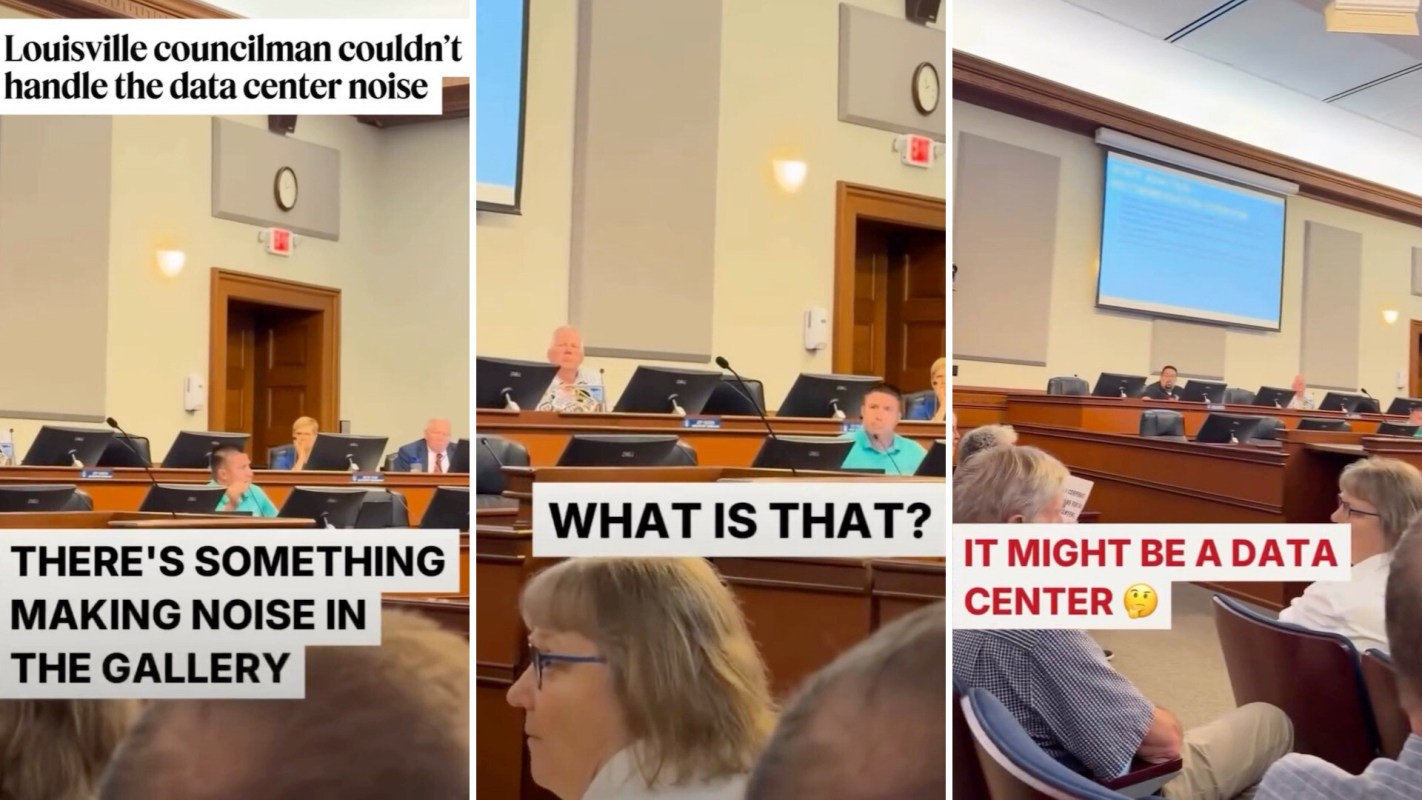
At a Louisville Metro Council meeting, a resident used a phone to play ambient noise intended to mimic what neighbors fear could become a constant part of daily life if a proposed large data center campus on Camp Ground Road is approved.
Here's what to know
A clip posted by Hellbender Newsroom (@hellbendernewsroom) on Instagram shows the protest unfolding. While the sound plays, Louisville Metro Councilman Anthony Piagentini asks that it be stopped. The demonstration targeted the proposed hyperscale data center site on Camp Ground Road, giving a more tangible sense of the persistent industrial hum critics worry could affect nearby neighborhoods.
The proposal at the center of the dispute is from PowerHouse Data Centers and Poe Companies. It envisions a campus of about 154 acres, with roughly 1.8 million square feet of development and power capacity in the hundreds of megawatts.
Separately, Louisville's Planning Commission has recommended city rules that would prohibit future hyperscale data centers.
The conflict reaches beyond one company or one proposed site. It reflects growing tension in communities across the country as cities are asked to accommodate the physical footprint, power demands, and quality-of-life tradeoffs tied to the digital economy.
More background
Hyperscale data centers are massive facilities designed to store and process enormous amounts of data for cloud computing, artificial intelligence, and other online services. While supporters often describe them as engines of economic development, they can also bring industrial-scale infrastructure much closer to homes, roads, and shared community spaces.
TCD Picks » Quince Spotlight
💡These best-sellers from Quince deliver affordable, sustainable luxury for all




Noise has emerged as one of the most charged concerns. Large data centers can rely on extensive cooling systems, fans, and backup equipment, and residents elsewhere in the country have also pushed back when those sounds are seen as constant or disruptive.
The Louisville protest also raises environmental and community-impact concerns. Facilities that require hundreds of megawatts of electricity can strain local energy systems, especially as demand for AI and cloud services continues to rise. Even when the benefits are framed in corporate or regional terms, the burdens can fall most heavily on the people living closest to the site.
Residents are often asked to trust that impacts will be addressed later, even when they live with the consequences every day.
What's being done?
The most concrete response has come through policy. Louisville's Planning Commission has backed new rules that would ban future hyperscale data centers.
Zoning and planning decisions are often where communities have the greatest leverage. Once a project receives approval, residents may have fewer options beyond pressing for mitigation measures such as setbacks, sound limits, traffic controls, and tighter operating conditions.
For opponents, the meeting's message came down to a single line: "Imagine hearing that 24 hours a day."
Where can I learn more?
Louisville isn't the only place where residents have tried to show officials what this kind of noise could mean in daily life. Similar disputes have led to public demonstrations and lawsuits in other communities, where the low, constant hum from data centers has become a major point of conflict.
• In West Virginia, a mom recreated the relentless drone of life near a data center.
• In Wisconsin, neighbors suing Microsoft say constant humming from Microsoft keeps them inside.
• In Michigan, residents say unbearable data center noise upended life in Dowagiac.
• In Virginia, residents near Sterling describe constant buzzing in your head from nearby servers.
• In Vineland, residents filed a class action suit after unbearable noise near the facility.

Get TCD's free newsletters for easy tips, smart advice, and a chance to earn $5,000 toward home upgrades. To see more stories like this one, change your Google preferences here.






