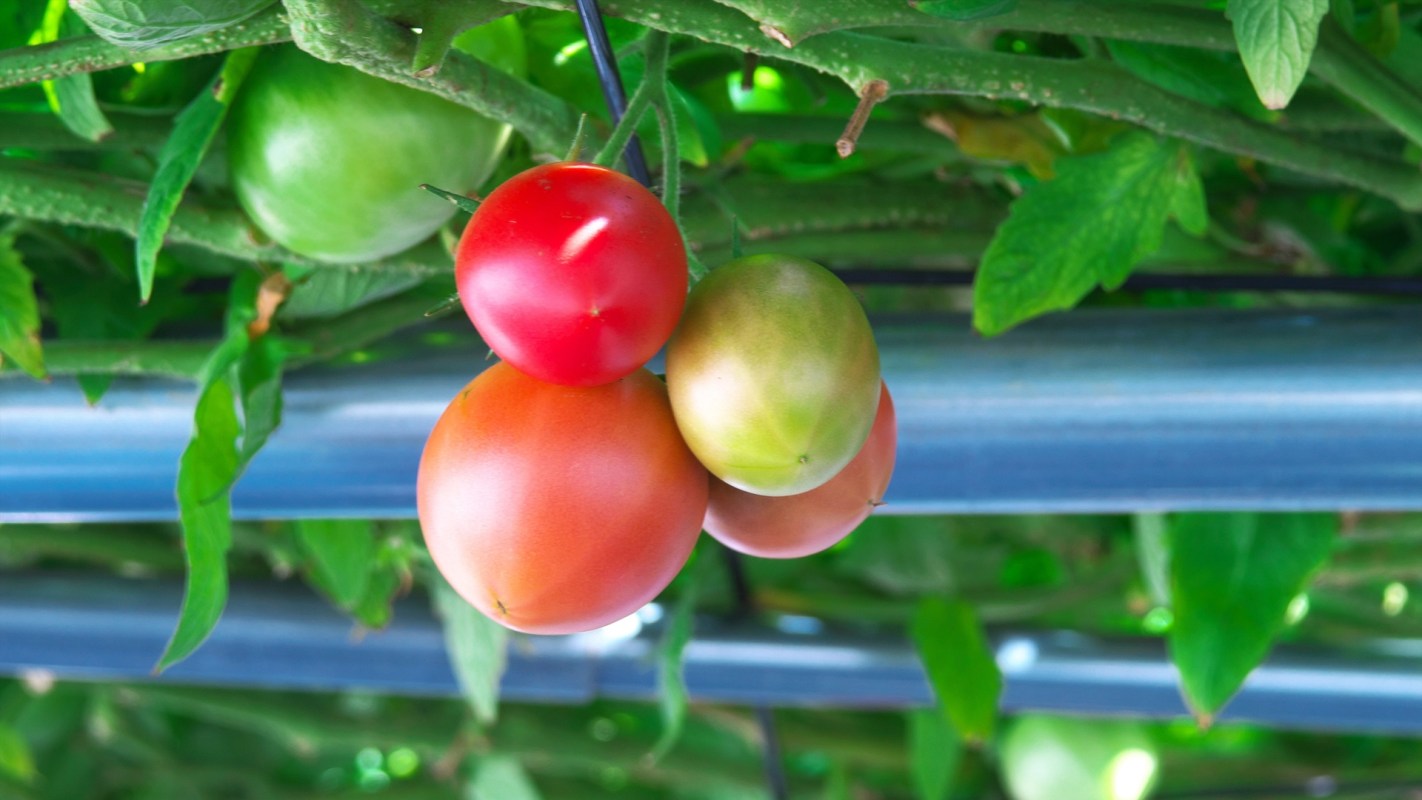
A new study has revealed that agrivoltaics may hold the key to a trio of challenges for farmers. It could allow for maintaining enough food production, cutting down on water use, and optimizing output through energy generation.
HortiDaily reported on research by teams from the University of Seville and the Polytechnic University of Madrid that examined growing tomatoes in a variety of scenarios. The study, published in Agricultural Water Management, indicates that agrivoltaics has the potential to enhance land-use efficiency while promoting sustainable farming.
To explore the issue, the teams experimented with reduced water supply for tomato crops, both with and without solar panels, as well as fully irrigated crops as a control. As expected, reducing water negatively impacted tomato yields.
Fully irrigated plants produced the highest yields, but on the positive side, the water used for tomato crops under panels was more efficient at growing fruit.
To properly account for these variables, the team came up with a Land Equivalent Ratio that measured the combined efficiency of energy production, water usage, and tomato yield.
Both the Seville and Madrid areas with solar panels scored well over 1, which indicates that combining energy production and agriculture was a significantly better use of land than keeping them separate.
TCD Picks » Quince Spotlight
💡These best-sellers from Quince deliver affordable, sustainable luxury for all




The study also showed that using less water overall could be an important strategy if growers can more precisely track the state of the plants. Despite cutting water by 50%, yield fell just 20%, and the researchers feel there is room for improvement.
The research demonstrated the efficiencies of agrivoltaics. While tomatoes did have a bit of a drop-off in yield with the panels and reduced water use, many crops, like olives, thrive in the added shade.
Farm workers and livestock also appreciate it, and farmers benefit from a passive revenue stream as well. With drought increasingly threatening agriculture, examining reduced water usage is a greater consideration for scientists.
Solar-powered farming could help mitigate these issues, allowing society to generate clean energy that reduces pollution while sustainably supporting farmers.
To truly optimize solar panels and tomatoes, the researchers suggested that refining irrigation management with newer technology could help preserve yields while reducing water use.
|
Which of these savings plans for rooftop solar panels would be most appealing for you?
Click your choice to see results and earn rewards to spend on home upgrades. |
 Save $1,000 this year 💸
Get TCD's free newsletters for easy tips to save more, waste less, and make smarter choices — and earn up to $5,000 toward clean upgrades in TCD's exclusive Rewards Club.