


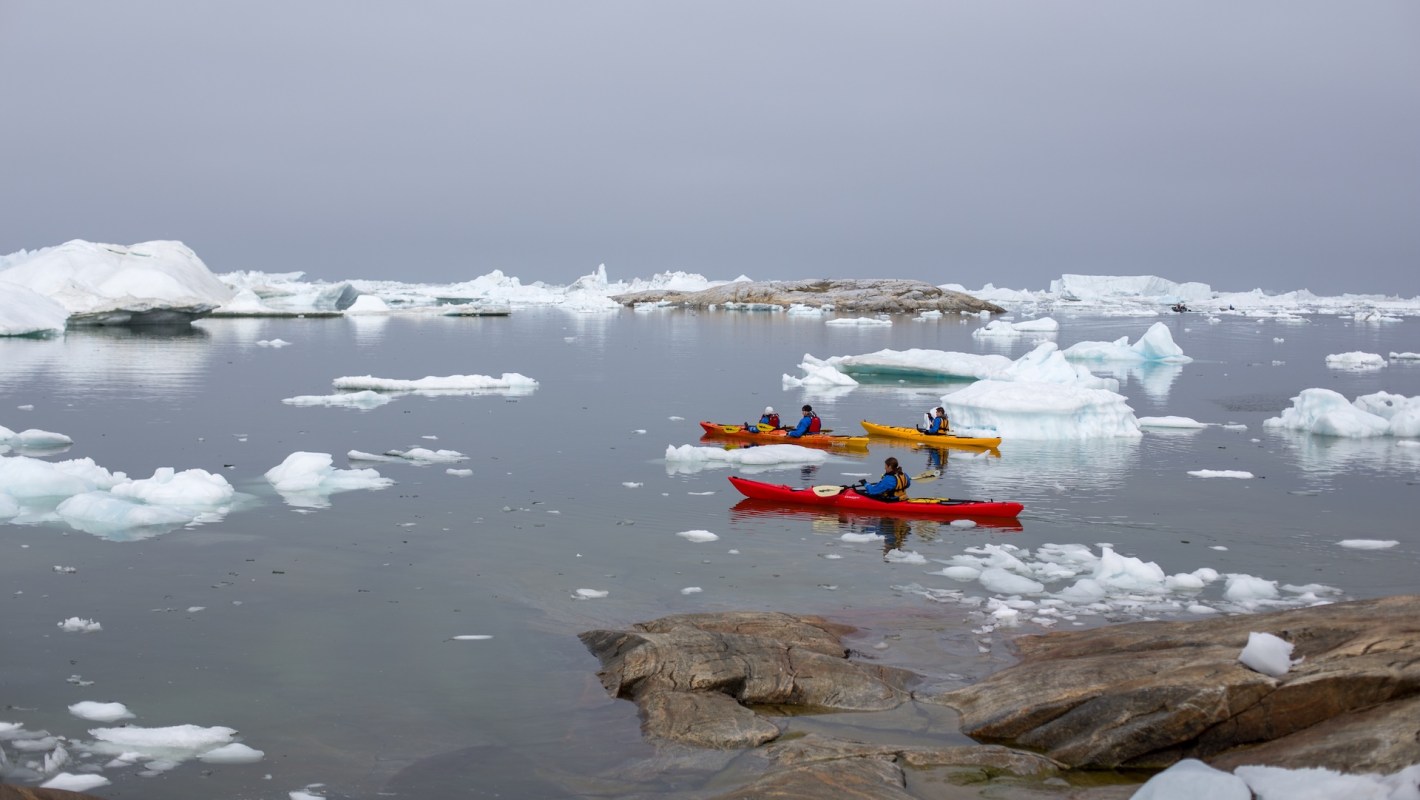
When Kristian Louis Jensen set off on a kayaking mission to gather water samples around Greenland's remote glaciers, he expected to find trace levels of microplastics.
As Euronews Green noted, Jensen earned a master's degree in environmental protection, and the Inuit scientist was up to speed on the massive environmental catastrophe that is plastic.
Plastic pollution is an issue the general public has long been aware of, but microplastics weren't identified as a distinct phenomenon until 2004.
Given Jensen's field of expertise, he'd likely know that microplastics have been found in the deepest reaches of the ocean and in Antarctica's punishingly cold climes. Those findings could even have informed his expeditions to a remote glacier off the coast of Greenland.
While Jensen was studying for his master's, he created a "self-built microplastic filter" called "the Plastsaq." The sampling tool wasn't designed for lab environments, but rather for citizen scientists to conduct sampling near local waterways.
Jensen isn't an occasional kayaker, either. He owns Purpose Paddling, which combines "adventure with curious learning" and provides paddlers with a firsthand look at the "ecological importance" of the Norwegian archipelago of Lofoten.
TCD Picks » Quince Spotlight
💡These best-sellers from Quince deliver affordable, sustainable luxury for all




Jensen, who documents his kayak expeditions on Instagram (@purpose.paddling), told Euronews that his expeditions forced him to confront what he called "the invisible footprint of humanity" in the planet's quietest corners.
Consequently, he sought out the most "isolated corners of the Arctic" to collect water samples, expecting to find garden-variety plastic particles and debris, and he did. But what he found in addition to that was "terrifying."
Euronews explained that Jensen's sampling occurred "hundreds of kilometres from any kind of road." But in his samples, traces of car tire particles were present.
Rubber tires are a pernicious source of plastic particulate matter on and near active roads, and 35% of microplastics in Germany were traced back to car tires.
|
What's the most you'd pay per month to put solar panels on your roof if there was no down payment?
Click your choice to see results and speak your mind. |
 $200 or more 💰
 That particular discovery rattled Jensen.
"Finding [tire particles] on a pristine glacier in eastern Greenland was a shock because it validated a terrifying thesis: these particles are no longer just an urban issue," he recalled.
Jensen further explained that identifying tire particles in such a remote, "pristine" place suggested that the glacier and the far reaches of the Arctic served as a natural sink for environmental contaminants.
"They have become dust, airborne, and have travelled thousands of kilometres to the Arctic. This is 'fossil fuels in motion.' It tells us that the Arctic is a 'sink' for the world's pollution," he added.
As the outlet observed, car tires lose between 10% and 30% of their mass while in use — and plastic is notoriously slow to decompose.
"That mass doesn't disappear. It breaks down into toxic dust that settles at the very start of our food chain," he said.
Ultimately, Jensen asserted that nations needed to address microplastics with the same urgency afforded to planet-warming emissions.
"We cannot claim to be tackling the fossil fuel crisis if we ignore the solid petrochemicals rolling beneath our vehicles," Jensen said.

Get TCD's free newsletters for easy tips to save more, waste less, and make smarter choices — and earn up to $5,000 toward clean upgrades in TCD's exclusive Rewards Club.







