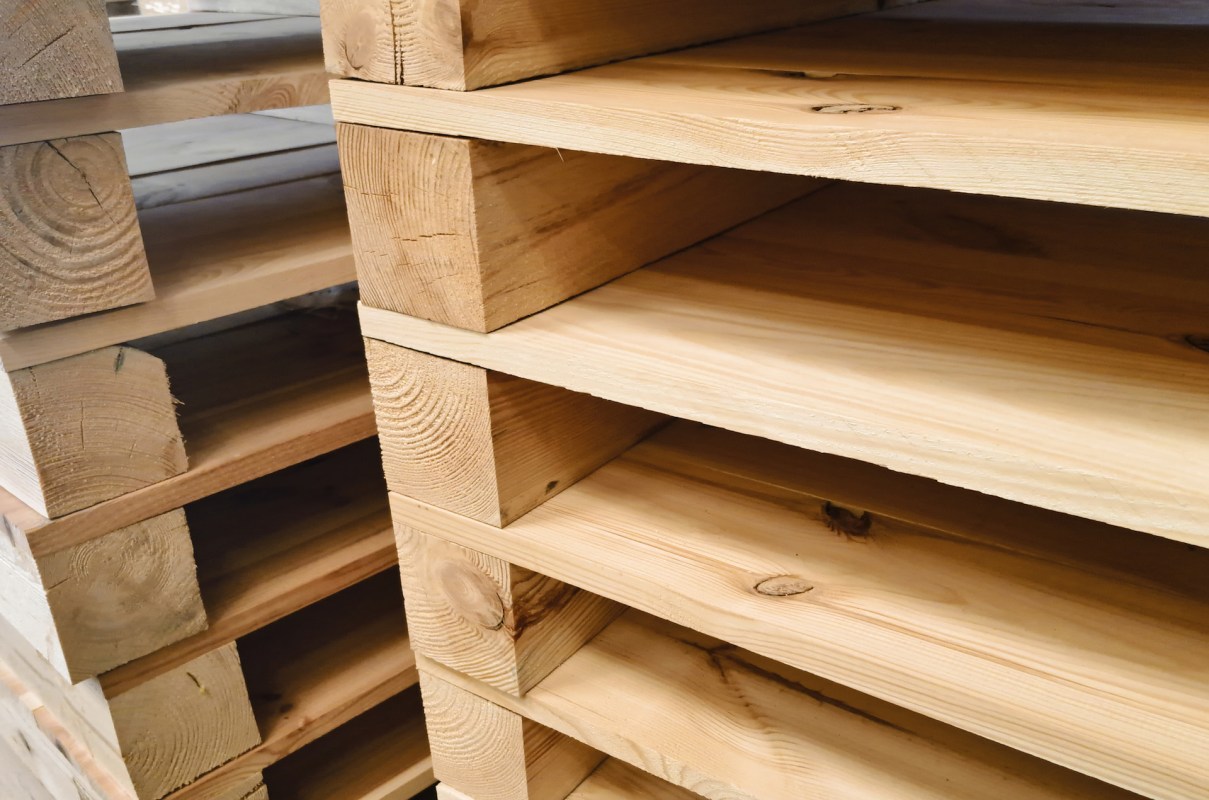
Researchers have discovered a way to make wood stronger than ever.
A team of scientists at China's Nanjing University revealed a process to create self-densified wood, according to New Atlas. This product is said to exhibit "ultra-high" tensile strength, flexural strength, and impact toughness.
Traditional methods for compressing wood to increase its resilience involve energy-intensive hot pressing, which mechanically flattens the material in one direction, the report explained.
Wood fibers are primarily made of cellulose, along with lignin — a complex polymer that gives structural support to wood and other plants. These components form the walls of what amount to long hollow tubes that run lengthwise in wood.
At their core is a space called the lumen, which is what limits the material's strength, according to the report.
This self-densifying process starts with soaking the wood in sodium hydroxide and sodium sulfite to remove some of the lignin. It's then boiled in deionized water to remove residual chemicals, according to the researchers' study on the process, which was published in the Journal of Bioresources and Bioproducts.
TCD Picks » Good Store Spotlight
Get 10% off your next purchase with code TCD10




That's followed by soaking the partially delignified wood in a solvent called N,N-dimethylacetamide to remove water, then in a heated mixture of lithium chloride salt and the solvent to activate cellulose. This causes the cellulose and remaining lignin to swell and expand inward to fill the lumen.
After air-drying, the processed wood shrinks uniformly on all sides, creating a more dense structure without changing its length, New Atlas explained.
After bending, stretching, and compressing this self-densified wood, the researchers found that its mechanical properties not only far exceeded those of natural wood but that it also significantly outperformed many compressed densified woods and metals such as aluminum alloys.
"Notably, the self-densified wood exhibits uniform shrinkage in the cross-section while maintaining its longitudinal dimension. ... Such super-strong yet lightweight wood has great potential for application as a sustainable engineering material, replacing traditional structural materials such as metals and alloys, " the study noted.
TCD Picks » Quince Spotlight
💡These best-sellers from Quince deliver affordable, sustainable luxury for all




|
Would you live in a house made of fungus? Click your choice to see results and speak your mind. |
 Heck yes 👍
 This could increase the applications for wood in the construction industry and reduce the sector's carbon footprint. Plus, wood naturally sequesters carbon from the atmosphere.
Engineered woods, which include various laminated products, offer sustainable alternatives to traditional materials, including steel and concrete, which produce a significant amount of planet-warming pollution.
According to the U.S. Forest Service, forest covers about a third of the land area of the United States. Increasing the use of wood products can promote healthy forest regeneration while reducing emissions and waste.
Other sustainable building materials are also being developed from hemp and discarded rice hulls, paving the way for a cleaner, greener future in the construction industry.

Join our free newsletter for weekly updates on the latest innovations improving our lives and shaping our future, and don't miss this cool list of easy ways to help yourself while helping the planet.