


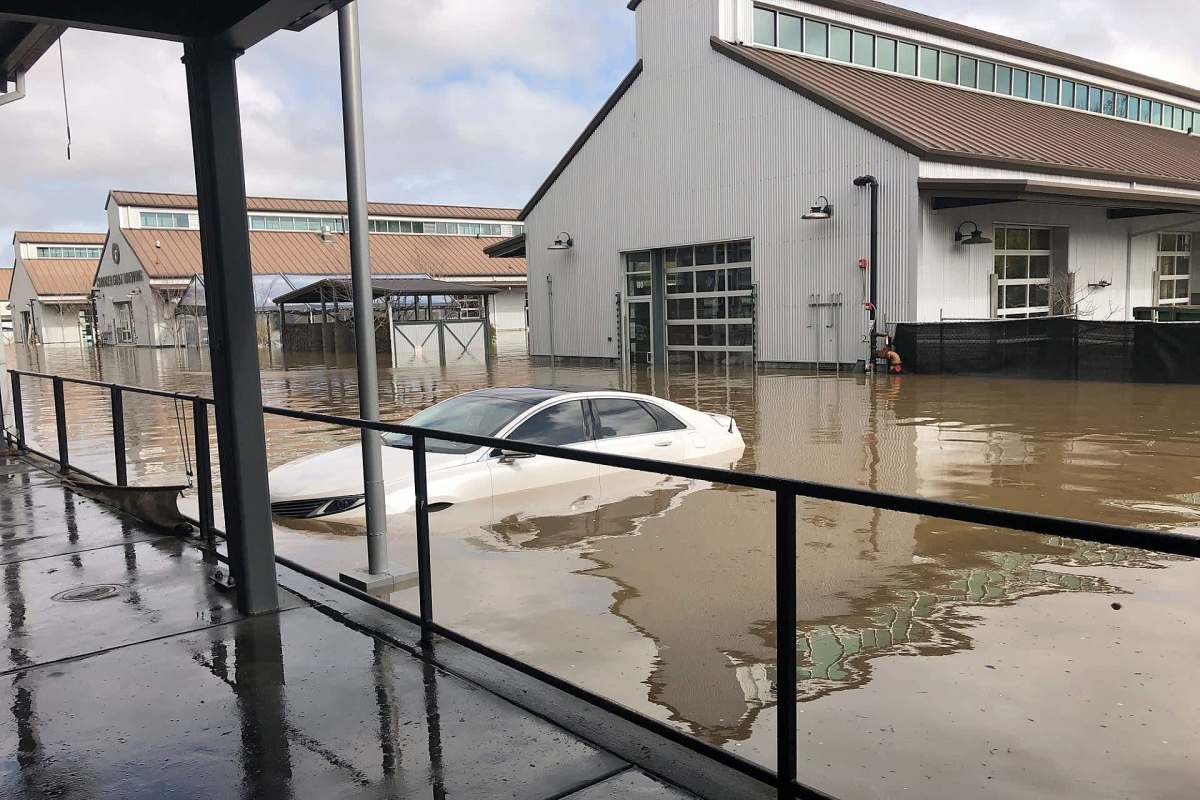
One California county is already feeling the costly effects of sea-level rise, as severe flooding spread across the area in early January.
What's happening?
As reported by the San Francisco Chronicle, Marin County began the new year with intense rainfall across the region, leading to damaging storm surge, king tides, and severe flooding. As a result, the county issued an emergency proclamation in order to seek financial assistance from the California Office of Emergency Services.
While the damage from the recent strong storms is estimated to be more than $4 million, local officials fear that future impacts could become even more costly as sea levels continue to rise.
According to a recent study from the Transportation Authority of Marin, the county could see up to 2 feet of sea level rise by the end of the century. To protect Marin County's shoreline from encroaching waters, experts determined that it will cost an estimated $17 billion to complete various sea-level rise resilience projects.
"Sea-level rise has crossed from future scenario into a balance sheet risk," said Janelle Kellman, former mayor of Sausalito, California, and founder of the nonprofit Center for Sea Rise Solutions. "What's happening now is flooding. What's coming later is permanent transformation."
Why is sea-level rise in Marin County important?
King tides are the highest seasonal tides, caused by natural alignments of the sun, moon, and Earth. However, climate-fueled sea-level rise is making them more formidable. This could spell trouble for countless coastal communities such as Marin County.
As water levels climb, these tides may become too costly for residents to endure without future intervention. With more than 260,000 residents in Marin County, sea-level rise could displace a large portion of that population.
Rising global temperatures are a direct contributor to rising sea levels primarily through two ways: thermal expansion, or the process of warmer water taking up more space, and the melting of land-based ice formations, which adds more water to our oceans.
The rise in both global temperatures and sea levels has coincided with human-caused air pollution that also continues to reach record highs every year.
What's being done to protect the county's coastal communities?
Rylan Gervase, director of legislative and external affairs at the Bay Conservation and Development Commission, noted that Marin County was making serious progress in planning its future sea-level rise resilience projects. However, these projects won't exactly be a walk in the park.
TCD Picks » Quince Spotlight
💡These best-sellers from Quince deliver affordable, sustainable luxury for all




|
Should the government be paying us to upgrade our homes?
Click your choice to see results and speak your mind. |
 Definitely 💰
 "Marin has a chance to be really innovative and look at some interesting solutions," Gervase said, per the Chronicle. "It is going to be expensive, and it's not going to be easy."
Unfortunately for Marin, many of the county's most vulnerable, low-lying areas are located in low-income communities. This could jeopardize vital infrastructure for thousands of residents.
Kristina Hill, a professor at the University of California, Berkeley's Department of Landscape Architecture & Environmental Planning, explained that despite the challenges the county faces, it may be imperative for other at-risk coastal communities in the U.S. to understand the best course of action to take with sea-level rise adaptation projects.
"What happens to them is going to be a bellwether for other areas that are at risk," Hill said, per the Chronicle.

Get TCD's free newsletters for easy tips to save more, waste less, and make smarter choices — and earn up to $5,000 toward clean upgrades in TCD's exclusive Rewards Club.
Cool Picks






