


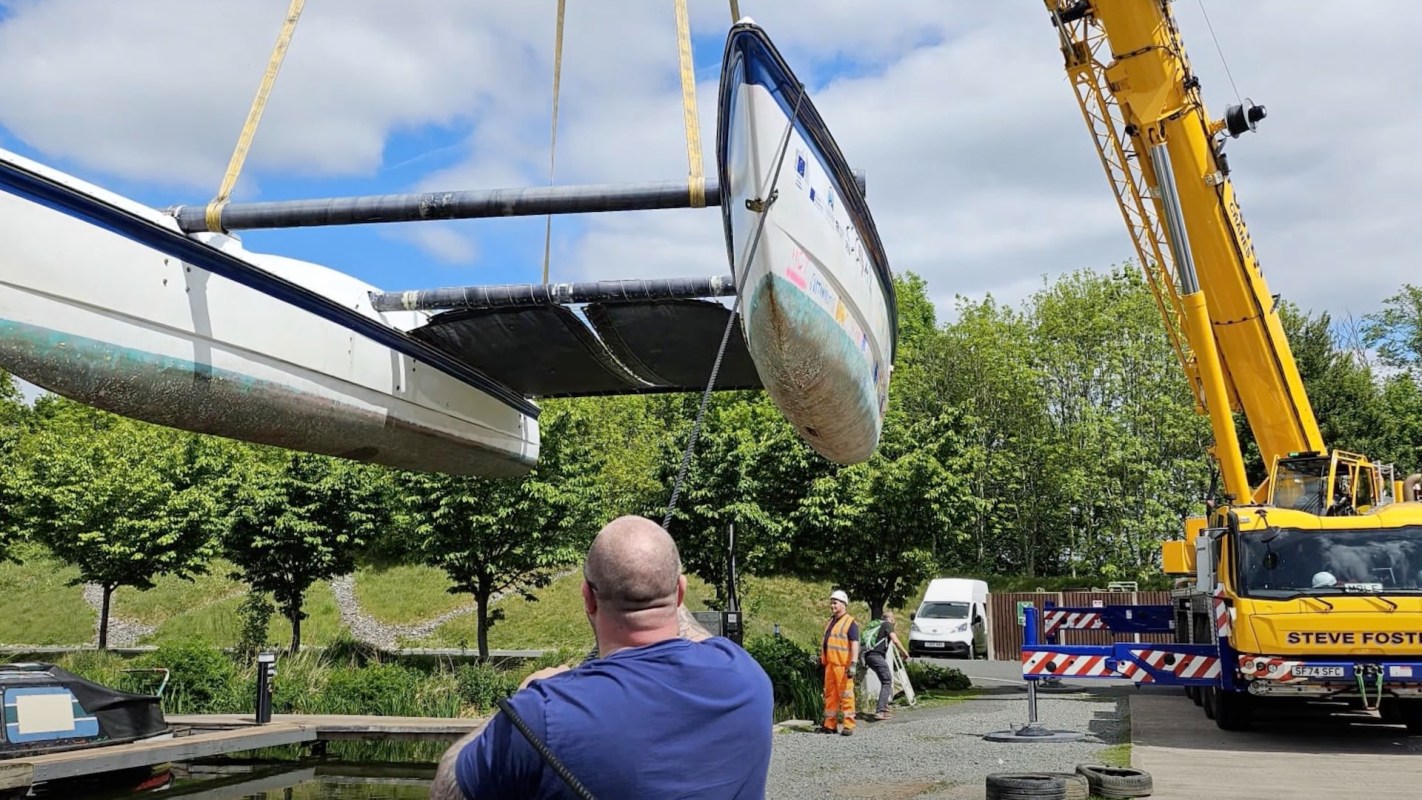
A nonprofit headquartered in the United Kingdom has developed a simple yet ingenious way to remove plastic waste from waterways by harnessing the power of bubbles, the BBC reported.
Think Ocean created its so-called "bubble barrier" as a way to lift underwater plastic to the surface, where it can be more easily collected.
"We hear people all the time saying, 'I can't see any plastic; this river is clean,'" explained Hugo Valdes-Vera, the founder of Think Ocean, per the BBC.
"It's not really true, because 85% of the plastic we can't see. It's underwater."
While a solution to the world's plastic pollution has thus far proved elusive to researchers, nonprofits, and governments alike, the brilliance of Think Ocean's idea has been its relative simplicity.
Placing a bubble-emitting device at the bottom of a waterway pushes plastic particles back up to the surface, where a specially outfitted catamaran can scoop them up.
It's that simple. To allow small fish to pass, the bubble barrier features narrow, bubble-free gaps that enable them to navigate. For larger fish, Think Ocean makes sure that the pressure of the bubbles is low enough for them to swim through.
Despite the simplicity, Valdes-Vera has argued that the bubble barrier represents a revolutionary way to prevent plastic waste from reaching the world's oceans.
"If we deploy seven of these vessels in the seven most polluted rivers in the U.K., we can become the first country on the planet to lock plastic inland," Valdes-Vera said, per the BBC.
Experts have agreed, saying that Think Ocean's solution has shown particular potential because it can be scaled up to fit rivers and creeks of practically any size.
TCD Picks » Quince Spotlight
💡These best-sellers from Quince deliver affordable, sustainable luxury for all




|
Should we be pouring money into nuclear fusion technology? Click your choice to see results and speak your mind. |
 Yes — it'll pay off 👍
 "You could cover the whole of the riverbed with the bubble screen," said Christopher Samson of the University of Derby, which has partnered with Think Ocean on the project, per the BBC.
"There's no reason that you can't cover a whole river this way."
Already, the European Union hopes to invest significant resources into the bubble barriers. The European Commission wants to fund 42 of the bubble barriers and collection vessels to be deployed on the continent's rivers, Valdes-Vera told the BBC, pending a successful trial.
The cleanup cannot come fast enough for the world's waterways.
According to the United Nations Environment Programme, the equivalent of 2,000 garbage trucks full of plastic waste are dumped into the world's oceans, rivers, lakes, and other waterways every single day.
This adds up to between 21 million and 25 million tons of plastic each year, a figure that is expected to increase dramatically based on current trends.
Worse yet, this plastic does not just disappear; it merely breaks down into smaller and smaller particles known as microplastics and nanoplastics.
These tiny plastic particles have saturated the world's environment. Researchers have detected microplastics in the deepest parts of the ocean, at the top of Mount Everest, and even inside our own vital organs.
This plastic poses a direct threat to human health, food supplies, drinking water, and vital ecosystems.
If widely deployed, Think Ocean's bubble barriers and collection vessels could go a long way toward removing these harmful plastics from the environment.
During one test, bubble barriers were able to remove as much as 5.5 tons of plastic from waterways in a single day, according to the BBC.
Solving the world's plastic problem will require an all-of-the-above approach that combines collection methods, such as the bubble barrier, with efforts to reduce the amount of plastic the world produces in the first place.
To make a difference, you can use less plastic by ditching plastic grocery bags and choosing plastic-free options in your everyday life.
For what plastic you do have, you can prevent it from ending up in the environment by knowing your recycling options or repurposing plastic-containing products and containers.

Join our free newsletter for weekly updates on the latest innovations improving our lives and shaping our future, and don't miss this cool list of easy ways to help yourself while helping the planet.
Cool Picks





