


Traditionally, the "retail holiday" known as Black Friday kicks off a seasonal retail frenzy, with supposed deep discounts in pre- and post-holiday sales.
Shoppers have long been scolded for falling prey to discount-induced overconsumption, but a thread on Reddit's r/mildlyinfuriating suggested that retailers like Home Depot are not only exacerbating the problem, but are also deceiving consumers while they're at it.
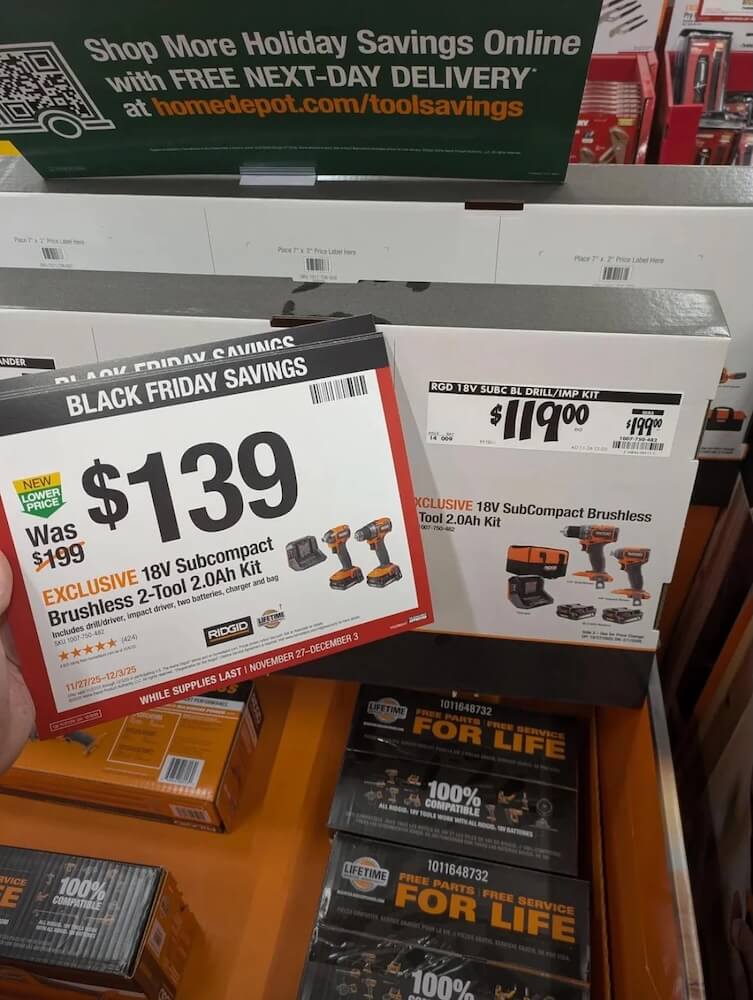
"Black Friday Deals at Home Depot" was the post's innocuous title, but the appended image told a different story.
It showed a standard retail endcap stacked with Ridgid 18V SubCompact Brushless 2-Tool Kits, seemingly on sale for $139, down about 30% from an alleged original price of $199.
However, an affixed price tag under the "Black Friday" promotional sign indicated that prior to the "sale," the Ridgid drill kit was priced at $119 — a near 20% price hike on "sale." It's unclear if the $119 price was placed prior to tariffs, but the effect still struck a nerve on Reddit.
Unfortunately, misleading "sales" don't appear to be uncommon among big-box retailers. Amazon's Prime Day sales are notorious for similar ups and downs, and Target has been caught in the act, too.
It should be noted that Amazon, at least, now has a "price history" tool right underneath its prices for logged-in users displaying up to 90 days of records, and all indications are that it's accurate and does show when an item was previously priced higher. Still, without use of that information, Amazon and other retailers generally display current-moment sales as if they are can't-miss prices when they might have been happy to sell the product for a good bit less only a day or month prior.
There is some sense for a business to test prices and never outright advertise a price as worse than it was recently, but from a shopper's standpoint, unreliable sales pricing — particularly while the cost of necessities like food and electricity skyrocket — can make people feel hoodwinked, with the added insult of effectively taxing buyers for trying to maximize their dollars.
Amid unstable pricing, it's even harder for consumers to know what things should cost. In turn, misleading sales can prompt cash-squeezed customers to overpurchase in a futile attempt to stay ahead of escalating costs. Or, at least, when ad inundation leads to a "fear of missing out" effect, sales can increase for items that people wind up not really needing or using often enough to justify the purchase.
The end result is often more unnecessary manufacturing, more waste, and more unwanted, unused goods in our overflowing landfills. Pollution is generated at every step of the process, but landfilled waste is a massive source of planet-heating gases.
TCD Picks » Quince Spotlight
💡These best-sellers from Quince deliver affordable, sustainable luxury for all




|
Should companies be required to help recycle their own products?
Click your choice to see results and speak your mind. |
 Definitely 👍
 In short, this destructive cycle is terrible for consumers and catastrophic for the planet, often also bad for a business' long-term reputation when it comes to customer trust, and on that note, Reddit users were miffed by the tactic.
"When will the magic spell ever break [so] people realize nothing is ever a good deal," one said.
"Take a pic of the old sticker and I promise you they will give you the better price," another advised. Some retailers do have policies to price-match competitors' current sales, but The Cool Down was unable to verify that Home Depot would price-match its own past prices. That may be up to the store manager's discretion.
This "[predatory] practice needs to be outlawed," a third countered.
As for the Ridgid drill kit, as of publish time, it currently retails for the same low price of $139 on HomeDepot.com.

Get TCD's free newsletters for easy tips to save more, waste less, and make smarter choices — and earn up to $5,000 toward clean upgrades in TCD's exclusive Rewards Club.
Cool Picks





