


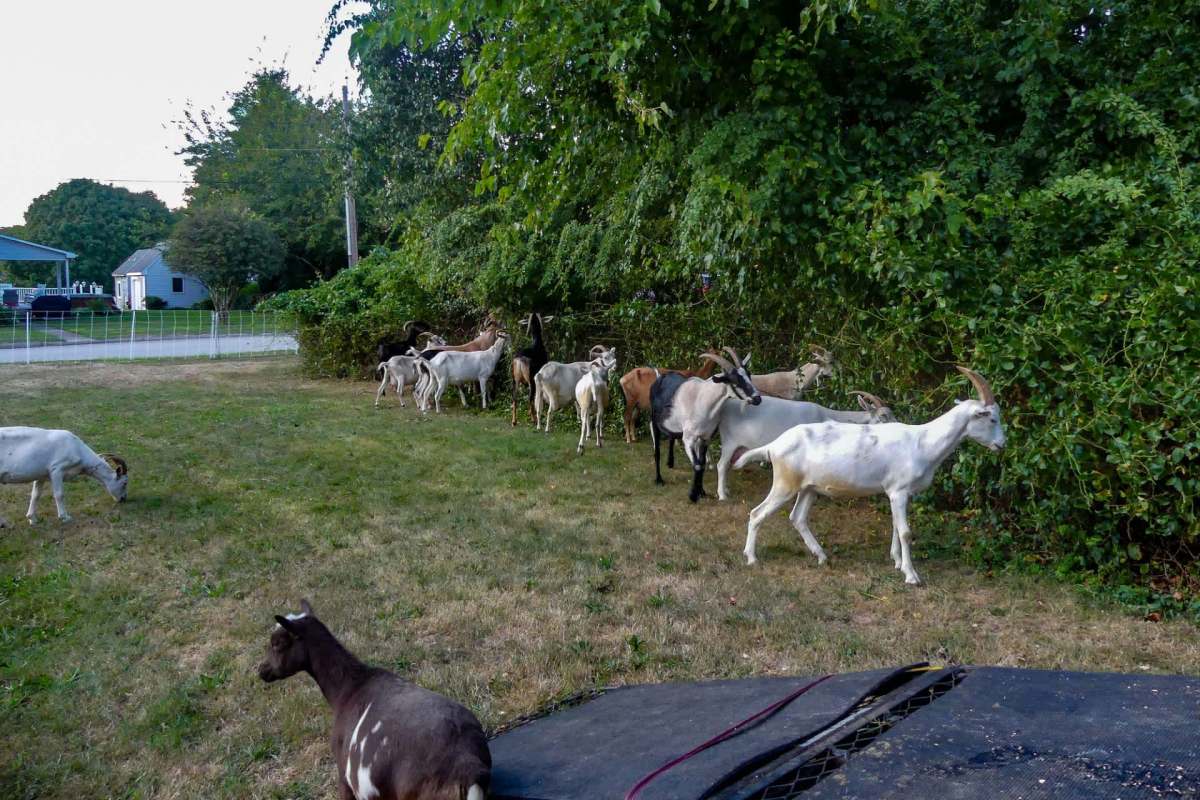
Goats are becoming a tool of choice for some North Carolina residents who want to beat back invasive vines without relying on chemical sprays.
On private properties and city land alike, the animals are being used to chew through hard-to-control plants such as English ivy and kudzu, opening space for healthier vegetation to return and for the native plants to thrive.
What's happening?
Raleigh homeowner and environmentalist Nina Szlosberg-Landis recently used that approach after English ivy spread through her wooded backyard, as reported by WUNC. She hired a herd from Stephen Paul, who runs Goats on the Go Raleigh-Durham.
This was the perfect all-natural solution for Szlosberg-Landis, who had promised the old homeowners to protect the land on the property by avoiding the use of artificial chemicals. A herd of 20 goats cleared the area in four days, WUNC reported, eating the ivy and other invasive growth down to the ground.
"It is like a fairy land back there, pretty much all year on the ground," Szlosberg-Landis said. "However, it's covered with ivy. And it was growing up the trees, and so it was really taking over that whole backyard area."
The challenge is much bigger than one backyard. According to WUNC, English ivy, wisteria, and kudzu were widely planted in the 1950s and 1960s for decoration, privacy, and erosion control, but they now crowd out native plants in parks and neighborhoods.
TCD Picks » Quince Spotlight
💡These best-sellers from Quince deliver affordable, sustainable luxury for all




Raleigh Invasive Species Program assistant coordinator Sydney Merrell said those plants can be especially damaging to local ecosystems.
"A lot of the time, they're outcompeting native plants that are now rare or almost endangered," Merrell said.
The practice is also spreading to other parts of North Carolina. Raleigh has already used goats on city projects, and WUNC reported that Asheville, Chimney Rock, and Belmont have also turned to goats to help remove invasive plants.
Why does it matter?
Dense invasive growth can blanket trees and the forest floor, blocking sunlight, weakening wooded areas, and reducing habitat for birds and insects that rely on native plants.
English ivy spreads quickly, grows on many types of surfaces, and absorbs sunlight that native plants would otherwise benefit from. Merrell said some invasive vines become so large and heavy that they can "actually strangle and pull the trees down."
Removing invasive plants can also open the door to native landscaping, edible gardens, or other plantings that support pollinators and reduce maintenance over time.
Growing native plants and food at home can help lower grocery bills, provide fresher and better-tasting fruits and vegetables, and support mental and physical health by getting people outdoors and moving.
If a cleared yard becomes a garden, homeowners can build on that progress with the TCD guides to growing their own food and controlling weeds without chemicals.
Many homeowners are looking for ways to avoid herbicides around children, pets, waterways, and wildlife, especially in difficult areas such as steep slopes and creek banks.
What's being done?
Paul told WUNC that goatscaping works best when invasive plants are putting energy into leaf growth. Grazing them repeatedly weakens them and improves the chances that native species can bounce back.
"What they're doing is they're really helping the native species to compete," he said.
Sean Gough, director of the Raleigh Invasive Species Program, said the city views goats as a useful first pass before crews return for more targeted treatment.
"Instead of us having them come in and dump gallons of herbicide on this, they can actually get a lot of the vegetation removed, and then we can come back and treat the sprouts, which is much easier," he said.
So far, WUNC reported, Raleigh has completed two goat-grazing projects and has identified at least a dozen more sites where the animals could help.
"They're incredibly cost-efficient, when compared to some of the other conventional contractors that we work with. And also really positive. People love goats," Gough said.
Szlosberg-Landis said the environmental benefits override any additional cost.
"For me, the benefit of having an environmentally positive way of dealing with it outweighs any, you know, potential increase in dollars and cents," Szlosberg-Landis said. "We only have one planet, and it's up to all of us to take care of it."

Get TCD's free newsletters for easy tips, smart advice, and a chance to earn $5,000 toward home upgrades. To see more stories like this one, change your Google preferences here.







