


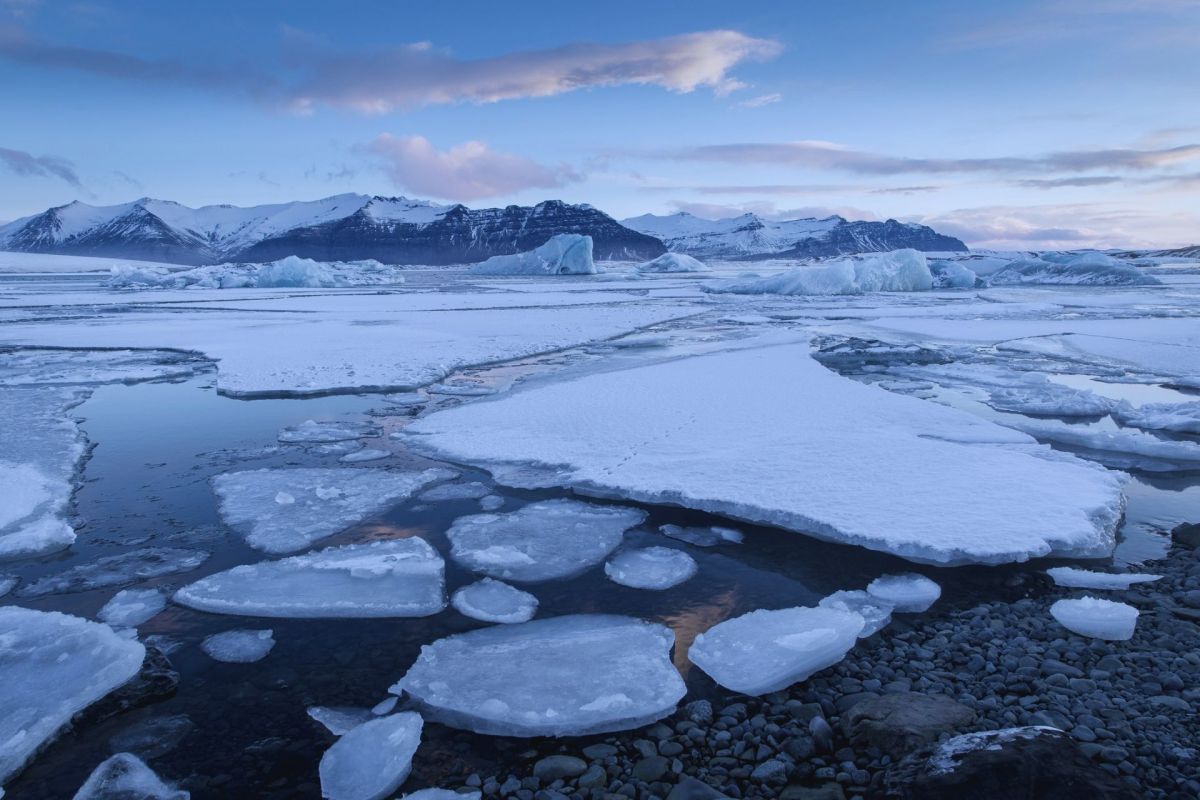
Rising global temperatures have contributed to the rapid melting of ice sheets in the Arctic.
While this has contributed to a number of harmful side effects on our planet, researchers have discovered a surprising development that could benefit marine life.
What's happening?
In a study published in the journal Communications Earth & Environment, climate researchers took a closer look at how Arctic ice melt is influencing the delicate balance of the planet's largest bodies of water.
As sea ice melts, microbes are playing a growing role in feeding Arctic marine ecosystems, which could change how the Arctic Ocean functions in a warming climate.
Melting Arctic sea ice can be a driving force behind a process called nitrogen fixation, where atmospheric nitrogen can be converted to ammonium, which may promote a healthier way of sustaining algae growth.
As more Arctic ice melts, the spike in nitrogen fixation could lead to an increase in the ocean's ability to support the marine food web.
TCD Picks » Quince Spotlight
💡These best-sellers from Quince deliver affordable, sustainable luxury for all




Lisa W. von Friesen, lead author of the study and postdoctoral researcher in marine ecology at the University of Copenhagen, noted the significance of the team's discovery.
"Until now, it was believed that nitrogen fixation could not take place under the sea ice because it was assumed that the living conditions for the organisms that perform nitrogen fixation were too poor," said von Friesen. "We were wrong."
Why is nitrogen fixation important?
As the Arctic ice melts, sea levels are rising at an alarming rate. For example, one study noted that sea levels in India could rise by more than three feet by 2100.
This could result in a major disruption of ocean currents and weather patterns, increasing the likelihood of more severe storms. Coastal communities may also be at higher risk of flooding, leading to the potential displacement of millions of people across the planet.
|
Do you think we still have a lot to learn from ancient cultures? Click your choice to see results and speak your mind. |
 Definitely 👍
 But as sea levels rise, the increase in nitrogen fixation could lead to a much-needed boost for the production of algae, a major food source for a number of marine species, which could supplement marine food chains. This could also unlock another surprising benefit to Arctic ice melt.
"For the climate and the environment, this is likely good news," said Lasse Riemann, professor at the University of Copenhagen and co-author of the study. "If algae production increases, the Arctic Ocean will absorb more carbon dioxide because more CO2 will be bound in algae biomass."
"But biological systems are very complex, so it is hard to make firm predictions, because other mechanisms may pull in the opposite direction."
What's being done about Arctic ice loss?
To address rising temperatures and continued Arctic ice loss, many countries have increased their focus on cutting carbon pollution while also promoting the transition to renewable energy resources.
International initiatives to reduce our carbon impact, like the Paris Agreement, have set goals for countries to reduce emissions, with many pledging to achieve net-zero pollution over the next several decades.
Until then, Riemann explained that Arctic ice loss will remain a high priority for researchers, with a closer eye locked on the importance of nitrogen fixation.
"We do not yet know whether the net effect will be beneficial for the climate," Riemann said. "But it is clear that we should include an important process such as nitrogen fixation in the equation when we try to predict what will happen to the Arctic Ocean in the coming decades as sea ice declines."

Join our free newsletter for good news and useful tips, and don't miss this cool list of easy ways to help yourself while helping the planet.







