


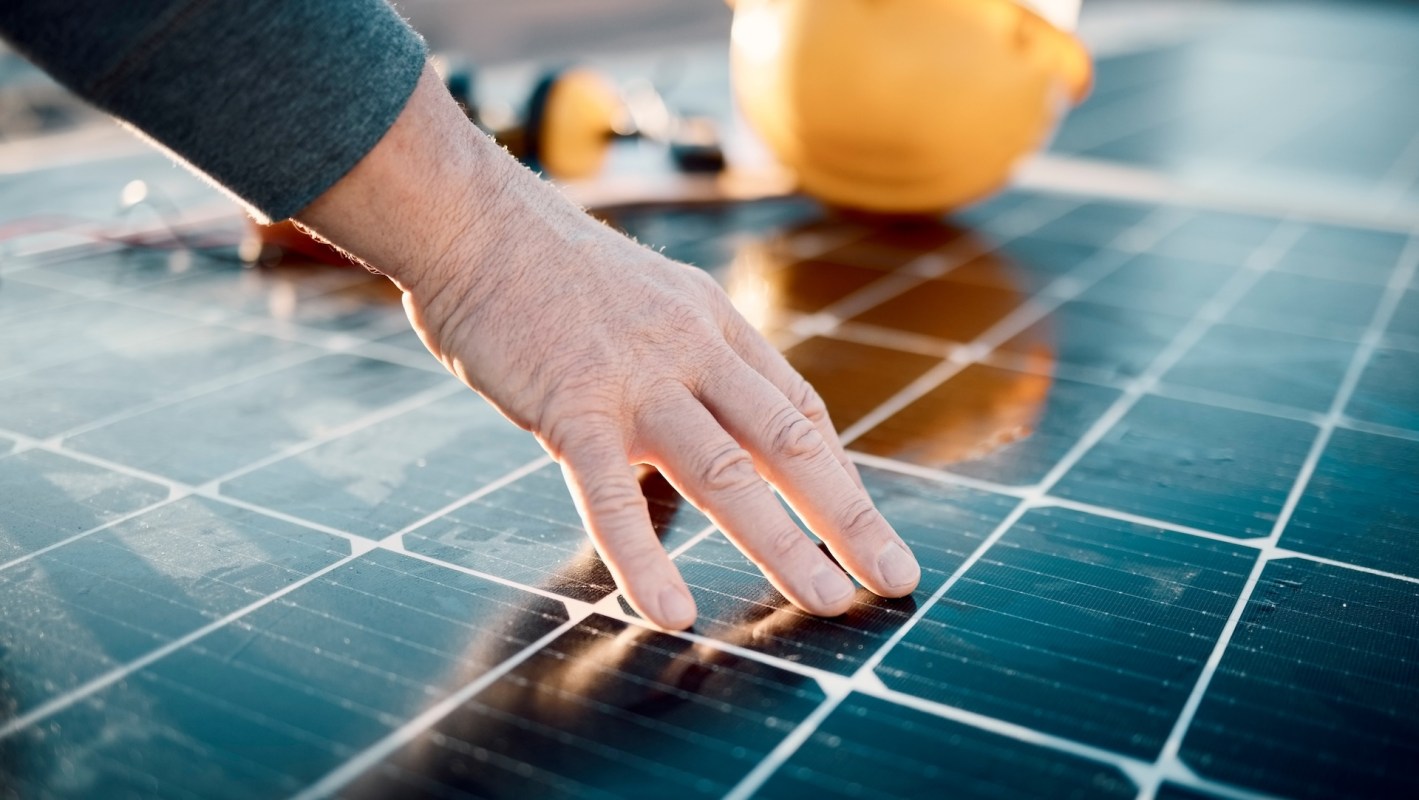
Chinese researchers are exploring a novel approach to increase the value of solar power by using "sunscreen" to protect solar cells from degradation.
Researchers at Southwest Petroleum University found that zinc oxide films can protect silicon heterojunction solar cells from ultraviolet damage and increase projected lifetime power output by 4.8%, according to pv magazine.
Here's what to know
In the study, the team examined zinc oxide, or ZnO, as a UV shield for silicon HJT solar cells, a high-efficiency technology that can lose performance when exposed to UV radiation.
Their results will be published in Current Applied Physics in October.
Jian Yu, the study's corresponding author, said methods for limiting UV-induced degradation typically focus on encapsulation materials that block or convert UV light or on device-level design changes.
The team proposed a different route, placing a wide-bandgap metal oxide layer to absorb damaging UV photons before they reach the more sensitive parts of the cell.
TCD Picks » Quince Spotlight
💡These best-sellers from Quince deliver affordable, sustainable luxury for all




The coating screened out much of the ultraviolet range while still transmitting visible light efficiently. UV transmittance was only about 16-18%, and average visible-light transmittance stayed above 90%.
After 60 kilowatt-hours per square meter of UV exposure, the ZnO coating kept power conversion efficiency degradation to 3.5%, versus 5.7% for uncoated cells. Applying zinc oxide to the module glass provided even better protection.
More background
Under the same UV exposure, module-level testing found that zinc oxide-coated glass reduced efficiency degradation to 4.1% from 5.0%. Over a projected 25-year operating life, those protected modules were estimated to reach a lower levelized cost of electricity of $0.0262 per kilowatt-hour.
The researchers said ZnO could be a good match for crystalline silicon because it absorbs UV photons in the 300-400-nanometer range while still allowing most visible light through, which could improve reliability.
What's being done?
To test the concept, the researchers used two main approaches: adding zinc oxide directly to pre-metallized HJT cells and coating the front glass of finished modules.
The films were produced by DC magnetron sputtering, and the team tuned their optical properties by changing deposition power, pressure, oxygen flow, and substrate temperature.
Both methods improved durability, though coating the glass appeared promising because it offered full-area coverage. After 60 kWh/m² of UV exposure, cells protected by ZnO-covered glass had short-circuit current and efficiency degradation of 1.2% and 2.3% versus 2.8% and 4.7% without the coating.
The researchers also said the concept may extend beyond HJT technology to tunnel oxide passivated contact, perovskite, and tandem solar cells, potentially broadening its usefulness across the industry.
"By efficiently absorbing and blocking high-energy UV photons, a physical protective barrier analogous to a sunscreen is formed on the cell surface, effectively suppressing UV-[induced degradation] from a materials perspective," Yu said.

Get TCD's free newsletters for easy tips, smart advice, and a chance to earn $5,000 toward home upgrades. To see more stories like this one, change your Google preferences here.







