


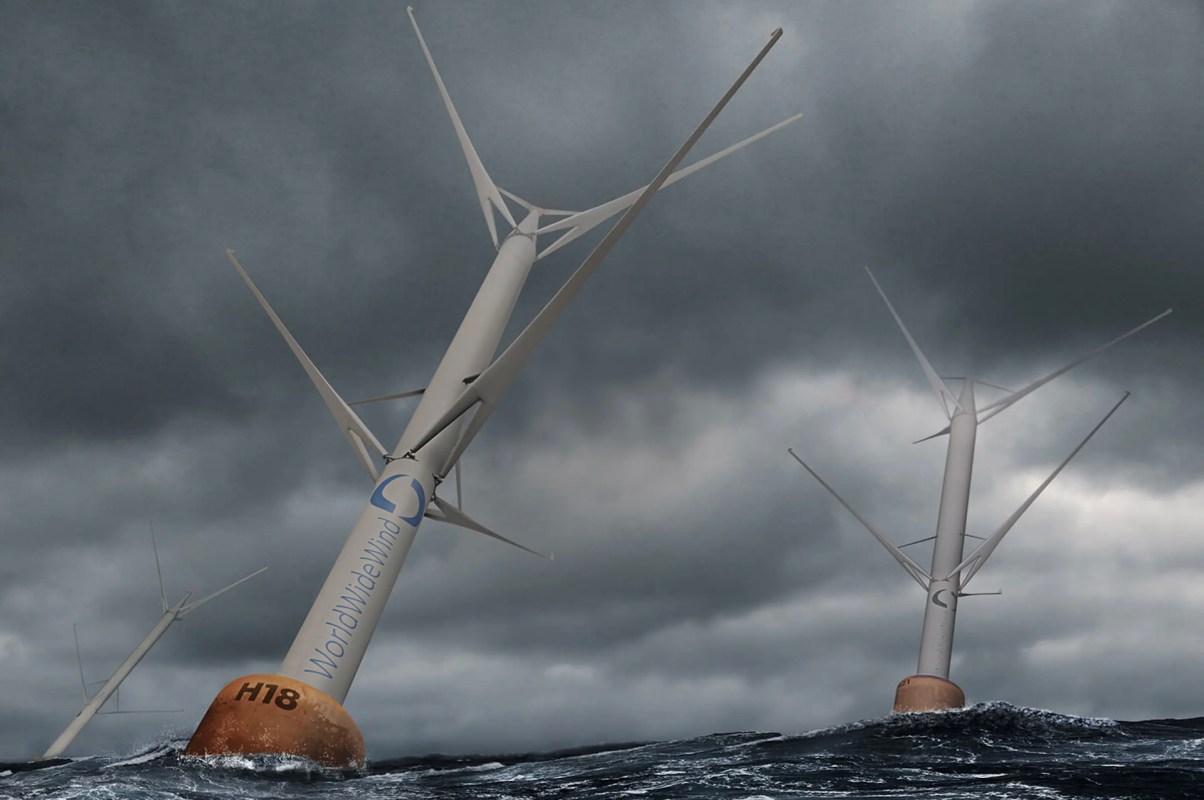
A radical new wind turbine design due to test soon in Norway has the potential to turn offshore wind energy production upside down — or at least sideways, with an unusual twist.
If successful, the "counter-rotating vertical-axis turbines" from Norwegian startup World Wide Wind (WWW) could, according to the company, reduce costs and double wind energy generation at sea by allowing builders to supersize floating wind turbines.
More broadly, wind power technology improvements like this can help reduce dependence on dirty energy sources that create heat-trapping gases that overheat the Earth.
At the heart of the new design are three key concepts.
One is that the design is floating, meaning it doesn't have a structure built into the seafloor and is instead tethered to it. This in itself isn't revolutionary, but it's useful. Several huge wind farms are being built with floating technology. These can be sited in deeper-water areas, allowing access to more wind resources and making them less controversial for interrupting views.
A second part of the new design is that the blades turn on a vertical axis rather than a horizontal one. This ditches the usual "pinwheel" look of wind turbines in favor of an orientation like an upside-down stand mixer's. It's unusual, though at least one other company is exploring vertical-axis floating wind.
The third innovation makes the design truly stand out: adding another counter-rotating (aka contra-rotating) turbine and blades on the same axis but rotating in the opposite direction.

The WWW design addresses several problems. Per New Atlas, it puts heavy, high-maintenance hardware near the base or underwater, which a top-heavy horizontal-axis turbine can't do. This should allow the device to be taller and the blades larger (in wind energy, bigger is better).
With the design's tilting vertical axis and blade configuration, it can capture wind from more directions and reduce turbulence in its wake (another issue with horizontal-axis turbines). This allows devices to be packed closer together in a wind farm, the company told New Atlas.
Last but not least, because of the opposite rotations of the turbines, the torque on the system (a vertical-axis issue) is neutralized, while the relative rotation is essentially doubled.
TCD Picks » Quince Spotlight
💡These best-sellers from Quince deliver affordable, sustainable luxury for all




"Whichever way the wind's blowing, the floating double [vertical-axis wind turbine] passively tilts to an optimal angle, and the two turbines begin turning in opposite directions, effectively doubling the speed at which the 'rotor' is turning in the 'stator,'" Loz Blain of New Atlas explained.
"You can think of that as a way to double your power generation, or as a way to reduce your generator cost by half," Trond Lutdal, former CEO of WWW, told New Atlas in 2022. "So it's lower cost, it's much more scalable, and any maintenance happens at the bottom and not hundreds of feet up in the air."
The test prototype, which WWW is partnering on with builder AF Gruppen, is 62 feet tall and has a 30-kilowatt production capacity. However, New Atlas said the company envisions scaling to 1,312 feet tall and 40 megawatts of capacity, or "nearly twice" what today's largest wind turbines do.
New Atlas reported that a larger 1.5-megawatt prototype is scheduled for testing in 2025, with hopes of a 24-megawatt version — bigger than any current offshore turbine — being commercially available by 2030.
"Bring it on!" the outlet concludes. "If these massive machines do what they say on the tin, the world needs them yesterday."

Join our free newsletter for weekly updates on the coolest innovations improving our lives and saving our planet.
Cool Picks





