


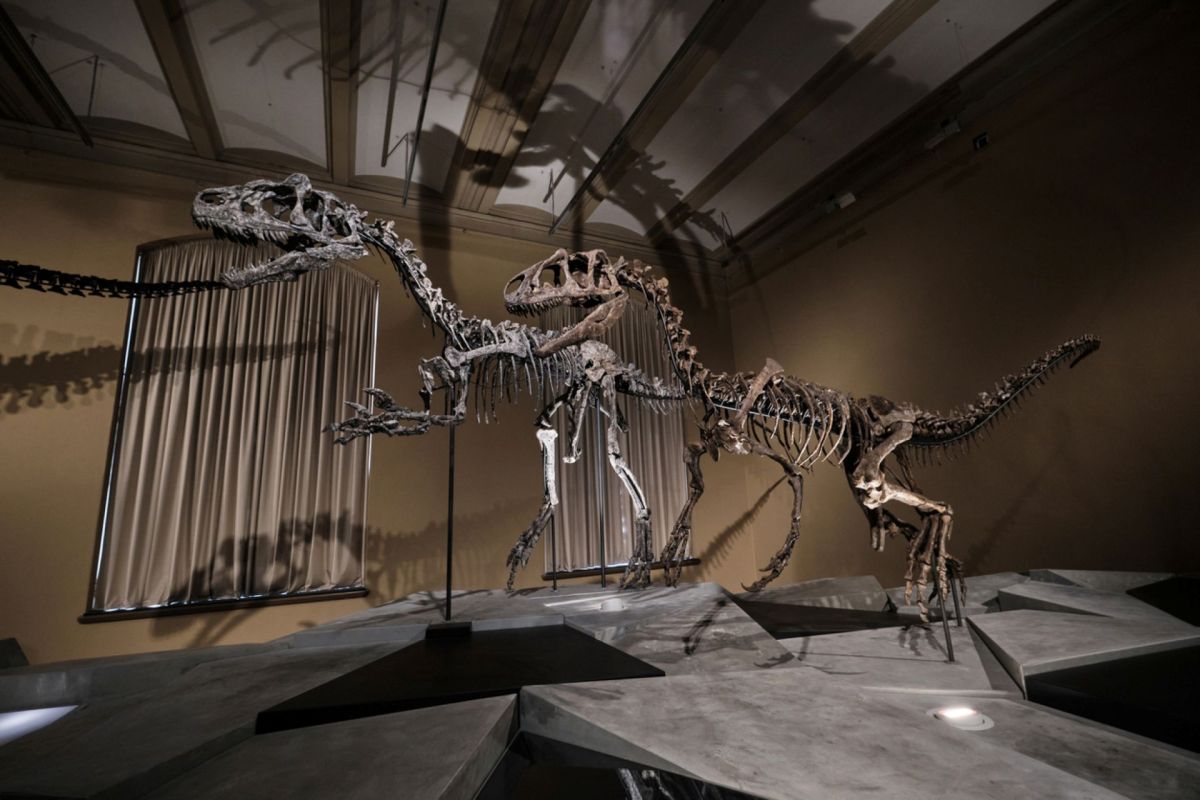
Tyrannosaurus rex's famously tiny arms may not have been an awkward evolutionary leftover after all. A new study suggests their arms shrank as giant predators increasingly relied on huge skulls and crushing jaws to take down prey.
That pattern appears to have evolved multiple times across different groups of meat-eating dinosaurs.
Researchers from University College London and the University of Cambridge analyzed 82 theropod species, a mostly carnivorous dinosaur group that moved on two legs and included T. rex. Their study, published in Proceedings of the Royal Society B, reported that forelimb reduction arose separately in at least five lineages, according to UCL News.
The strongest link was not between tiny arms and overall body size. Instead, the team said that unusually short forelimbs tracked more closely with sturdier skulls and strong jaws, pointing to a shift in hunting strategy.
As huge herbivores such as sauropods became more common, predators may have shifted away from seizing prey with their claws to overpowering it with powerful bites, according to UCL News. To test that idea, the researchers created a new skull-robustness measure that used bite force, skull shape, and how firmly the skull bones fit together. Using that system, T. rex placed first for skull robustness, with the giant theropod Tyrannotitan next.
"We sought to understand what was driving this change and found a strong relationship between short arms and large, powerfully built heads," lead author Charlie Roger Scherer said. "The head took over from the arms as the method of attack. It's a case of 'use it or lose it.'"
TCD Picks » Quince Spotlight
💡These best-sellers from Quince deliver affordable, sustainable luxury for all




The finding helps explain one of the most recognizable mysteries in paleontology: why some of the largest predators in Earth's history ended up with such small arms. It also suggests that evolution may have repeatedly favored the same solution when giant hunters faced giant prey.
Studies like this help scientists understand how anatomy changes as animals adapt to new environments, food sources, or competition. In this case, the rise of enormous herbivores may have triggered an evolutionary arms race that reshaped entire predator bodies.
The researchers did not just revisit old fossils. They also developed a new framework for comparing skull strength across dinosaur species. Rather than relying on a single measurement, the system examined multiple physical traits, providing a more detailed way to study how predators may have hunted.
The analysis also showed that different dinosaur groups developed tiny arms in different ways. In abelisaurids, UCL News noted, the hands and lower parts of the arms became much smaller, while tyrannosaurids had a more balanced reduction across the forelimbs. That suggests that separate lineages may have arrived at a similar outcome through different developmental routes.
The work is part of a larger dinosaur-evolution research effort at UCL that works closely with the Natural History Museum.
"While our study identifies correlations and so cannot establish cause and effect, it is highly likely that strongly built skulls came before shorter forelimbs," Scherer said, per UCL News. "It would not make evolutionary sense for it to occur the other way round, and for these predators to give up their attack mechanism without having a back-up."

Get TCD's free newsletters for easy tips, smart advice, and a chance to earn $5,000 toward home upgrades. To see more stories like this one, change your Google preferences here.







