


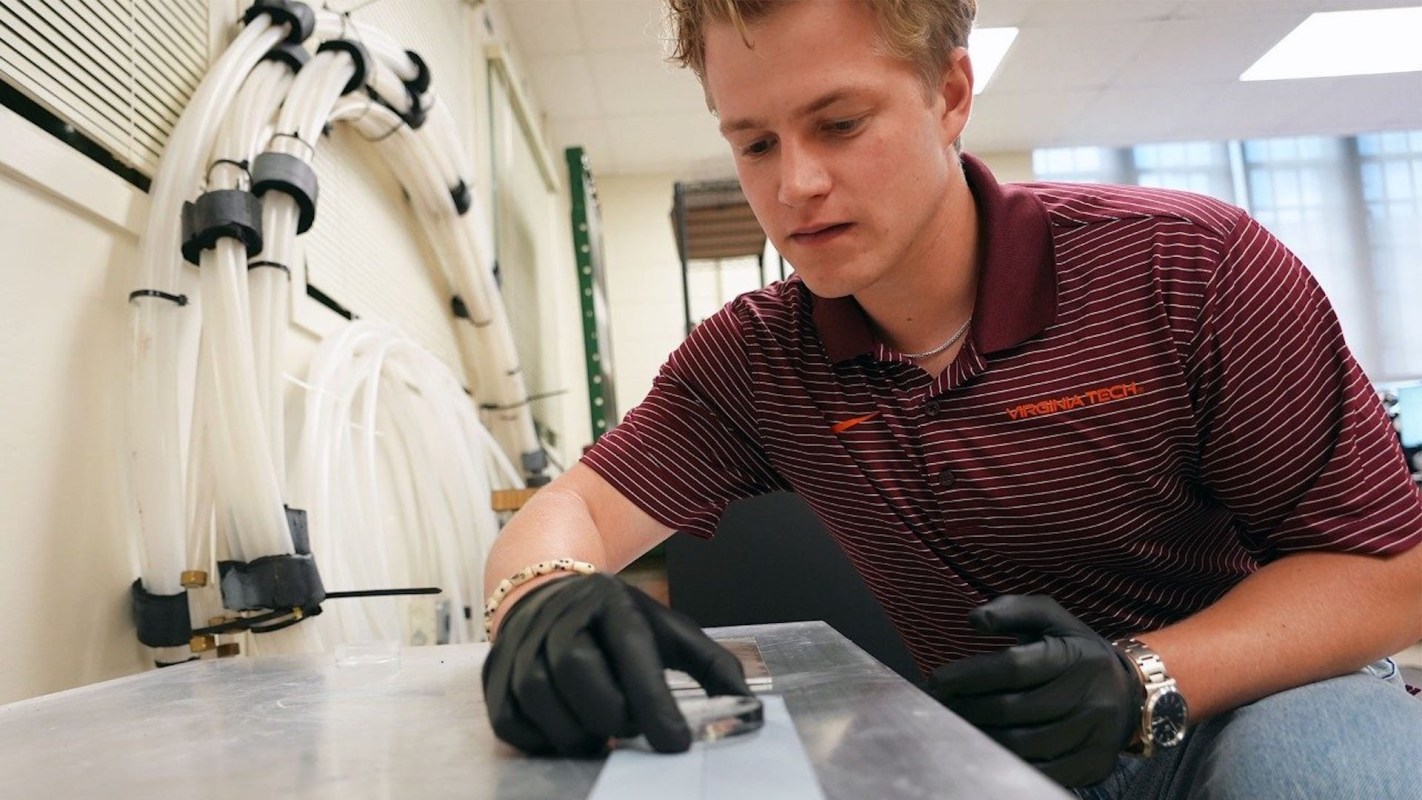
Rocks that move themselves across deserts sound like fiction, but in Death Valley, "sailing stones" moving across dry lakebeds are a real thing. Technically, the stones don't move themselves; rather, a combination of melting ice and wind moves them, a process that inspired a research team from Virginia Tech to see if it could use the mechanics of sailing stones to make ice move on its own.
After five years, the team has done just that and published its research in the journal ACS Applied Materials & Interfaces.
Sailing stones are a rare natural occurrence that happens when rain turns into thin sheets of ice on the hard desert floor. As these sheets eventually melt, slight breezes can come along and move them, which can drag rocks along, too, making the rocks appear as if they're moving on their own.
After discovering this phenomenon, scientists in Virginia Tech's Nature-Inspired Fluids and Interfaces Lab decided to try creating a surface that would move ice on a level, horizontal path without the aid of wind. As TechXplore stated in its article, "It's not a magic trick or a supernatural occurrence but a clever engineering feat."
The team accomplished this feat by creating aluminum plates with a design featuring small, V-shaped grooves in a herringbone pattern. Once they constructed these plates, scientists made ice disks, heated the plates, and then placed the ice disks on them. As the ice melted and turned to water, the grooves channeled the water forward, while the herringbone pattern prevented the water from moving backward.
The research team also coated a few plates with a spray that was water-repellent just to see what might happen. On those plates, the ice disks initially stuck before suddenly zooming across the plate.
According to the research team, while much more exploration is needed into this process, the initial research shows multiple implications.
As stated in their research paper, "These findings demonstrate the potential for passive ice removal and phase-engineered microtransport by harnessing controlled melting and surface-guided motion, with implications for anti-icing systems, self-cleaning surfaces, and power-free microfluidic transport."
The team's findings could be a huge boon to consumers and the environment. Self-cleaning surfaces and anti-icing technology could possibly allow people to ditch the usual chemicals needed for these, not only saving them money, but also preventing these chemicals from contaminating the soil, air, and water around them.
More than that, one of the more promising applications of this process could be energy harvesting. If the metal plates contained different patterns, such as circles, then melting ice would rotate continuously. By connecting a turbine or magnets to the rotating disks, the disks could generate power. If done on a large enough scale, it could provide cleaner (and less expensive) energy.
TCD Picks » Quince Spotlight
💡These best-sellers from Quince deliver affordable, sustainable luxury for all




Since scientists need to learn much more about this process, it's uncertain when technologies based on it might become widely available to meet public needs. However, the initial research into moving ice is extremely exciting.
|
Should the U.S. be investing more in battery production to catch up with China?
Click your choice to see results and speak your mind. |
 Absolutely 📈
Join our free newsletter for weekly updates on the latest innovations improving our lives and shaping our future, and don't miss this cool list of easy ways to help yourself while helping the planet.
Cool Picks





