


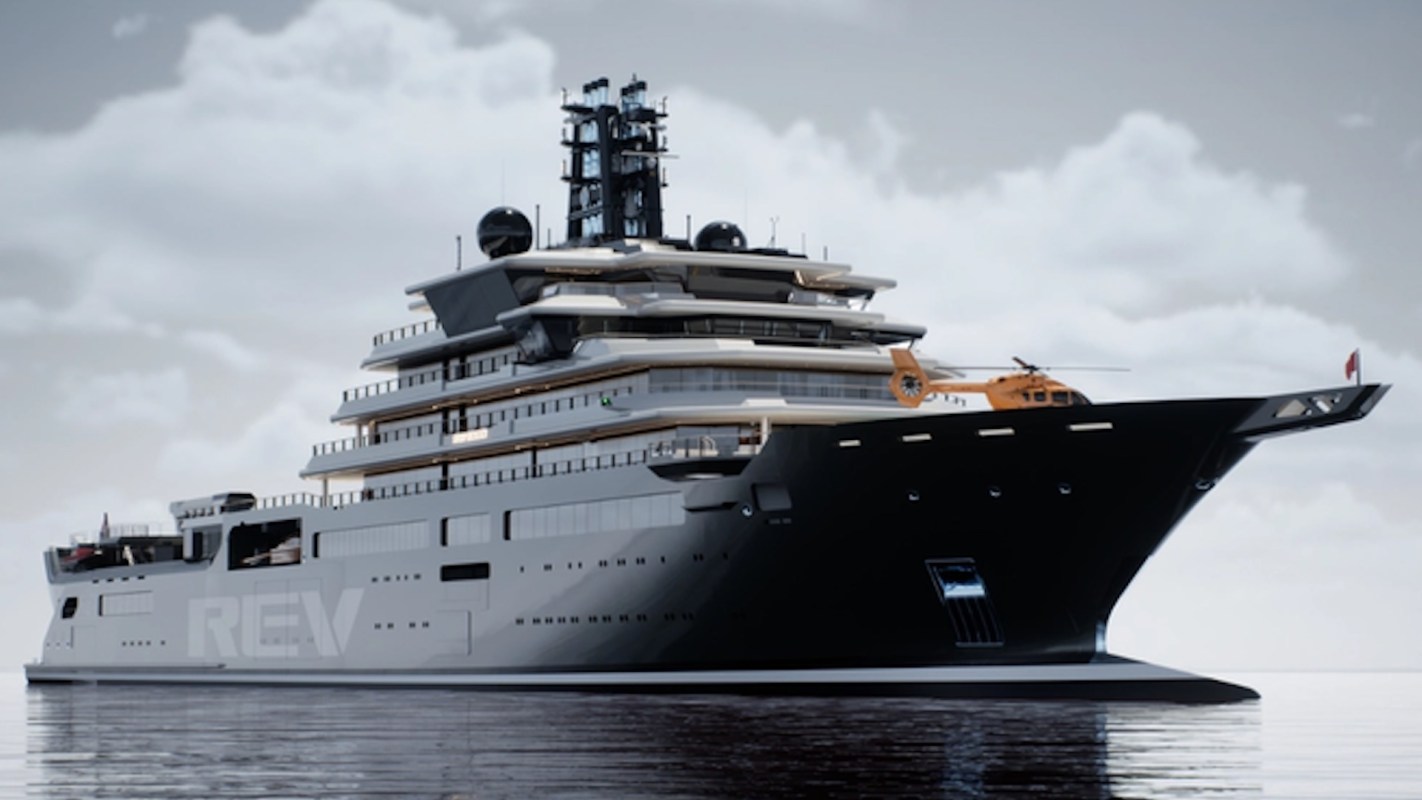
Unlike many superyachts, which usually draw attention for their owners, costs, or extravagant destinations, REV Ocean is being noticed for its purpose. The 639.4-foot vessel is now the world's largest superyacht, and it was created to help scientists better understand the ocean and support efforts to protect it.
What happened?
REV Ocean may look like a luxury yacht, but research sits at the center of its mission. The vessel's design was developed by Espen Øino and H2 Yacht Design, according to Forbes.
To support scientific work, the ship has a submarine hangar, a metalworking shop, and a 3D-printing facility. Those onboard resources are intended to help researchers study some of the ocean's least understood areas.
Its first voyage is planned as an 18-month research program spanning 10 missions focused on gathering information that can aid marine conservation in the Atlantic, Caribbean, and Pacific. More details are expected at the U.N. Ocean Decade Conference in Rio de Janeiro in April 2027.
REV Ocean science director Eva Ramirez-Llodra said the effort is starting at a time when countries are pursuing major biodiversity goals.
"We cannot protect what we don't know," she said, according to Forbes. "REV Ocean's role is to help close that knowledge gap while connecting science with policy, decision-making and regional priorities."
TCD Picks » Quince Spotlight
💡These best-sellers from Quince deliver affordable, sustainable luxury for all




One of the voyage's early destinations is Brazil's Vitória-Trindade Chain, a broad Atlantic system of underwater mountains.
The itinerary also includes the Caribbean Biodiversity Corridor, where scientists plan to examine deep-ocean ecosystems that have long received less attention than coral reefs, mangroves, and seagrass beds.
Why does it matter?
Healthy marine ecosystems help support fisheries, food supplies, tourism economies, and coastal protection. They also play a major role in regulating the climate and storing carbon.
The project is unfolding as governments work toward the Global Biodiversity Framework target of protecting 30% of the planet by 2030.
Without reliable data, those protections can be more difficult to design and harder to enforce.
REV Ocean's approach could also help speed action. After each expedition, the vessel will host a weeklong port convening so that scientists, policymakers, funders, and regional leaders can quickly review findings rather than waiting years for formal analysis.
That kind of faster collaboration could help communities make more informed decisions about conservation, resource management, and economic resilience.
What are people saying?
Ramirez-Llodra called the initiative a "pivotal moment" for global ocean conservation and said the ship is intended to link research directly with real-world decision-making, Forbes reported.
Mission lead Professor Jose Angel Alvarez Perez emphasized how much remains unknown about the Vitória-Trindade Chain.
"This expedition gives us the opportunity to finally understand what lives in these vast, largely mysterious habitats," he said.
Jonathan Delance, mission lead with the Ministry of Environment for the Dominican Republic, emphasized the importance of looking beyond the region's more familiar ecosystems.
"Mangroves, seagrass, coral; these things are critical, but the deep ocean forms the majority of the Caribbean," he said. "We need to learn more about it."

Get TCD's free newsletters for easy tips, smart advice, and a chance to earn $5,000 toward home upgrades. To see more stories like this one, change your Google preferences here.






