


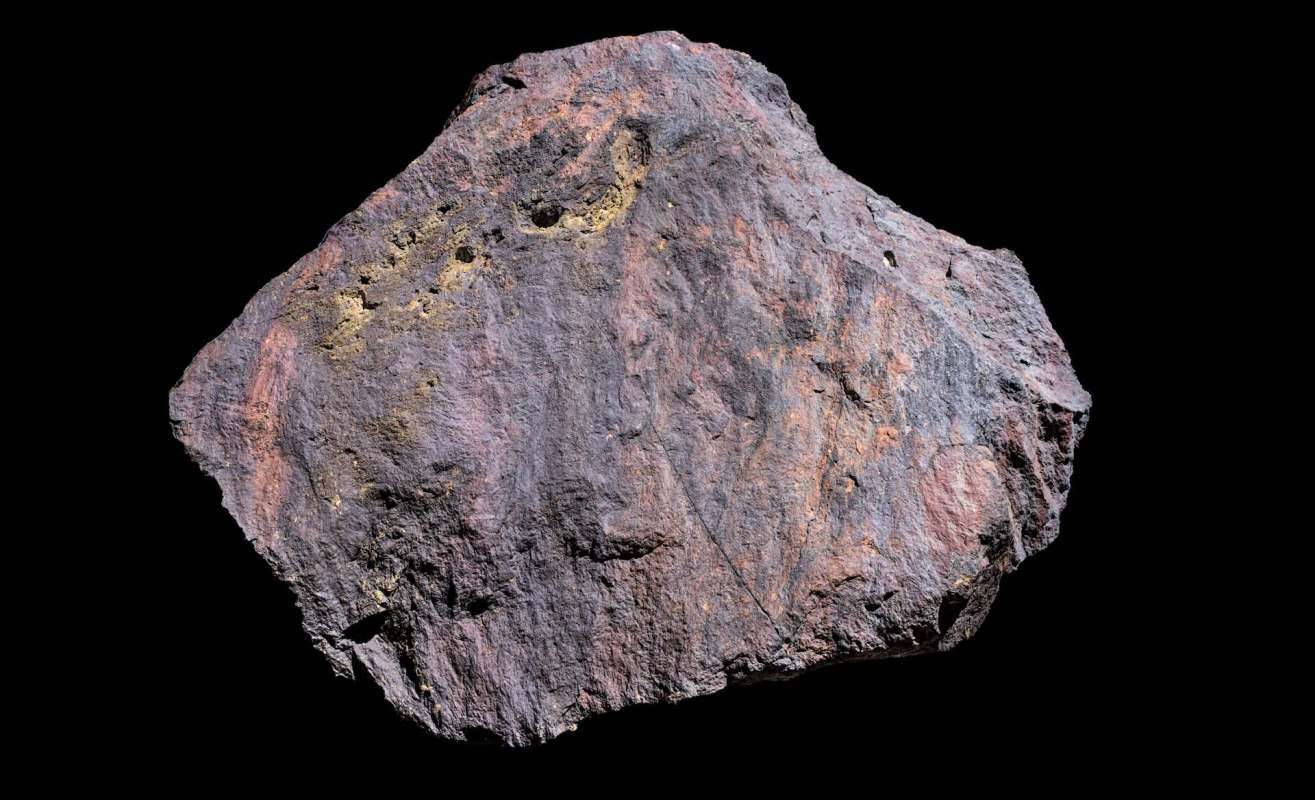
A meteorite discovered in Algeria is giving scientists a rare look at a stretch of Mars' history that had been missing from the geological record.
The rock, known as Northwest Africa 13441, seems to bridge a long-standing gap in the geological timeline. It could also have preserved evidence from an ancient region of Mars that stayed chemically unchanged for billions of years.
Here's what to know
In a study published in June, Boston College researchers reported that the meteorite crystallized about 1.3 billion years ago, SciTechDaily reported.
Most known shergottites — the dominant class of Mars' igneous meteorites — are either younger than 600 million years or about 2.4 billion years old.
This one's neodymium isotope signature — or chemical footprint — was also found to be essentially chondritic, making it a common type of stony meteorite made up of dust and small grains from the early days of the solar system. This means that the meteorite closely resembles some of the most primitive material left over from the solar system's formation.
More background
Martian meteorites are rare.
TCD Picks » Quince Spotlight
💡These best-sellers from Quince deliver affordable, sustainable luxury for all




Scientists have identified only about 400 of them, and they remain among the only pieces of Mars that can be directly studied in laboratories on Earth while researchers wait for spacecraft-collected samples to return.
These rocks reach Earth after powerful impacts blast fragments into space. Some of those fragments reach Earth's orbit and survive the trip through our atmosphere, creating a natural delivery system for planetary science.
Scientists involved in the study think Northwest Africa 13441 formed near the boundary between Mars' crust and mantle and may retain a chemical record from very early in the planet's history, SciTechDaily reported.
Mars does not feature plate tectonics like Earth, so ancient reservoirs inside the planet can survive far longer than they would here, where the crust and mantle are constantly recycled.
A better understanding of how rocky planets form and evolve can help researchers refine models used in space exploration, geology, and high-precision lab science — work that can support improved tools, measurements, and planning for future missions.
What's being done?
Researchers are continuing to study the meteorite with advanced isotope techniques to better understand where it fits in Mars' history.
Because samples such as this are so scarce, one rock can clarify several issues, including the timing of Martian volcanism, the nature of the planet's interior, and how long ancient chemical reservoirs persisted.
The same precision instruments and analytical methods used to decode a meteorite can strengthen scientific tools on Earth, helping researchers better study materials, natural resources, and planetary changes.
If ongoing research continues to bear out its significance, Northwest Africa 13441 could stand as one of the strongest records yet for an otherwise obscure period in Mars' evolution.

Get TCD's free newsletters for easy tips, smart advice, and a chance to earn $5,000 toward home upgrades. To see more stories like this one, change your Google preferences here.






