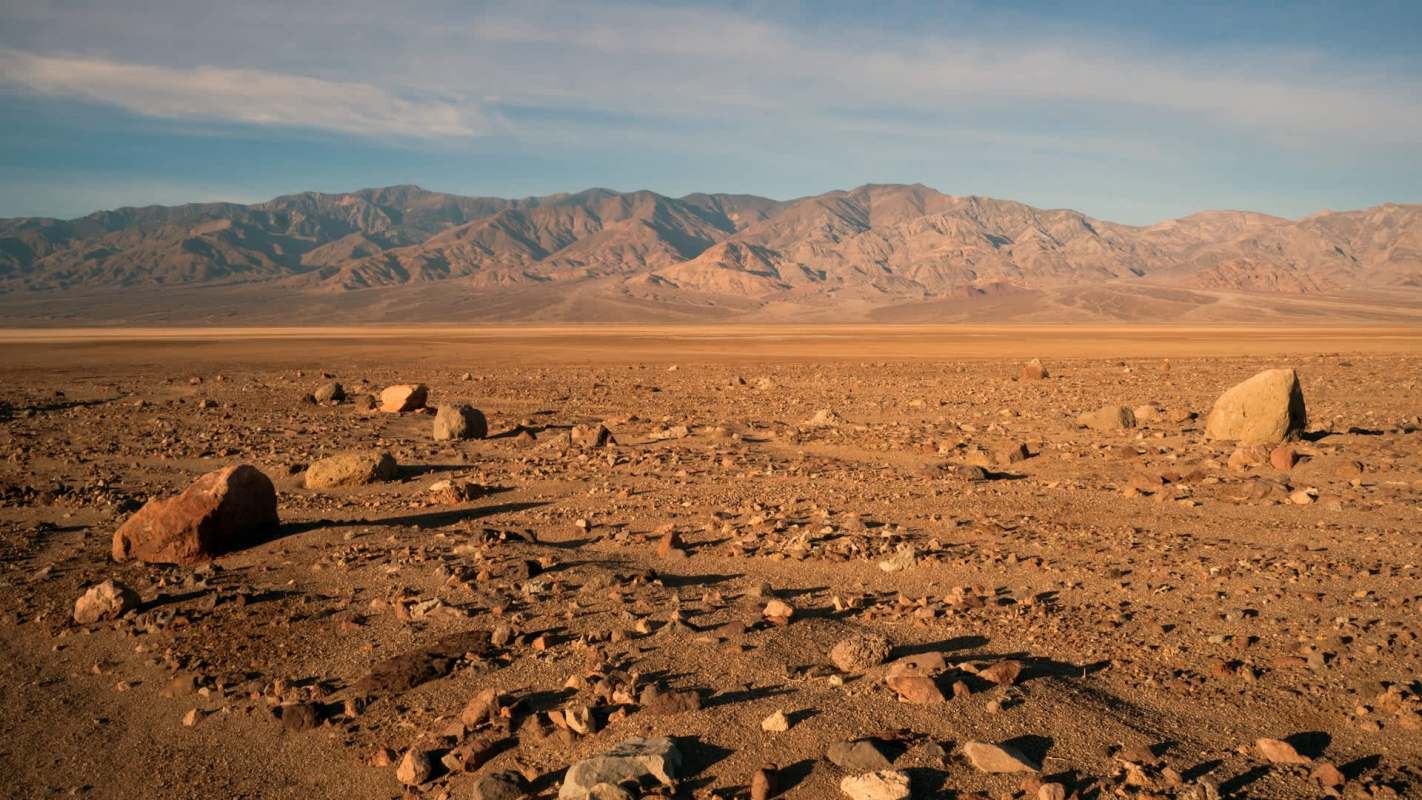
A rock discovered in the Sahara Desert is offering scientists a rare glimpse at Mars during its earliest days when the planet may still have had abundant water.
The meteorite, known as Teghaza 001, could be the oldest piece of Mars ever recovered on Earth. Researchers say it points to a planet that began drying out surprisingly early while also developing a crust more complex than scientists once expected.
What's happening?
EarthSky reported that a team led by the California Institute of Technology dated Teghaza 001 to more than 4.1 billion years old, years after prospectors found the meteorite in September 2022.
The announcement came July 16, 2026, though the study has so far been released only as a preprint, meaning it has not yet been peer-reviewed.
Mars formed around 4.5 billion years ago, so Teghaza 001 appears to date to the planet's earliest history.
EarthSky said Teghaza 001 joins Allan Hills 84001 as only the second known sample from Mars' crust dating to that earliest era.
TCD Picks » Good Store Spotlight
Get 10% off your next purchase with code TCD10


Scientists determined the rock's age using zircon minerals; their uranium turns into lead on a timetable researchers can measure.
Its chemistry offers another surprise. The meteorite contains abundant silicon, a sign that ancient Mars may have produced crust with granite-like characteristics even though the planet lacks plate tectonics, unlike Earth, where granite is usually linked to tectonic activity.
Why does it matter?
Water and crust formation are two of the biggest clues scientists rely on to understand whether a planet may once have had habitable conditions.
The rock also paints a complicated picture of early Mars: substantial water appears to have been present near the start of the planet's history, even as signs suggest that the process of losing it was already underway.
One line of evidence comes from hydrogen ratios preserved in Teghaza 001, which researchers use to reconstruct changes in a planet's atmosphere over time, according to EarthSky. That fits with the broader view that Mars' magnetic field weakened, its atmosphere thinned, and much of its liquid water eventually disappeared.
It does not mean Mars was covered in granite, nor does it prove the planet once had plate tectonics. Instead, it suggests early Mars may have formed a more chemically evolved crust than scientists had assumed, likely through complex magma processes.
Studying why Mars dried out can help scientists better understand how rocky planets evolve, what allows water to remain stable over geologic time, and how unusual Earth's long-lasting habitability may be.
What's being done?
Researchers are now comparing Teghaza 001 with other Martian evidence, including Allan Hills 84001 and notable rover observations from the Martian surface.
Recent findings from Perseverance have already identified rock outcrops and mineral mixtures that appear more granite-like than expected.
Because the study remains a preprint, the next step is peer review and follow-up papers.
As EarthSky noted, zircon "clocks" can be reset by melting or fluid exposure, which could mean the meteorite's story is more complicated than it first appears.
As Lee Saper, a geochemist at NASA's Jet Propulsion Laboratory, put it, Teghaza 001 "will revolutionize the way that we think about early Mars."
And as Eva Scheller, a planetary scientist at Stanford University, said of the granite-like signal: "It's very strange; we don't expect that."

Get TCD's free newsletters for easy tips, smart advice, and a chance to earn $5,000 toward home upgrades. To see more stories like this one, change your Google preferences here.