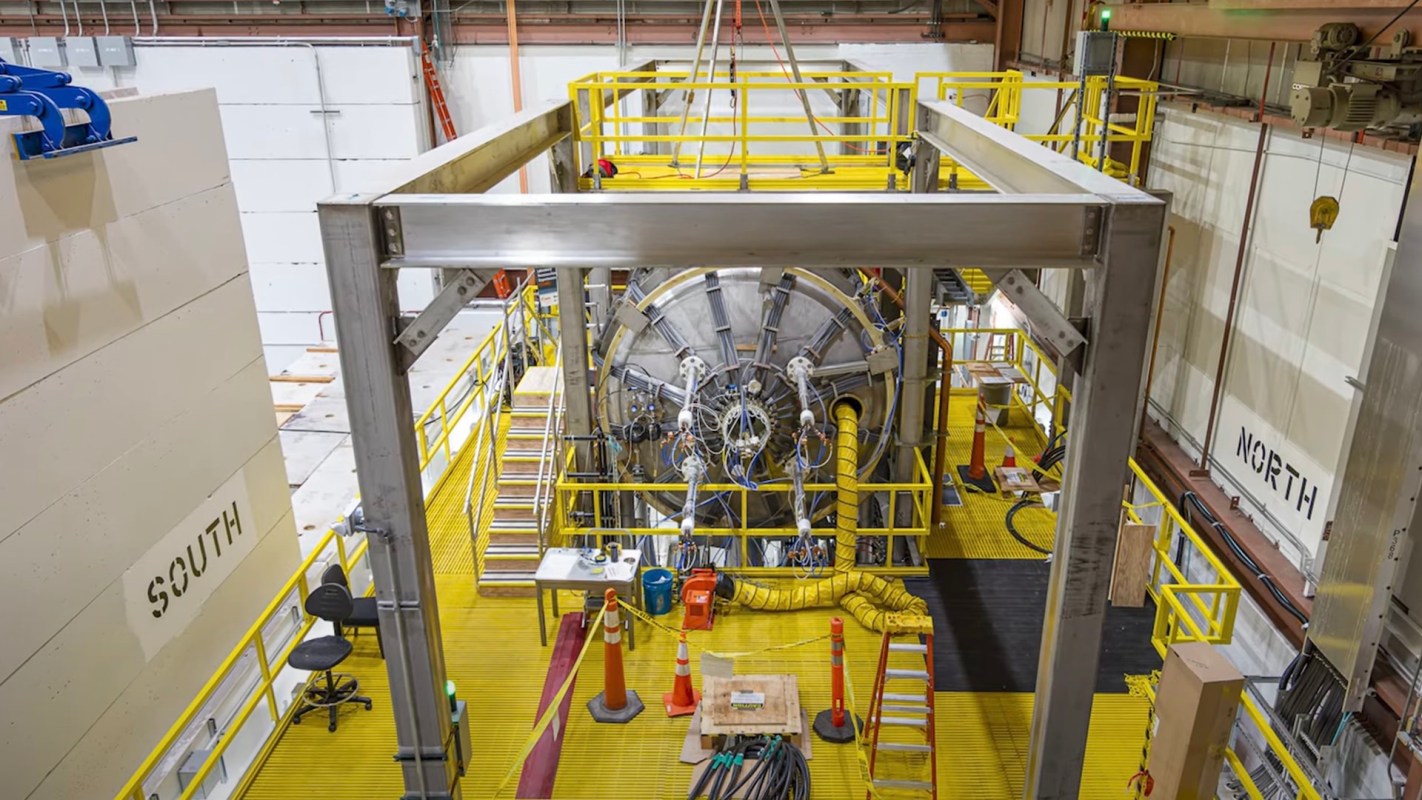
A unique device that allows scientists to study one of the most powerful forces in the galaxy just debuted at the Princeton Plasma Physics Laboratory.
The Facility for Laboratory Reconnection Experiments, which focuses on magnetic reconnection, will help researchers understand "exactly how reconnection causes solar flares and tokamak disruptions," per a PPPL news release.
"At 12 feet long, 9 feet in diameter and weighing more than 10 tons, FLARE is a first-of-a-kind, world-class facility," according to the release.
Tokamaks are doughnut-shaped fusion apparatuses that hold a future of limitless clean energy. The development of the technology is hampered, however, by magnetic reconnection, which releases charged particles. When emanating from the sun, these particles can wreak havoc on Earth's outer atmosphere, satellites, and electrical grids.
In magnetic reconnection, magnetic field lines approach each other, break apart, and rejoin in new formations, producing massive amounts of energy. FLARE will help scientists uncover information that spacecraft, high-powered computer simulations, and lab work have not revealed, principal investigator Hantao Ji said.
"It's a new way of doing research that goes beyond what is currently available," he added.
The device can discharge over 6 million joules — which could power 1,000 homes for 5 seconds — during an experiment, and it will be used to prove whether reconnection happens at multiple so-called X points simultaneously. FLARE will mimic outer space and measure how reconnection heats plasma, how much energy it takes, and how fast it happens.
"Because of limitations in research space and available energy, we haven't been able to conduct experiments to observe what happens," PPPL principal research physicist Jongsoo Yoo said. "So far, there hasn't been any hard evidence either way. We're going to change that. We believe FLARE will be the first device to show experimentally that reconnection can occur at many X points."
Expanding astrophysical and fusion plasma studies should someday help people, cities, and businesses save money via clean energy. Instead of tapping dirty energy sources that harm human health and pollute the planet, humans can reap the benefits of Earth's power.
For now, individuals will have to settle for solar panels and other infrastructure that harnesses free energy from the sun, wind, water, underground, and more. These renewables offer relief from fluctuating coal, gas, and oil prices and even sever reliance on the grid.
TCD Picks » Upway Spotlight
💡Upway makes it easy to find discounts of up to 60% on premium e-bike brands





|
Should we be harnessing the ocean to power our homes? Click your choice to see results and speak your mind. |
 Absolutely 👍
 This is especially important as rising global temperatures caused by the burning of these fossil fuels lead to increasingly severe extreme weather events. The release also noted the importance of investing in such work, as the Trump administration has slashed government spending on climate analysis and other life-saving efforts.
"By investing in long-term scientific research, the national laboratories produce results that can bolster the rest of America's science and technology sectors," Christian Newton, chief of staff at the Department of Energy's Office of Science, said, per the news release.

Join our free newsletter for weekly updates on the latest innovations improving our lives and shaping our future, and don't miss this cool list of easy ways to help yourself while helping the planet.
Cool Picks