


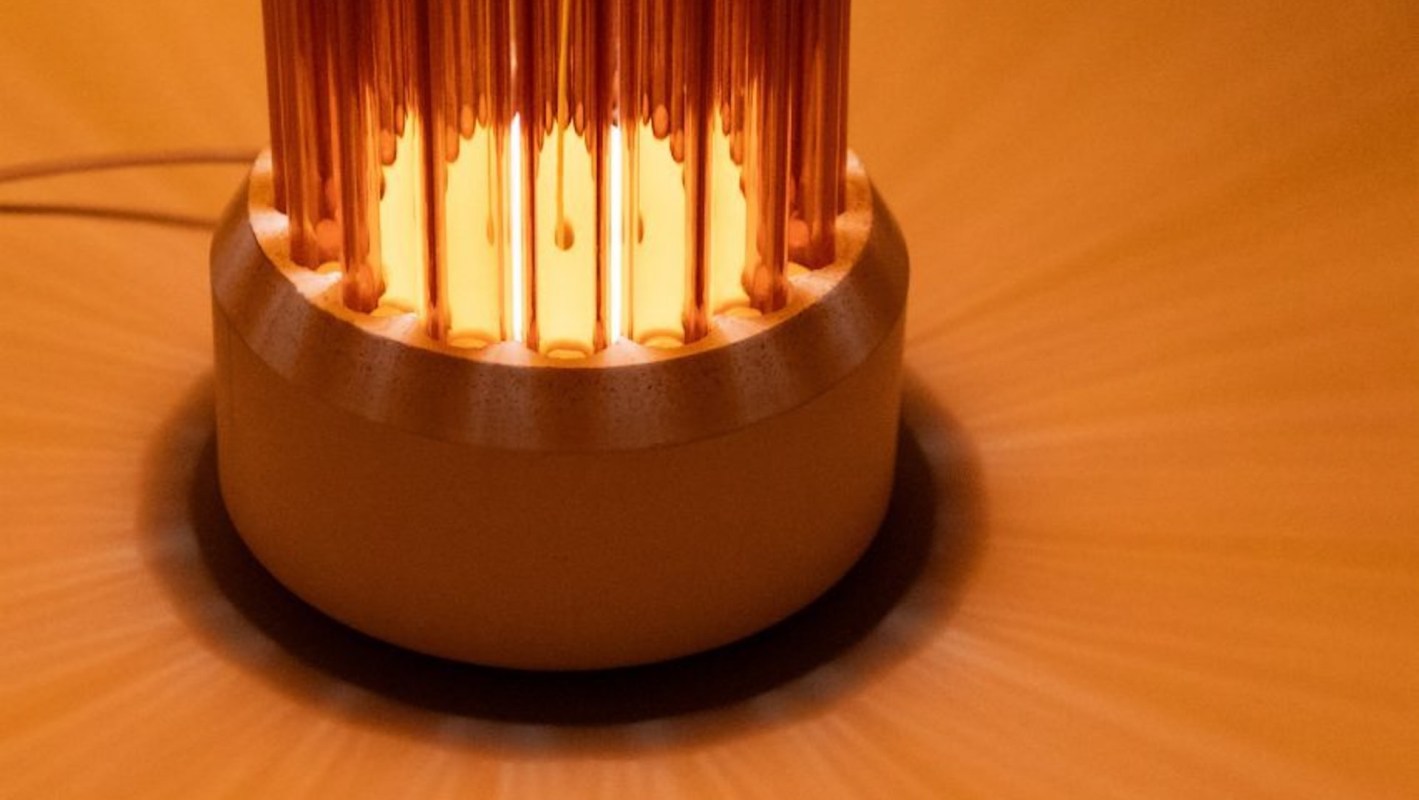
A groundbreaking lamp made with an incredible material is likely sitting on a shelf in former Irish President Mary Robinson's home.
It all started in the Massachusetts Institute of Technology Design Intelligence Lab, where a team is working on a way to simplify electronics construction with more sustainable materials. One of the early products is a modern-looking lamp with key parts embedded into it, thanks to a revolutionary process. It was gifted to Robinson when she visited campus in May to deliver a commencement speech, according to Dezeen.
The team wanted "to create more sustainable consumer electronics while also expanding the palette of materials we use to make them," lab director Marcelo Coelho told the online publication.
At issue are hard-to-recycle electronic materials that require a lot of resources and high temperatures to create, with air pollution as a by-product. The lab's invention, Geolectric, uses geopolymers instead.
"Geopolymers look and feel like ceramics, which adds a whole new material dimension to electronic products typically made from plastic or rubber," Coelho said, per Dezeen.
The inorganic ceramic-like substances can be shaped at room temperature after being mixed with an alkaline solution. This allows electronics to be placed inside them before they harden, rather than being screwed or glued into the insides of hard plastic casings, as in common products, according to an MIT news release and Dezeen.
The result includes unique touch features incorporated into Robinson's lamp and a duplicate that the lab created. Geopolymer discs cap each side of a ribbed glass tube, which shines more brightly as a hand approaches. It turns on fully with contact. The illuminators look like cylinders that could contain antimatter in a "Star Trek" episode.
"It creates a very magical experience," Coelho said, per Dezeen.
Other possibilities are even more impressive.
"One of my favorites is a kitchen counter embedded with heaters, touch interfaces, and sensors that, with the help of AI [artificial intelligence] could help and teach you how to cook," Coelho told Dezeen. "Another area we are looking at is outdoor furniture that creates new kinds of social games and interactions in the city."
TCD Picks » Upway Spotlight
💡Upway makes it easy to find discounts of up to 60% on premium e-bike brands





|
Would you live in a home with lights made of plants? Click your choice to see results and speak your mind. |
 Definitely 👍
 San Francisco's Gantri is also making unique illuminators with 3D printers and plant-based materials. In Japan, window panes that can convert low light into electricity to power lamps and other devices are in the works. The innovations are examples of cleaner alternatives to everyday tasks.
If MIT's sustainable material can replace concrete and plastics in building materials and common products, it could help to reduce significant pollution. Production fumes from the cement sector are widely reported to be responsible for 8% of planet-warming gases, and long-lasting plastic trash can linger in the environment for hundreds of years before breaking down into harmful microplastics.
While they are used for bridge parts and protective coatings, geopolymers aren't yet common because they are made differently than concrete and ceramics, requiring "some adaptation from manufacturers," Coelho told Dezeen.
But other waste-curbing solutions are readily available. Ditching single-use coffee pods and grinding your own beans gives you more control over the taste, "preserving delicate flavor compounds," according to Nebraska's Canyon Coffee Roasters. A little know-how and the right equipment can save you cash in the long run and improve your morning brew. Replacing plastic grocery bags with cloth ones will give you a tougher tote while reducing waste as well.
On the tech side, building electronics into products could be the manufacturing method of the future. The MIT lab team expects that as demand for embedded computing grows, "so does the need for sustainable alternatives that can support electronic functionality while reducing environmental impact."

Get TCD's free newsletters for easy tips to save more, waste less, and make smarter choices — and earn up to $5,000 toward clean upgrades in TCD's exclusive Rewards Club.
Cool Picks





