


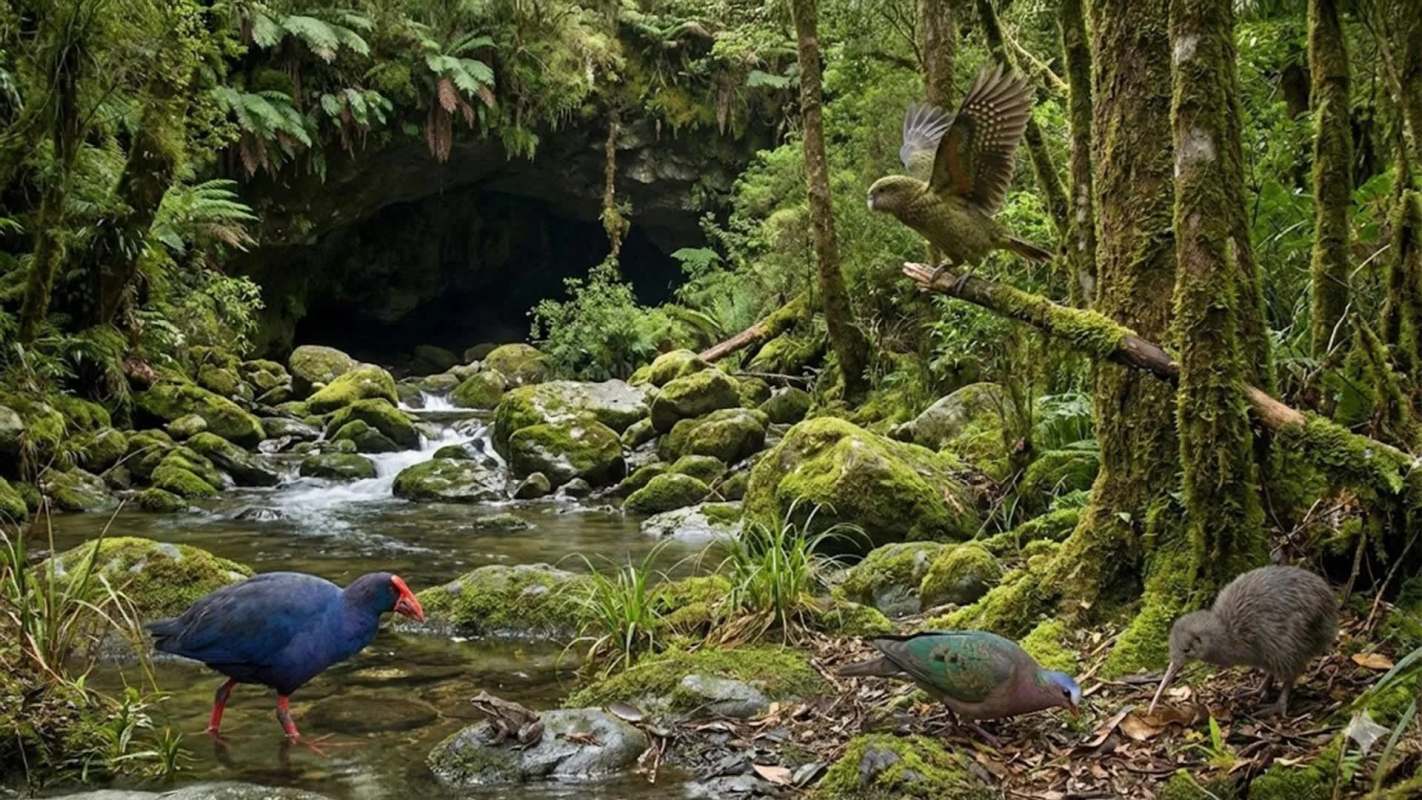
Fossils recovered from a cave in the Waitomo area of New Zealand's North Island preserve evidence of an ecosystem from about 1 million years ago, long predating any human presence.
Among the remains are ancient birds and frogs, as well as a newly identified relative of the kākāpō that may still have been capable of flight.
What happened?
Working together, researchers from Australia and New Zealand found a substantial cache of terrestrial vertebrate fossils inside the cave, including bones from 12 bird species and four frog species.
As ScienceDaily reported, the site gives researchers a first major view of this part of New Zealand's land-based wildlife from around 1 million years ago.
One of the standout species is Strigops insulaborealis. The modern kākāpō is the only flightless parrot, but this older relative appears to have had less powerful legs, may have climbed less, and could still have flown.
Trevor Worthy, lead author of the study and an associate professor at Flinders University, said the fossils indicate a bird community unlike the one people later encountered.
TCD Picks » Quince Spotlight
💡These best-sellers from Quince deliver affordable, sustainable luxury for all




"This is a newly recognized avifauna for New Zealand, one that was replaced by the one humans encountered a million years later," Worthy said.
The team also found an extinct ancestor of the takahē and a pigeon linked to Australia's bronzewing pigeons, helping close a major gap in New Zealand's fossil record.
Why does it matter?
Taken together, the fossils show that major natural disruptions were reshaping New Zealand's wildlife well before humans settled there.
The researchers estimate that roughly a third to half of species disappeared in the million years before people arrived in Aotearoa, New Zealand.
Much of the conversation about ecological loss in New Zealand has focused on the damage that followed the arrival of humans about 750 years ago. This discovery indicates that volcanic eruptions and rapid climate shifts had already been transforming habitats far earlier.
"These extinctions were driven by relatively rapid climate shifts and cataclysmic volcanic eruptions," Co-author Dr. Paul Scofield, Canterbury Museum's senior curator of natural history, said.
The findings indicate that ecosystems can change dramatically even without direct human pressure.
What's being done?
To determine when the animals lived, the team relied on an unusually precise natural dating framework.
The fossils were preserved between volcanic ash layers dated to about 1.55 million years ago and to a massive eruption around 1 million years ago, according to ScienceDaily.
Because of that geological setting, scientists now have a rare benchmark for examining how species responded to abrupt environmental change. It also suggests the site may be the oldest known cave on New Zealand's North Island.
Researchers from Flinders University, Canterbury Museum, the University of Auckland, and Victoria University of Wellington are now using the discovery to reconstruct what they describe as a "missing volume" in New Zealand's natural history.
That baseline could prove valuable for future conservation work, especially as scientists compare ancient ecosystem shifts with modern biodiversity pressures.
"These new findings cast light on the 15 million-year period from then to 1 million years ago, which is largely absent from New Zealand's fossil record," Scofield said.
Worthy added that the fossils "provide a critical, missing baseline for New Zealand's natural history."

Get TCD's free newsletters for easy tips, smart advice, and a chance to earn $5,000 toward home upgrades. To see more stories like this one, change your Google preferences here.







