


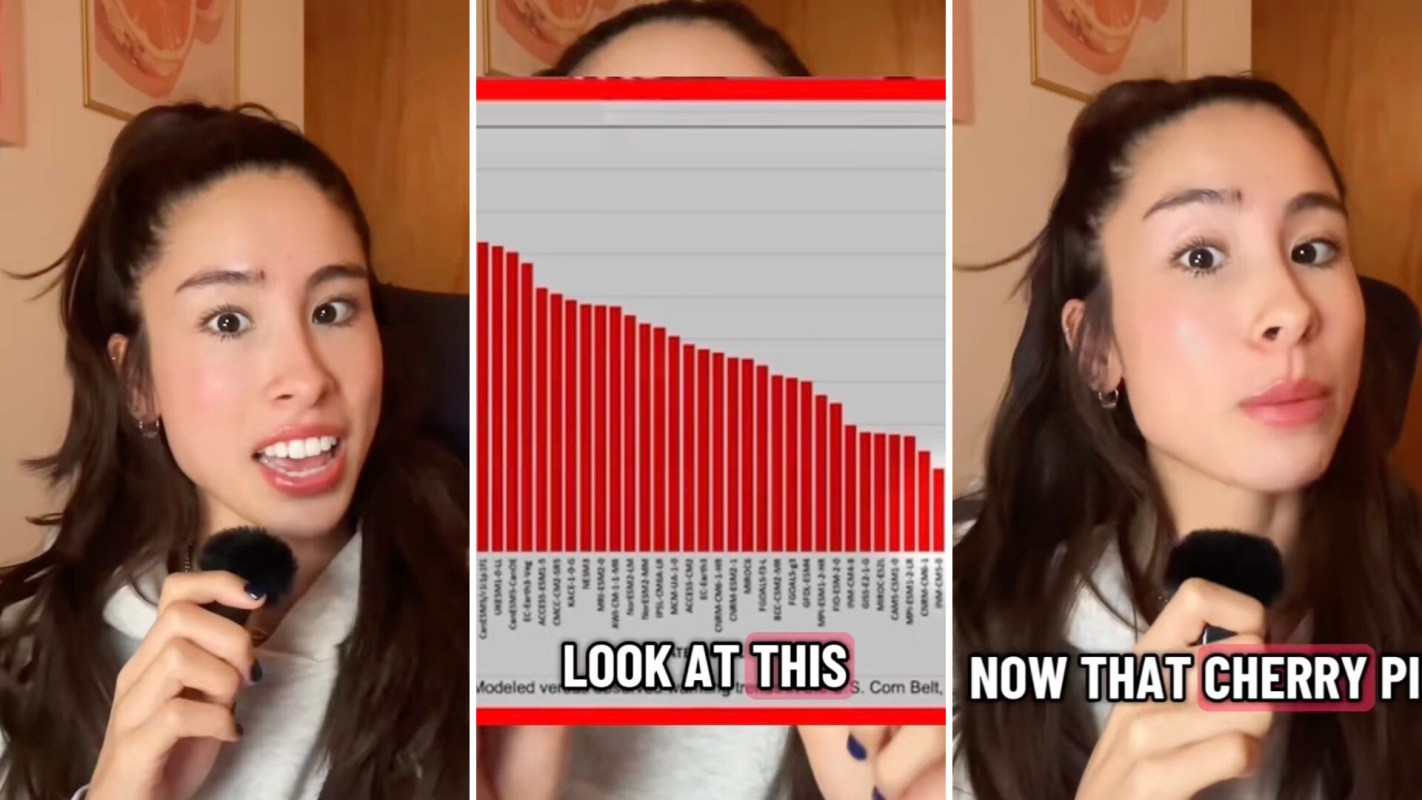
Some regions have experienced cooling trends even as the average global temperature rises — but this doesn't negate our urgent need to curb carbon pollution and limit the warming of our planet.
People who seek to refute the scientific consensus on climate change often point to falling regional temperatures to suggest that the planet isn't getting warmer.
However, as TikToker and former United Nations climate negotiator Lia Newman (@liaandtheworld) noted, these arguments tend to rely on misleading graphs and cherry-picked data.
@liaandtheworld @The Free Press and @Lucy claim that models predicted 1 degree Celsius of warming and we've only observed 0.1 so we don't have to worry about climate change. Without mentioning that she's holding a graph of the US Corn Belt and not a global average!!! 😡😡 Let's easily refute her misleading claim: 1) climate models are not tuned to predict small regional trends precisely over short timescales. It's like rolling dice - you know the average outcome but each roll varies. 2. the US corn belt is actually a known cooling hotspot. This is because of irrigation, the use of reflective crops, and aerosol pollution - so it's an exception, not the rule. The truth is climate models are scarily accurate. And cherry picked regional charts don't overturn climate science. #thefreepress #takedown #factcheck #climate ♬ original sound - liaandtheworld
In a TikTok series debunking inaccurate claims about climate science, Newman examined a graph showing that temperatures in the U.S. Corn Belt increased less between 1973 and 2022 than climate models had predicted.
As Newman explained, the graph isn't wrong — but it doesn't show the full picture, either.
"This is a graph specifically on the U.S. Corn Belt, one small region over a short time period, using that to say global climate trends are wrong," Lia said. "That's just not how climate models work and is deeply dishonest."
The Corn Belt has long been an anomaly in the warming trend, with some scientists calling it a "warming hole."
As climate scientists Zachary Labe told Wisconsin Public Media, warming ocean temperatures have likely contributed to increased precipitation in the Midwest.
This increased rainfall is helping regional temperatures stay relatively low during the daytime.
"It's an outlier case and doesn't prove that climate models are wrong," Newman said. In the video description, she added, "The truth is climate models are scarily accurate."
TCD Picks » Quince Spotlight
💡These best-sellers from Quince deliver affordable, sustainable luxury for all




|
Do you think America has a plastic waste problem? Click your choice to see results and speak your mind. |
 Definitely 👍
 Global climate models predict that rising temperatures will lead to changes like intense storms and devastating droughts that could damage infrastructure and threaten our food supply.
These risks make it all the more important to learn the science of the changing climate so that we can all take steps to reduce our environmental impact and ensure a safer, cooler future for all.

Get TCD's free newsletters for easy tips to save more, waste less, and make smarter choices — and earn up to $5,000 toward clean upgrades in TCD's exclusive Rewards Club.
Cool Picks





