


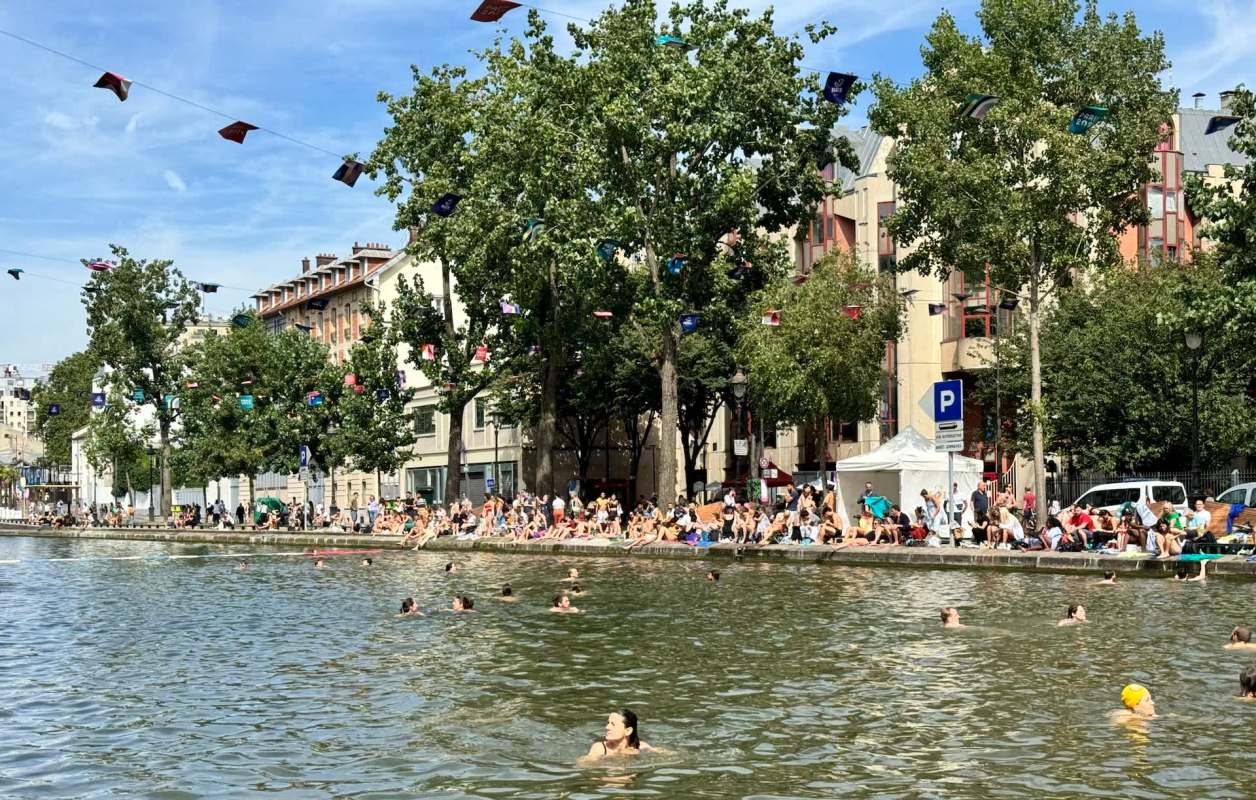
With the Paris region approaching 86 degrees Fahrenheit, people in homes without air conditioning were forced to cobble together their own ways to cool down, according to Al Jazeera.
The latest heat wave has also highlighted how uneven access to cooling remains for lower-income renters in and around Paris.
What's happening?
Residents in Saint-Denis, north of Paris, told Al Jazeera they were taking whatever relief they could get. Ibrahim Doukanthi, who grew up in the area and now lives in La Plaine, said he sometimes goes into the Canal Saint-Denis to cool off, even though swimming there is not officially allowed.
Inside his home, Doukanthi said to Al Jazeera, "What I do is take the spray bottles – I call them 'pshit-pshit' – fill them with water, spray myself down, then sit in front of the fan."
Some residents said they did not even have access to those limited workarounds. Louiza Ammari, a childcare worker living in social housing, said a municipal pool's clothing rules stopped her from going. Her family also isn't allowed to install an inflatable children's pool or air conditioning.
"We really have nothing to cool off with," Ammari said.
TCD Picks » Quince Spotlight
💡These best-sellers from Quince deliver affordable, sustainable luxury for all




The impact has reached far beyond discomfort. France's public health agency said the heat wave during the week of June 22 was associated with 2,025 excess deaths, a week-over-week increase of 30% nationwide and 62% in the Paris region.
Why does it matter?
Experts cited by Al Jazeera said extreme heat does the most damage in places where people are packed into overcrowded, poorly insulated housing and have limited access to green space or affordable places to cool down.
Bruno Villalba, a political science professor at AgroParisTech Paris-Saclay, said to Al Jazeera, "The heat wave is merely a symptom of social vulnerability, particularly in terms of housing."
Mael Ginsburger, a sociology professor at Université Paris-Cité, made a similar point: "We are not all equally exposed, just as we are not all equally responsible."
As extreme weather disasters intensify, so do the threats to people's health and finances. Severe heat can increase the risk of heat illness, dehydration, and death while adding pressure to public buildings.
It can also make safe work more difficult, raise household spending on cooling and medical care, and worsen financial instability for families already living paycheck to paycheck.
Housing makes that divide especially clear. As Al Jazeera stated, Ginsburger's research found that 70% of higher-income households in France say their homes are adequately insulated for heat, compared with 46% of lower-income households.
For people without housing, the threat can be even greater, since hot pavement and elevated nighttime temperatures offer little relief.
What's being done?
Some local responses are already underway, including free swim hours at one municipal pool and the standard heat wave measures of temporary water stations and additional shelters. Even so, critics say those short-term responses fall well short of the scale of the problem.
Paul Alauzy, with Médecins du Monde, or Doctors of the World, said to Al Jazeera, "Once again, the authorities are stubbornly resorting to reactive, weather-dependent management."
Experts also pointed to wider fixes, including better home insulation, more public cooling spaces, and more trees and green areas in dense neighborhoods.

Get TCD's free newsletters for easy tips, smart advice, and a chance to earn $5,000 toward home upgrades. To see more stories like this one, change your Google preferences here.






