


!["A health-conscious government would discourage/ban such [advertisements].”](https://www.thecooldown.com/wp-content/uploads/2025/09/surrogate-advertisingimage-recZz5zTf9X0si6b3.jpg?w=1920&h=800)
A simple train ride became the source of tremendous frustration for a passenger in India, who noticed every seat was covered with controversial advertising.
The passenger expressed their anger in the r/indianrailways subreddit. They also shared a photo of the ad, which was plastered on each seat of the Shatabdi Express train.
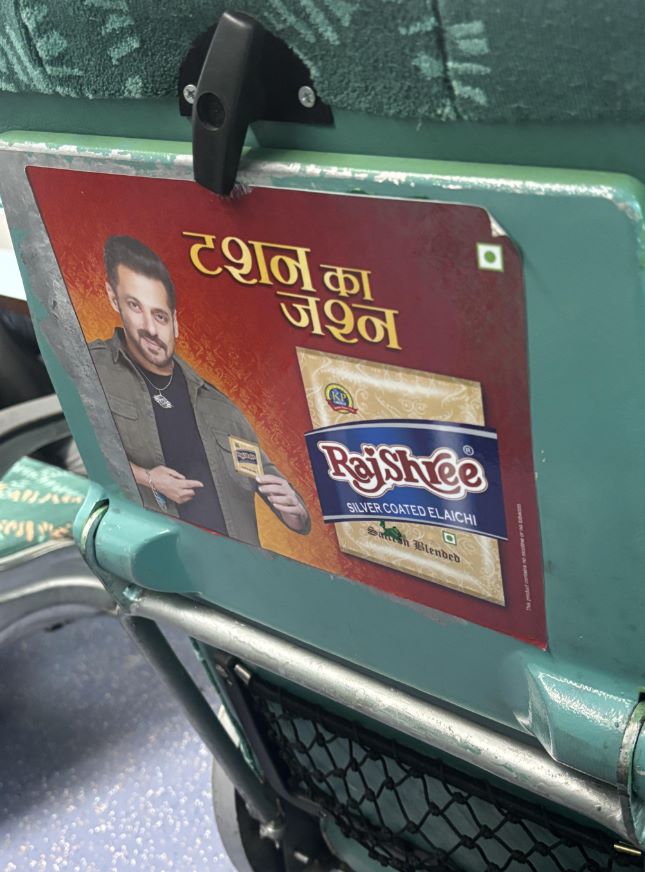
The ad shows Bollywood star Salman Khan promoting Rajshree Silver Coated Elaichi, a cardamom "mouth freshener".
But this also appears to be a case of surrogate advertising, a popular technique used by tobacco companies, like Rajshree.
Direct advertising of tobacco and alcohol products is banned in India, but companies that produce those products get around the law by advertising other products that may be similar but are legal to advertise, and which still get the brand's name out to the public.
"We talk about youth empowerment, mental health, and addiction awareness, but then we let these companies buy every inch of public space and stuff our faces with poison," the post said. "It's in buses, trains, cinema halls, paan shops, TV ads, YouTube. It's everywhere."
According to the Global Action to End Smoking, more than 250 million people used tobacco in India in 2022, making it the country with the second-highest number of tobacco users globally.
Not only does that use take a toll on people's health — smoking can lead to cancer, heart disease, lung disease, and more — but it also has a considerable environmental impact.
Smoking releases toxic, polluting fumes into the air, and cigarette butts are one of the most commonly littered items, adding to the amount of waste that ends up in our soil and oceans.
The photo also showed just how prevalent advertising has become. Not only is it on billboards, in magazines and on TV shows, but it's also now on the back of train seats, on public beaches, and even in the middle of traffic jams.
TCD Picks » Quince Spotlight
💡These best-sellers from Quince deliver affordable, sustainable luxury for all




|
Should companies be required to help recycle their own products?
Click your choice to see results and speak your mind. |
 Definitely 👍
 This all promotes a culture of consumerism, which results in more products being sold and produced, which ultimately results in more heat-trapping pollution being created from the manufacturing process and likely disposal.
"Tear it down," one commenter wrote.
"Crony capitalism," another added. "A health-conscious government would discourage/ban such [advertisements]."

Join our free newsletter for good news and useful tips, and don't miss this cool list of easy ways to help yourself while helping the planet.
Cool Picks






