


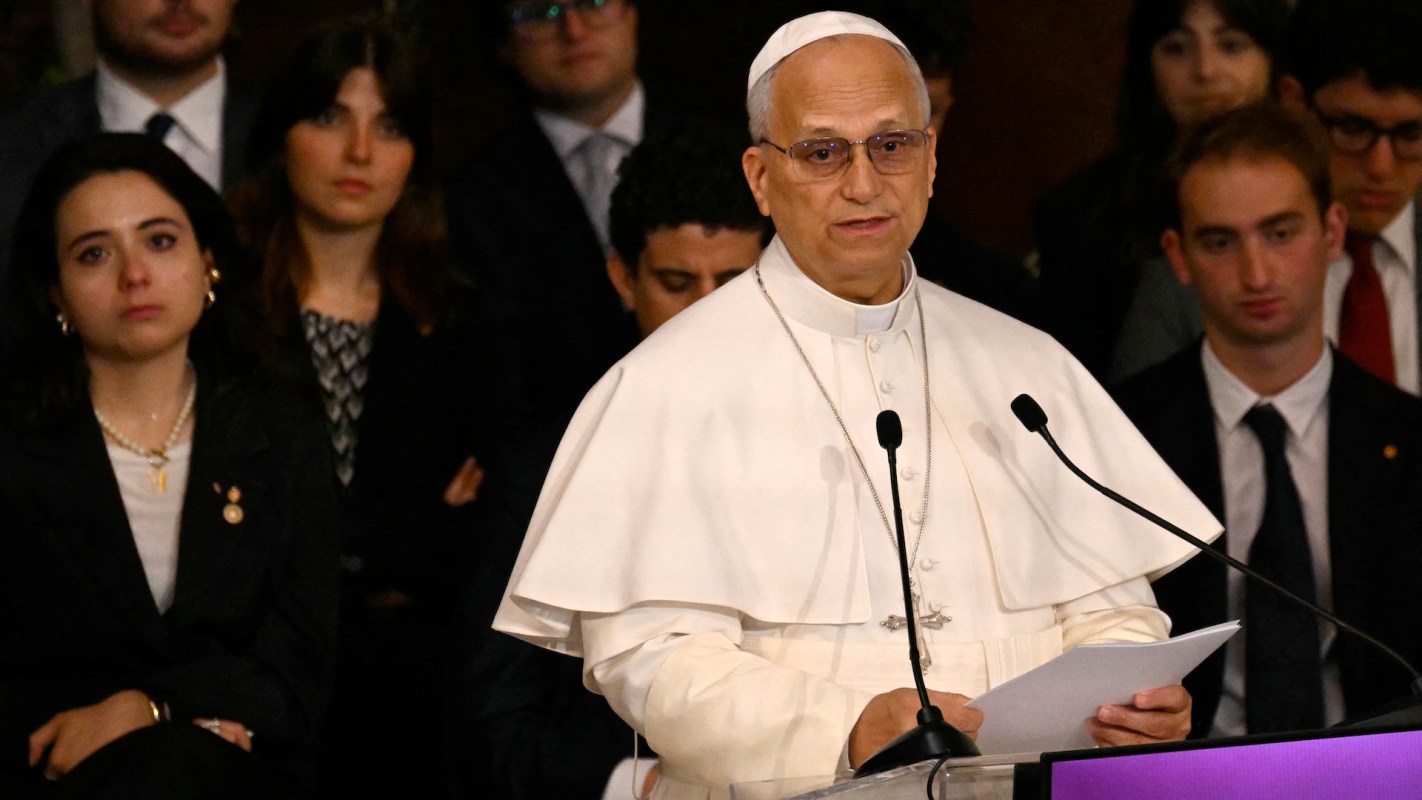
Pope Leo XIV is warning that artificial intelligence is making warfare more dangerous and says AI-guided weapons are pushing the world toward what he calls a "spiral of annihilation."
Speaking on May 14 at Rome's La Sapienza University, the pontiff said the rapid expansion of military AI — combined with rising defense spending — is putting human life, public services, and basic ethical boundaries under growing strain.
What happened?
Addressing students and faculty at Europe's largest university, Pope Leo XIV criticized AI's expanding role in warfare and called for closer scrutiny of how the technology is built and used in military and civilian settings.
According to The Next Web, he pointed to the wars and violence in Ukraine, Gaza and the Palestinian territories, Lebanon, and Iran as signs that combat is becoming increasingly "inhuman" as advanced technologies are integrated into war. His warning was clear: AI must not be allowed to create distance between people and responsibility for life-and-death decisions.
The pope also took aim at European governments for increasing military budgets while education and healthcare remain under pressure. His comments come as defense spending across Europe has risen sharply. The Stockholm International Peace Research Institute says military outlays among European NATO members rose 14% in 2025 to $864 billion, the fastest growth since 1953.
The speech was notable for another reason: It marked the first papal visit to La Sapienza since 2008, when Pope Benedict XVI scrapped a planned appearance after protests, according to The Next Web. Pope Leo was reportedly warmly received.
TCD Picks » Quince Spotlight
💡These best-sellers from Quince deliver affordable, sustainable luxury for all




Among those in attendance were 72 young Palestinians who arrived in Italy last week from Gaza via a humanitarian corridor arranged by the Diocese of Rome, the Sant'Egidio Community, and the university. They will study there with scholarship aid and support.
Why is AI warfare concerning?
The pope's warning lands at a moment when AI weapons are no longer hypothetical. Autonomous drones, AI-assisted targeting systems, and surveillance tools are already reshaping warfare. Critics argue that as machines take on a larger role in combat, the danger is not just escalation but also fading accountability — especially if humans become more willing to let software make deadly decisions.
That concern extends well beyond the Vatican. Researchers, ethicists, and arms-control advocates have long warned that autonomous weapons could make wars move faster, become less transparent, and grow harder to control. Even so, there are still no binding global rules that fully prevent machines from selecting and attacking targets without meaningful human oversight.
There is also the broader issue of resources. AI depends heavily on physical infrastructure, especially the energy grid. Training and operating advanced systems require vast amounts of electricity, large data centers, and often significant water for cooling.
AI can improve grid management, forecast demand, and help wind and solar systems run more efficiently. But it can also strain power supplies, increase water use, create security vulnerabilities, and raise energy costs when growth outpaces infrastructure. Paired with military buildup, critics warn, that risks funneling more money into energy-intensive systems while neglecting schools, hospitals, and resilient public services.
In that sense, Pope Leo's remarks were about more than war. They were about priorities: what societies choose to fund, what they choose to regulate, and whether technology is being shaped to serve people — or the other way around.
What's being done about AI weapons?
The Vatican is attempting to take a larger role in the debate over AI ethics. Just days after Pope Leo's speech, it announced a new Interdicasterial Commission on Artificial Intelligence to examine how AI is affecting humanity. The church has also continued building on its 2020 Rome Call for AI Ethics, a framework supported by major tech companies and the U.N. Food and Agriculture Organization that emphasizes transparency, accountability, and human agency.
Elsewhere, policymakers and advocates are pressing for stronger safeguards. The European Union's AI Act includes protections for some high-risk systems, and U.N. talks on autonomous weapons are ongoing, though progress has been slow. Many experts are calling for clear red lines to ensure humans remain in control of lethal decisions.
AI has the potential to help solve real-world problems, from strengthening clean energy networks to improving essential systems. But without meaningful guardrails, it can also deepen inequality, strain resources, and amplify harm at enormous speed. The pope's message was a reminder that the future of AI is still being shaped — and that the outcome will affect far more than the battlefield.

Get TCD's free newsletters for easy tips, smart advice, and a chance to earn $5,000 toward home upgrades. To see more stories like this one, change your Google preferences here.






