


Even as turmoil in the Middle East has caused global energy prices to spike, one region has decided to place new restrictions on the development of renewable energy.
On the island of Jersey in the English Channel, lawmakers passed legislation making it more difficult to install solar panels on agricultural land, according to the BBC.
"In short, my position is that Jersey fields should be kept for agriculture," said Montfort Tadier, a Jersey politician.
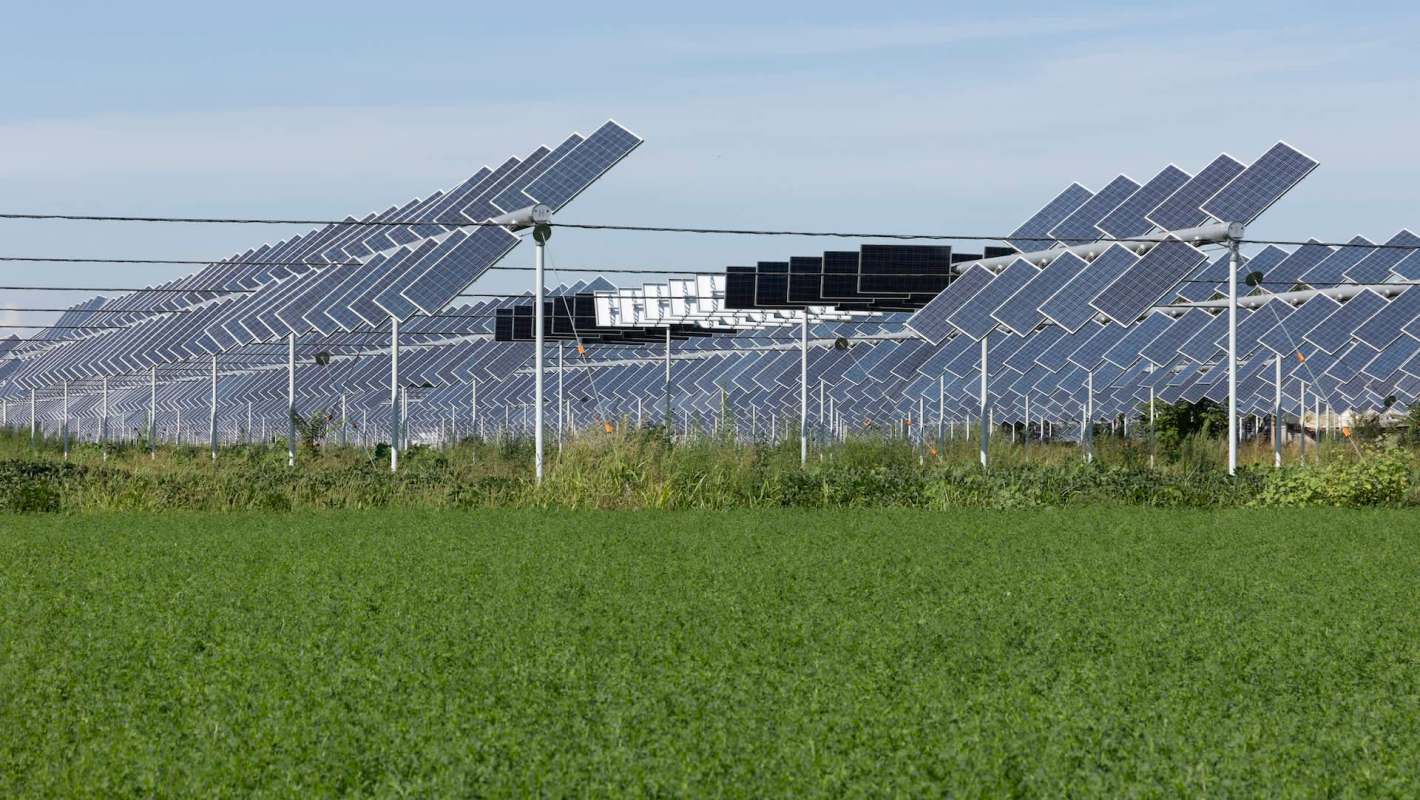
It's unclear if Tadier fully grasped that solar panels on agriculture land typically mean the panels are raised up and spaced out so that plants can still grow or farm animals like sheep can still graze underneath, actually providing doses of shade from the hot sun for both rather than obstructing that sunlight.
That said, Tadier did amend the proposition to allow for solar panels on agricultural land in "exceptional circumstances," the BBC said.
What's happening?
The move came even as pilot programs and demonstration farms around the world have made huge strides toward effectively commingling solar panels with agricultural practices such as growing crops and raising livestock.
By combining solar energy production with agriculture, the same land can be used to generate both electricity and food, two essential commodities. Further, such practices can make the land more profitable for owners.
The practice is known as "agrivoltaics," a combination of "agriculture" and "photovoltaics." As agrivoltaics has become increasingly common, researchers and farmers have discovered that it can both increase efficiency and decrease costs.
For example, one landowner found that by allowing sheep to graze amid solar panels, he could save money on landscaping and maintenance costs. The solar panels also provided covered areas where the sheep could escape the sun or rain.
Similarly, studies have found that certain crops actually grow better when planted in the space around solar panels.
TCD Picks » Quince Spotlight
💡These best-sellers from Quince deliver affordable, sustainable luxury for all




|
Which of these savings plans for rooftop solar panels would be most appealing for you?
Click your choice to see results and earn rewards to spend on home upgrades. |
 Save $1,000 this year 💸
 However, despite growing recognition of the benefits of agrivoltaics, lawmakers in Jersey decided to make it more difficult for landowners to install solar panels on their property.
Why are agrivoltaics important?
As energy and food prices continue to go up, seemingly without end, agrivoltaics present a relatively simple solution that addresses both issues. By allowing landowners to simultaneously produce both electricity and food, agrivoltaics makes land more productive and can increase the income of both farmers and the owners of large-scale solar arrays.
As the new rules imposed in Jersey show, though, solar panels still face strong opposition in some areas.
Ironically, locally produced, renewable sources of power would seem to make the most sense in places such as the island of Jersey. Jersey receives 95% of its power from France via three large undersea cables, according to Jersey Electricity.
Proponents of the new restrictions have framed their opposition to solar panels as a choice between electricity and food.
"If we are to be more environmental and more sustainable, we should be looking first and foremost to being more self-sufficient in terms of food," said Tadier, the Jersey politician, as quoted by the BBC. "Food security remains a critical area for us."
However, as agrivoltaics becomes increasingly common, more and more people are realizing that solar panels and food production are not necessarily mutually exclusive.
What's being done about agrivoltaics?
Spreading awareness of the benefits of agrivoltaics can help to dispel myths that one must choose between using land for solar energy or food production.
As research continues to identify the optimal ways to combine solar panels with crops and livestock, agrivoltaics will become more efficient at generating both electricity and food. This will be a rare "win-win" for property owners and local communities.

Get TCD's free newsletters for easy tips to save more, waste less, and make smarter choices — and earn up to $5,000 toward clean upgrades in TCD's exclusive Rewards Club.
Cool Picks




