


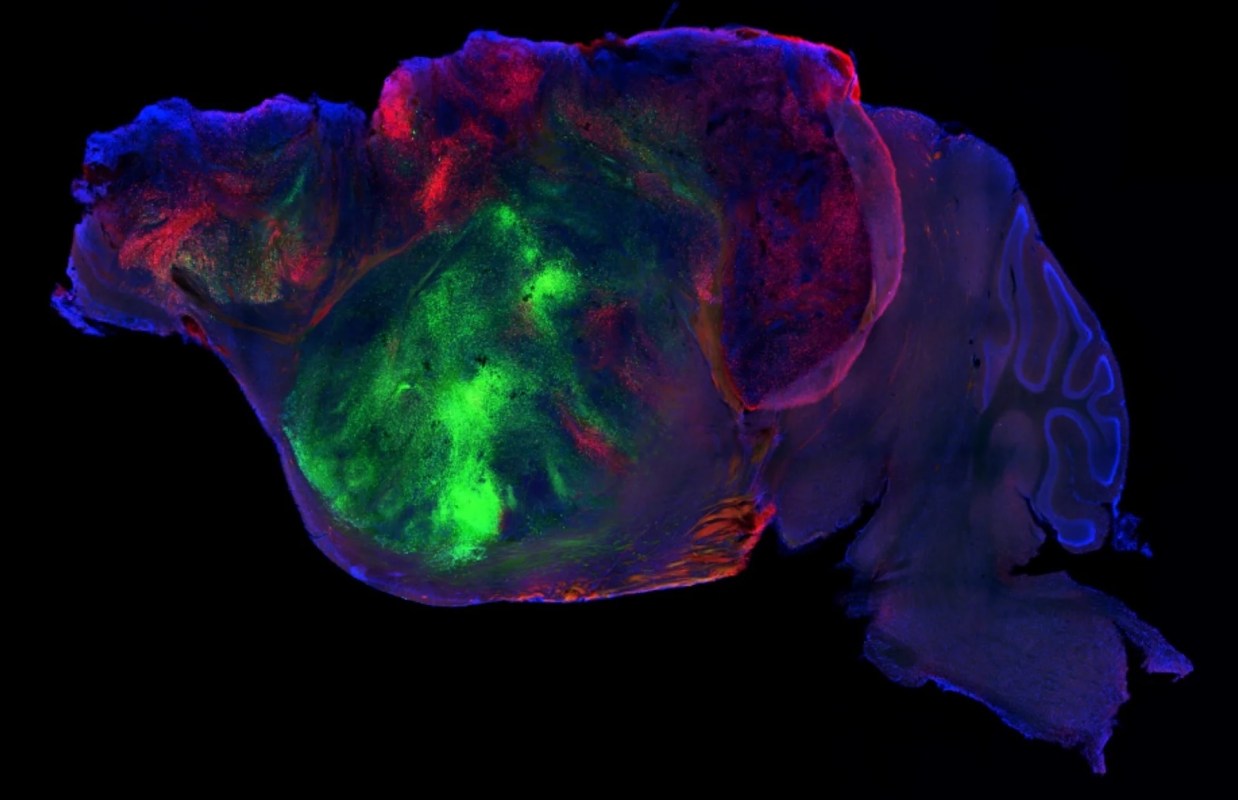
A team in California has built a modified lab mouse by filling part of a mouse brain engineered to lack much of its cortex with millions of human neurons grown in the lab, creating a potentially better model for studying serious brain disorders.
If the approach holds up, researchers could examine human brain development and disease in living animals whose neural behavior is closer to ours than that of standard mouse models.
Here's what to know
As reported by NPR, Sergiu Pașca, professor of psychiatry and behavioral sciences at Stanford University, and his team created mice missing much of the cerebral cortex and placed human cortical neurons into the resulting space. The findings were published in Nature.
Pașca said the strategy addressed a longstanding obstacle: Human neurons mature far more slowly than mouse neurons, so in earlier transplant experiments, the mouse brain often completed much of its wiring before the human cells could integrate.
"This is not going to replace all the models we had before, but it's going to provide us access to other aspects of human brain function that would be very difficult to study otherwise," he said.
Compared with mice left with depleted brains, the transplanted animals did better on memory tests and social behavior. In those experiments, about 4 million human neurons were added in place of roughly 14 million mouse neurons, and over weeks to months the implanted cells expanded.
TCD Picks » Quince Spotlight
💡These best-sellers from Quince deliver affordable, sustainable luxury for all




That kind of model could help researchers investigate disorders associated with disrupted brain development or brain injury, including cerebral palsy, intellectual disability, and epileptic encephalopathies.
The work is not a treatment itself, but it may improve how future therapies are designed and tested.
More background
Importantly, the implanted neurons seemed to do more than simply survive in the animals; they appeared to contribute meaningfully to brain function.
One example, Pașca said, was the mice's response to oxygen deprivation. Unlike ordinary mice, they showed a vulnerability that looked more human.
That could make the animals more useful for studying conditions in which low oxygen is a factor. Scientists have long wanted models that more closely reflect human biology, especially because drugs that look promising in animals often fail in people.
The research also highlighted how flexible the developing brain can be. Hongkui Zeng, executive vice president and director of brain science at the Allen Institute, said the cortex-depleted mice were more capable than expected.
"Surprisingly, the animal can adapt," she said. "It's incredible to see that."
The researchers stressed, however, that this should not be mistaken for a human brain inside a mouse. The added neurons did not organize into a normal layered cortex, and the study ended before the human cells reached a developmental point associated with a hallmark of consciousness.
What's being done?
The researchers said ethical limits were part of the project from the outset.
Nita Farahany, professor of law and philosophy at Duke Law who served as an unpaid member of an external ethics board for the project, said some boundaries were intentionally built in, including stopping the study before the human neurons matured further.
If similar methods are tried in larger, longer-lived animals such as pigs or non-human primates, that kind of oversight could become even more important.
Zeng said the stakes rise as implanted human neurons survive longer and form more elaborate circuits: "The ethical issues also become a lot bigger, more serious as well."
Better disease models could eventually help researchers develop safer, more effective therapies, but institutions may also need clearer rules about what kinds of experiments society is willing to accept.
"Hopefully, it will be incredibly powerful for tackling questions of disease and developing therapeutics," Pașca said.
At the same time, Farahany cautioned, "This brings us into new gray areas for which there are not clear ethical guidelines or norms."
Where can I learn more?
These studies help explain why researchers are pushing for brain models that more closely reflect human tissue. PFAS, air pollution, and microplastics are all being tied to brain changes and neurological risk, which makes the shortcomings of standard animal models harder to ignore.
• PFAS exposure suggested greater male-brain vulnerability to behavioral disruption in mice.
• Scientists linked air pollution to brain health risks and neurological disease.
• Researchers examining autopsied tissue found a disturbing number of microplastics in human brains.
• New evidence suggested microplastics are impacting our bodies in ways that may reach the brain.
• Scientists warned that microplastic contamination in human brains appears to be increasing over time.

Get TCD's free newsletters for easy tips, smart advice, and a chance to earn $5,000 toward home upgrades. To see more stories like this one, change your Google preferences here.






