


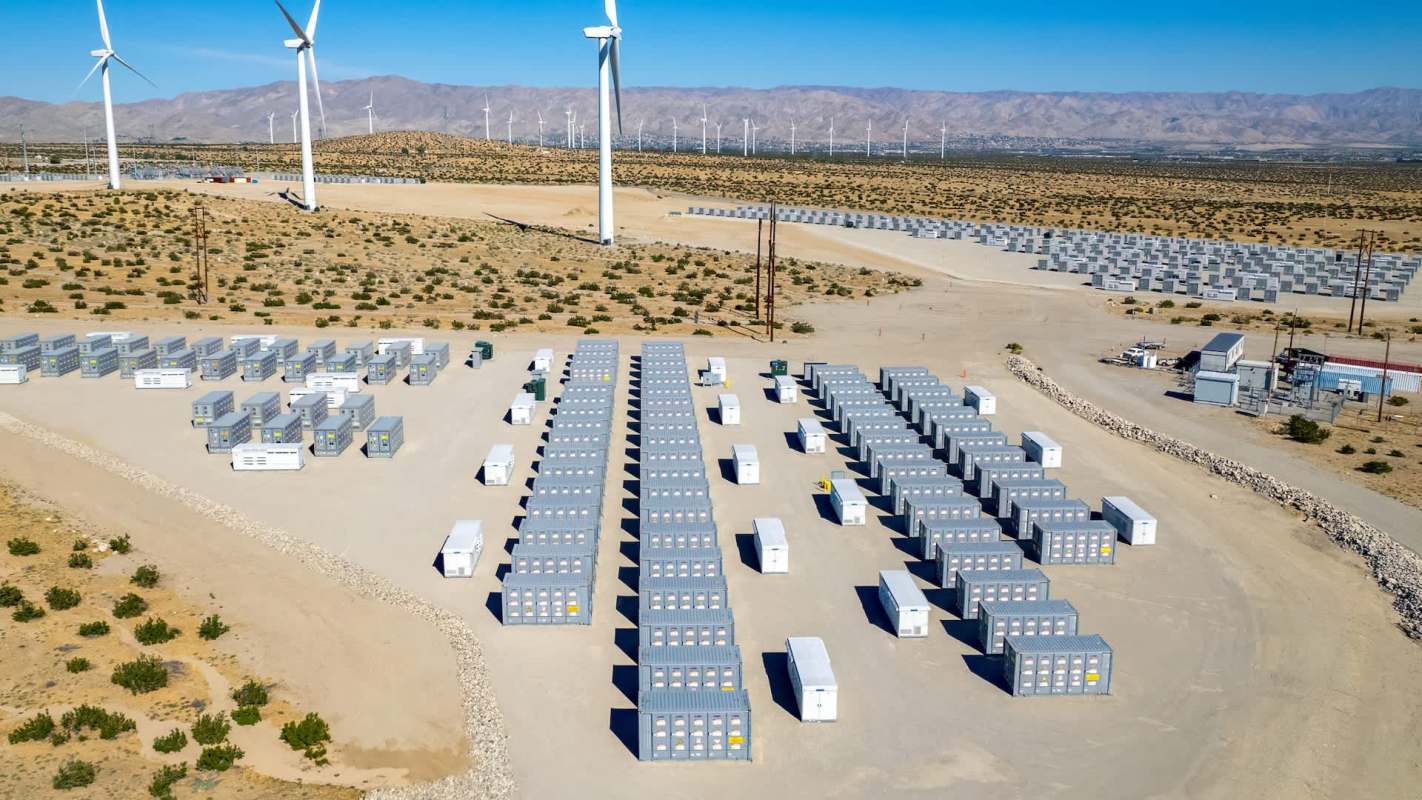
Statewide energy storage tied to California's grid surpassed 21 gigawatts, according to the California Energy Commission.
At that scale, California's battery network ranks among the biggest in the world, with stored capacity equal to about one-third of demand during the grid's most strained periods.
Here's what to know
Battery storage serving California was below 700 megawatts when Gov. Gavin Newsom took office in 2019. The CEC told Solar Power World that the statewide total reached 21,112 MW — an increase of over 2,500% in roughly seven and a half years.
During the September 2022 heat wave, California's peak demand rose above 63,000 MW. Against that kind of load, batteries are no longer a backup tool — they are an important part of supplying power when air conditioning, lighting, and appliances are all in heavy use.
Nearly 16,000 MW of the total comes from 310 utility-scale battery projects. Large battery installations in Nevada and Arizona that are connected to the California Independent System Operator grid add about 2,000 MW, and more than 3,000 MW comes from upward of 300,000 smaller batteries at homes, schools, farms, businesses, and industrial sites, according to Solar Power World.
Newsom framed the expansion as both an economic and energy-security strategy.
TCD Picks » Quince Spotlight
💡These best-sellers from Quince deliver affordable, sustainable luxury for all




"California is showing the world what real economic security looks like," he said, per Solar Power World. "It's one that can't be held hostage by foreign conflicts and Big Oil. The Golden State is leading the charge on building a reliable, affordable clean future."
Why does this matter?
Batteries can store daytime solar power and release it after sunset, reducing the need to fire up gas peaker plants. That can make the grid cleaner while also improving reliability during periods of high demand and extreme weather.
From January through June, Californians relied on solar more than natural gas for the first time. The CEC found that solar use over that span was 22% higher than in the same months of 2024, while natural gas use fell 51%, and battery capacity on the grid increased 80%, Solar Power World reported.
A grid with more storage can better smooth out supply swings, reduce reliance on expensive fossil-fuel generation, and improve resilience during heat waves or outages. Smaller batteries at homes, schools, and businesses can also provide local backup power and help customers get more value from rooftop solar.
What's being done?
The state said batteries will be critical if California is to hit its 2045 goal of fully clean retail electricity sales. By that point, officials project the need for more than 52,000 MW of battery and long-duration storage, and California said it has already achieved 41% of that total, per Solar Power World.
California has added more than 37,000 MW of clean and renewable resources to the grid since 2019. Data through the end of 2024 showed clean energy accounted for 67% of retail electric sales, and clean resources met 100% of CAISO grid demand for at least part of the day on 279 days in 2025, the outlet noted.
The CEC's Opt-In Certification Program cleared 1,850 MW of battery storage and 1,450 MW of solar generation, with more than 3,000 MW awaiting approval. The projects are subject to environmental and safety review and include agreements meant to deliver benefits to the communities hosting them.
"California has always prioritized innovation, investing in the science and technology of the future and advancing the goalpost on what is possible," CEC Chair David Hochschild said. "Seeing solar surpass gas on the grid is proof that our vision of a 100% clean energy future is absolutely possible."

Get TCD's free newsletters for easy tips, smart advice, and a chance to earn $5,000 toward home upgrades. To see more stories like this one, change your Google preferences here.






