


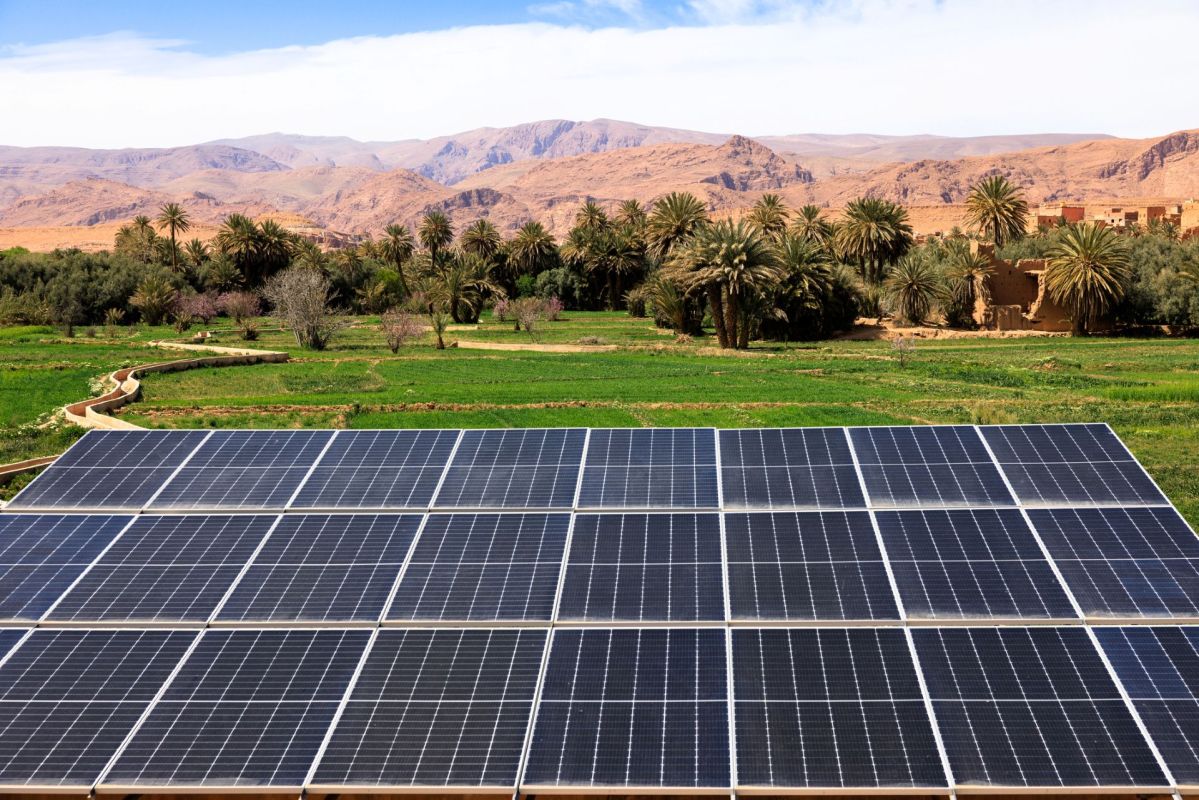
Africa's solar expansion increasingly involves more than adding panels. Several of the continent's biggest economies are also trying to make more of that equipment domestically.
As The Jazari Kual Show (@thejazarikualshow) broke down, one major supply-chain challenge remains, even as that shift could help expand access to cleaner, cheaper power in the continent.
What's happening?
In a TikTok explainer posted on August 10, content creator Jazari Kual provided an update on Africa's growing solar industry.
@thejazarikualshow Some of Africa's largest economies are trying to manufacture more solar equipment at home as demand for renewable energy grows across the continent. South Africa, Nigeria, Morocco and Ethiopia are expanding or pursuing domestic solar manufacturing. South Africa's Eskom plans a 1-gigawatt manufacturing facility, while Nigeria's local panel assembly capacity has grown from about 120 megawatts to roughly 300 megawatts in two years. But there is still a major dependency. Africa has essentially no commercial-scale production of the solar cells used inside panels, meaning many locally assembled panels still rely on components imported from China. #Africa #SolarPower #SolarEnergy #AfricaNews #FYP #TheJazariKualShow ♬ original sound - The Jazari Kual Show
"Some of Africa's largest economies are trying to manufacture more solar equipment at home as demand for renewable energy grows across the continent," Kual wrote in the caption.
The creator identifies South Africa, Nigeria, Morocco, and Ethiopia as part of that manufacturing push. He cites Nigeria's local panel assembly capacity rising from about 120 megawatts to roughly 300 megawatts in two years, while South Africa's Eskom is planning a 1-gigawatt facility.
The developments point to a broader shift for the continent. Rather than only purchasing solar technology, countries are also trying to build parts of the supply chain themselves. For a fast-growing region where electricity access and grid reliability remain major concerns, that is a notable development.
TCD Picks » Quince Spotlight
💡These best-sellers from Quince deliver affordable, sustainable luxury for all




But domestic assembly does not solve every supply issue. The video notes that many locally built panels still depend on imported parts. Kual notes that these countries are still heavily reliant on China for the solar cells that are responsible for converting sunlight into electricity.
He adds that Chinese companies dominate these markets, and also have excess supply for their domestic customers. Thus, Africa is a prime export market.
Why does it matter?
Solar manufacturing can shape how affordable, available, and resilient clean energy becomes. If more equipment is made closer to where it is ultimately installed, countries may be better positioned to avoid shipping delays, trim some costs, and create local jobs.
More solar capacity can help households and businesses gain access to more reliable electricity, especially in areas where power grids are strained or where expensive fuel imports push up costs.
It can also help reduce pollution tied to fossil-fuel power generation. One unresolved vulnerability is solar-cell supply. Without commercial-scale local cell production, countries that assemble panels domestically still remain tied to foreign supply chains.
Africa's solar ambitions are expanding, but the continent has not yet captured the highest-value segment of the manufacturing process.
What's being done?
The countries mentioned in the video are building assembly capacity and manufacturing know-how, even if full solar-cell production comes later. That can still strengthen local industries and help lay the groundwork for deeper investment.
The opportunity is growing, but so is the challenge.
"For now, even many panels labeled as locally manufactured still depend on Chinese technology underneath," Kual concludes in the video.
If you're thinking about solar for your own home, EnergySage can help you curate competitive bids from local installers without any of them getting your contact information unless you choose to work with one further. For consumers, that can make it easier to compare costs and find a system that lowers monthly energy bills.

Get TCD's free newsletters for easy tips, smart advice, and a chance to earn $5,000 toward home upgrades. To see more stories like this one, change your Google preferences here.






