


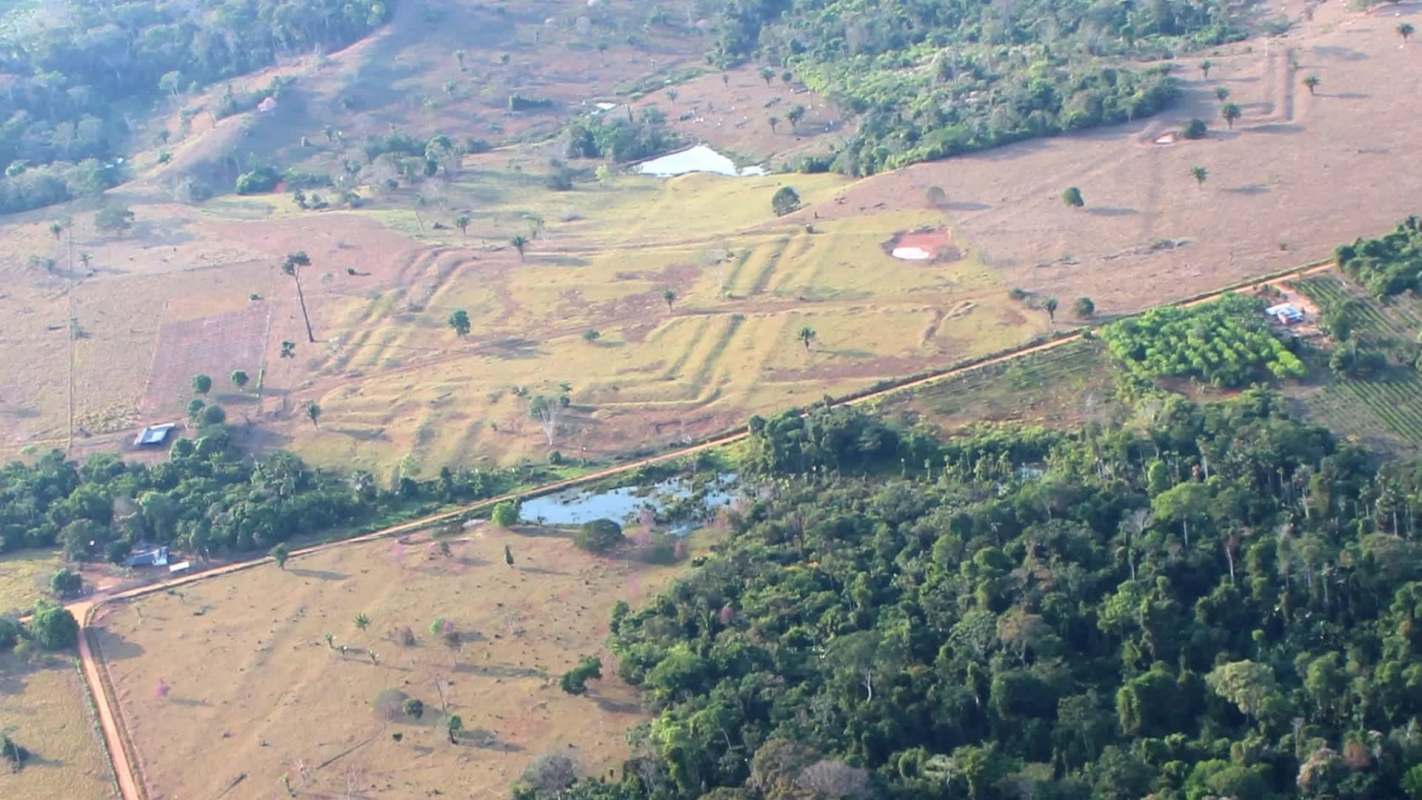
Hundreds of newly identified geometric earthworks hidden beneath the Amazon canopy in northern Brazil are reshaping what scientists thought they knew about ancient life in the rainforest, pointing to a vast civilization that may have supported between 1.25 million and 3 million people around 2,000 years ago, according to Smithsonian Magazine.
What's happening?
At its height, likely between 100 and 300 C.E., the Aquiry occupied more than 70,600 square miles in what is now northern Brazil — a footprint comparable to North Dakota.
The estimates come from lidar, a laser-mapping technique that can detect features under thick forest cover. Surveying 1,740 square miles, archaeologists recorded nearly 400 geoglyphs that had not been documented before, on top of roughly 1,700 already known from the region.
In the July 29 issue of Nature, researchers describe Aquiry settlements as villages of about 300 residents living in multi-family longhouses and raising squash, maize, and manioc while also managing Brazil nut trees and peach palms.
Lead researcher Martti Pärssinen of the University of Helsinki told NewScientist that the massive earthworks likely served as "venues for gatherings, political decision-making and displays of chiefly generosity, ritual dancing, music, feasting, athletic competitions and ball games."
Why does it matter?
Along with earlier research, the study further undermines the notion that the Amazon before European colonization was an untouched wilderness. Instead, evidence increasingly points to a landscape that large, organized societies shaped and managed over many centuries.
TCD Picks » Quince Spotlight
💡These best-sellers from Quince deliver affordable, sustainable luxury for all




Many modern assumptions about conservation, land use, and the region's history still rest on the idea that the rainforest was sparsely populated in the distant past. This research suggests ancient residents were able to build major public works and sustain dense populations without destroying the surrounding forest.
Some earthworks span as much as 123 acres, and their ditches reach about 40 feet in width and up to 16 feet in depth — all likely built without metal tools or animals.
Researchers now suspect the broader region could contain 23,000 to 30,000 geoglyphs, far exceeding earlier estimates for the entire Amazon.
Michael Heckenberger, an anthropologist at the University of Florida who was not involved in the study, told NewScientist that the new population estimates are "mind-blowing," but also "plausible and extremely important."
What's being done?
Scientists say the surveyed territory represents less than 3% of Amazonia, meaning much more could still be hidden across the forest.
Lidar is expected to play a major role because it allows archaeologists to detect ancient structures without clearing large areas of land. That makes it a powerful tool for studying the rainforest while minimizing disturbance.
Researchers are also trying to determine why the Aquiry geoglyphs appear to have gone out of use between 850 and 950 C.E. Available evidence points to a "relatively rapid collapse," Pärssinen told Live Science, per the Smithsonian, though the cause remains unclear.
"That old idea of a pristine Amazônia falls apart," Alceu Ranzi, a geographer at the University of Acre, told Science. Pärssinen also told Scientific American: "That's something amazing and something new."

Get TCD's free newsletters for easy tips, smart advice, and a chance to earn $5,000 toward home upgrades. To see more stories like this one, change your Google preferences here.






