


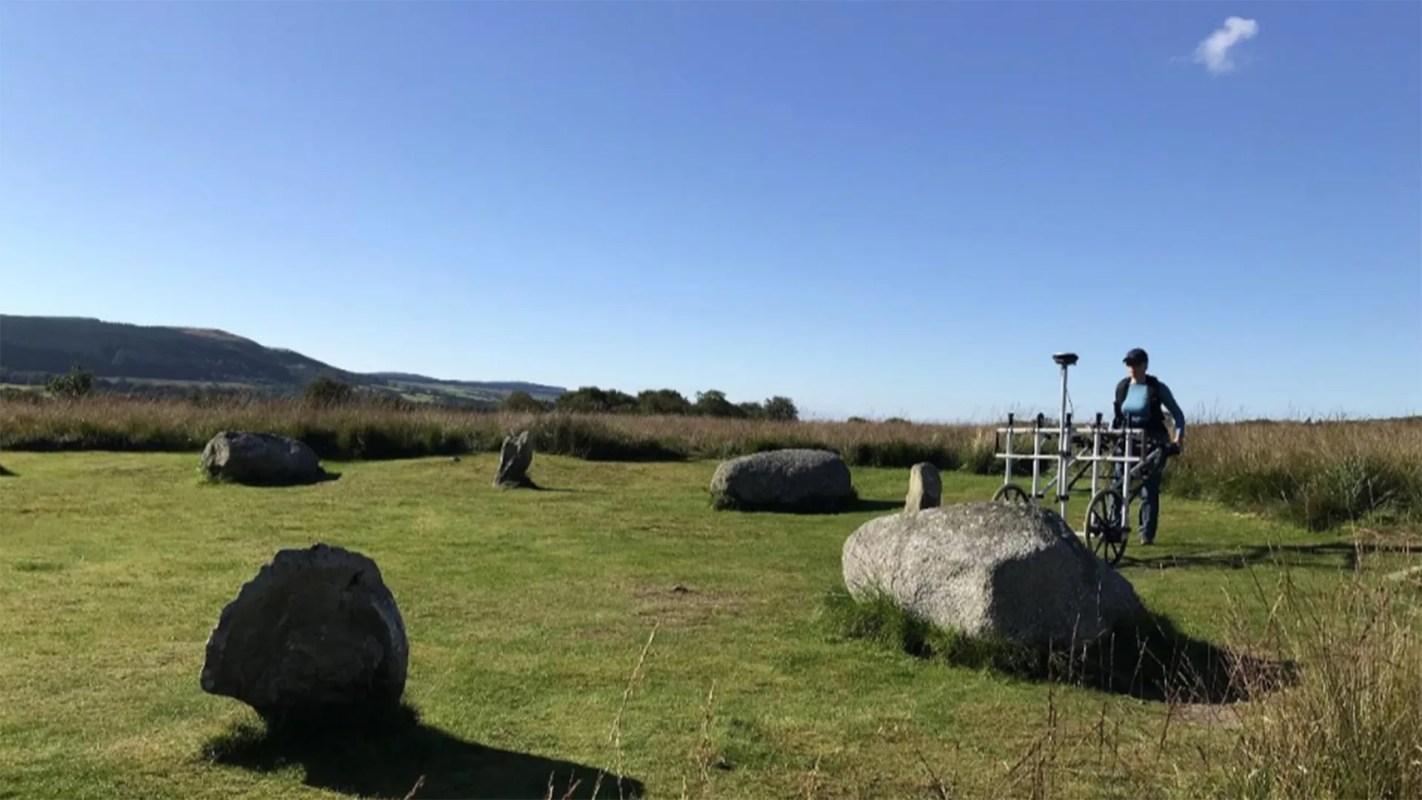
Archaeologists recently uncovered evidence of what could be a new ancient stone or timber circle buried underneath a Scottish wetland.
If confirmed, the buried feature would become another ceremonial monument in a landscape long regarded as one of Scotland's richest prehistoric sites, already known for standing stones, burial markers, and ritual spaces dating back thousands of years.
What happened?
The possible monument emerged during a geophysical study by Historic Environment Scotland, according to Live Science.
Researchers were assessing how well modern archaeological tools perform in peat-covered ground when their instruments picked up a circular pattern of magnetic signals below the surface.
Those readings outlined a ring about 92 feet wide. Within that pattern are 12 pit-like anomalies set roughly 21 feet apart, and two broader gaps could mark former pits that have decayed, bringing the original total to 14 posts or stones.
That would add to the monuments already recorded at Machrie Moor, where archaeologists have identified six ceremonial circles since the 1980s, Live Science reported. The same survey also indicates that Machrie Moor Circle 2 may once have had 14 stones, rather than the seven or eight used in earlier reconstructions.
TCD Picks » Quince Spotlight
💡These best-sellers from Quince deliver affordable, sustainable luxury for all




Why does it matter?
Because the feature has not been excavated, archaeologists still cannot say whether it was made of timber posts, standing stones, or a combination of both, being used at different times.
Earlier work at the site shows why each of those possibilities remains plausible. Previous excavations found that some of Machrie Moor's circles began as timber structures before being rebuilt in stone around 2000 B.C., according to Live Science.
Some were later used for cremations and burials, suggesting their role changed over generations. The circles also align with a notch near the top of Machrie Glen, where the midsummer sun would have risen, hinting that astronomy may have shaped ceremonial life there.
What are people saying?
Nick Hannon, senior heritage recording manager at Historic Environment Scotland, described the discovery as unexpected.
"We know that there is a lot of archaeology yet to uncover at Machrie Moor, but the discovery of a new circle completely surpassed our expectations," Hannon said in a statement issued June 30.
The scientists also cautioned: "There is no indication that any of these anomalies contain a stone" at this stage, leaving open the possibility that the monument was timber-based.
"It is likely that the newly discovered circle dates from a similar period as the other circles still standing," the press release said, suggesting the buried feature may belong to the same ancient ceremonial tradition as the other circles.

Get TCD's free newsletters for easy tips, smart advice, and a chance to earn $5,000 toward home upgrades. To see more stories like this one, change your Google preferences here.







