


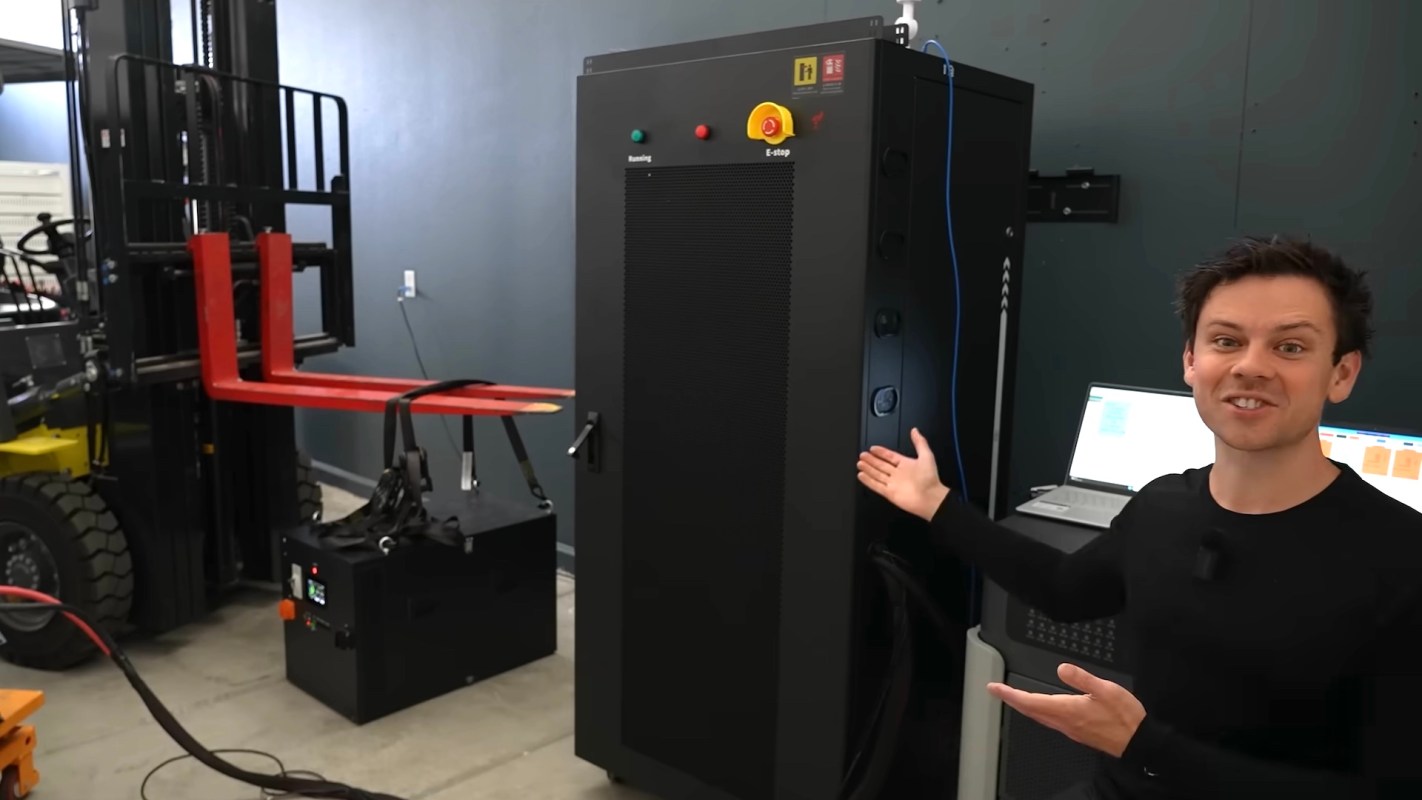
A new tool in one United States workshop could make it easier for anyone shopping for home battery storage to separate slick marketing from hard data.
As more households add backup power for storms, blackouts, and lower electric bills, content creator and DIY solar expert Will Prowse is showing how serious battery testing can be done off-grid — and why that matters.
What happened?
In a YouTube video, DIY Solar Power with Will Prowse (@WillProwse) introduced an 18-kilowatt battery cycling machine built to repeatedly charge and discharge large lithium batteries. As Prowse put it, "This thing can charge and discharge a battery with 18,000 watts continuously."
To demonstrate the scale of the system, Prowse began with a battery much larger than what most consumer test gear is designed to handle: a 600-pound unit rated at 32 kilowatt-hours and fitted with a 300-amp battery management system. As he said, "It can store 32 kWh. It is massive."
Prowse also stressed that the equipment can operate without a traditional industrial power setup. In the video, he said the arrangement uses a high-voltage battery to feed a Sol-Ark 60K three-phase inverter, while transformers adapt that output for Chinese three-phase test equipment.
"You don't have to buy a warehouse with 480-volt supply," he said. "You can make it anywhere with solar."
TCD Picks » Quince Spotlight
💡These best-sellers from Quince deliver affordable, sustainable luxury for all




In the comments, viewers connected the testing to real-world use cases. One wrote, "Man that 32kWh battery actually looks so perfect for off grid homes and cabins."
Why does it matter?
Home batteries are expensive, and for many families they are increasingly part of a practical resilience plan rather than just a luxury upgrade.
A battery that can safely store solar energy can help keep lights, refrigeration, communications, and medical devices running during outages, while also reducing peak electricity costs.
Independent testing is especially valuable. Manufacturers often advertise cycle life, capacity, and safety, but deeper testing can show how batteries actually behave under stress, including efficiency losses, overcurrent protection performance, and whether full usable capacity is really available.
Prowse said the machine can bundle several battery checks into one exportable file, making the results simpler to share. That kind of visibility could help people compare products more clearly and avoid disappointment after installation.
Cost could matter as well. Prowse said some battery cyclers can cost more than $100,000, while this single-channel model was about $8,000. That could make credible battery testing more accessible.
What's being done?
Prowse is using the machine to produce downloadable test results and evaluate large-format batteries under repeatable conditions. He also pointed to software upgrades that display charge and discharge efficiency and let multiple test steps be programmed together, reducing manual work.
That process could save battery sellers, installers, and reviewers from having to piece together separate electronic loads and power supplies. If testing becomes easier to repeat, quality control could improve, and customers may feel more confident before making a major purchase.
Commenters were already thinking ahead. One wrote, "It would be interesting to do a test of 50 cycles like your example with batteries that do not balance when charging."
Prowse said, "I want people to have access to the data, and I want more people testing these batteries." He also argued that battery businesses should "actually do it right and get something like this" so they can "print out the data and share it with your customers."

Get TCD's free newsletters for easy tips, smart advice, and a chance to earn $5,000 toward home upgrades. To see more stories like this one, change your Google preferences here.






