


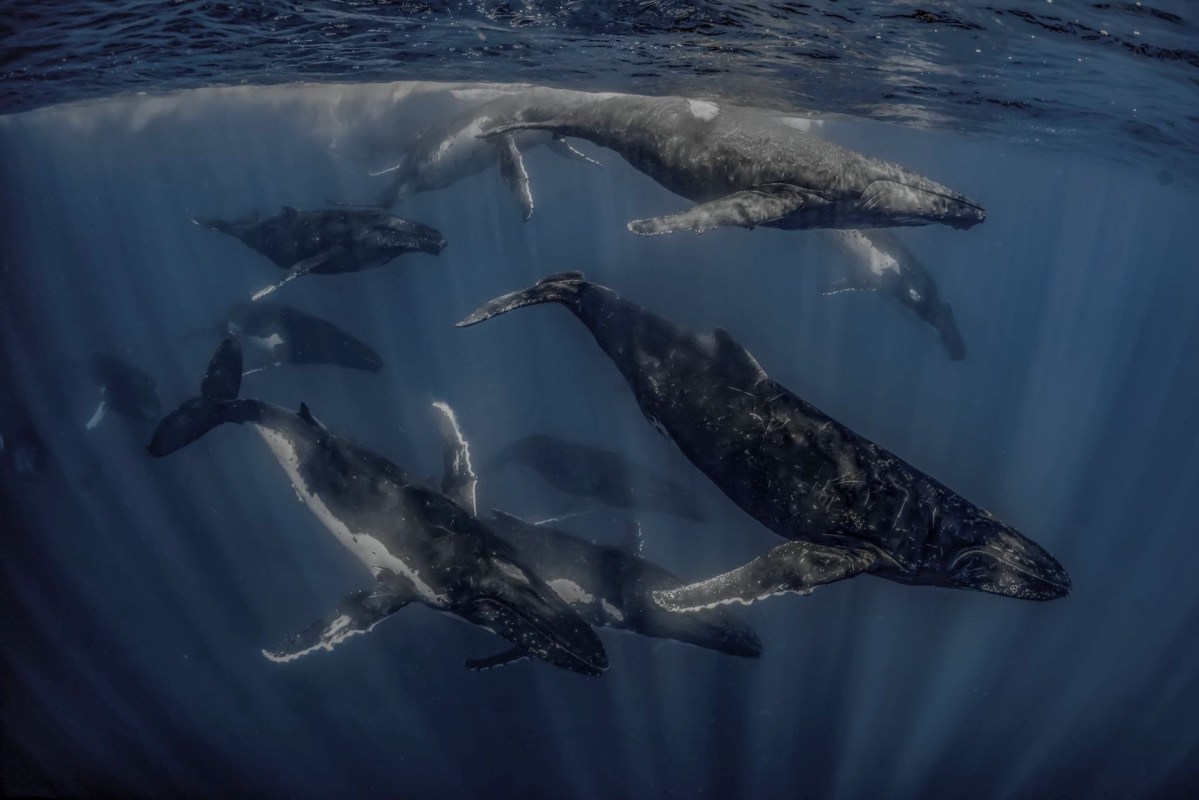
Nearly 300 humpback whales feeding together off South Africa's west coast have offered scientists and wildlife watchers a breathtaking glimpse of what marine recovery can look like, as the AP reported.
The sighting is a reminder of how drastic a species' fortunes can change when conservation efforts succeed.
What happened?
During an outing on the water last December, wildlife photographer Chris Fallows and author-naturalist Monique Fallows came across an enormous feeding aggregation of humpbacks.
This is the kind of gathering scientists call a whale "supergroup," and the South African couple recorded 299 whales, per the AP.
"It was extraordinary," Chris Fallows told the outlet. "Quite quickly we realized that there must be several hundred whales coming together in one particular area."
To avoid double-counting, they used photographs of each whale's uniquely patterned tail to identify individuals. After reviewing the images and data, Alex Vogel, Africa coordinator for whale-tracking organization Happywhale, said the sighting appears to be the largest of its kind.
TCD Picks » Quince Spotlight
💡These best-sellers from Quince deliver affordable, sustainable luxury for all




The sheer density of the gathering prompted Chris Fallows to describe the blow plumes as a "Manhattan skyline" of whale breath to the AP. Humpbacks are more commonly seen alone or in much smaller pods, so the mass sighting was a treat for the duo.
Why does it matter?
For scientists, the giant gathering highlights a major conservation success. As the AP noted, Southern Hemisphere humpbacks increased from fewer than 10,000 during the height of commercial whaling to more than 100,000 after the 1986 international moratorium.
Healthier whale populations are often a sign of healthier oceans, and thriving marine ecosystems help support fisheries, tourism, and coastal economies.
In places such as South Africa, whale watching and ocean wildlife tourism can bring business to local communities while also helping people build a stronger connection to nature.
Even so, not every whale population has recovered in the same way. The International Union for Conservation of Nature lists seven of the 14 great whale species as endangered or vulnerable.
Marine life still faces persistent dangers, including entanglement in fishing gear, ship collisions, and the changing climate.
What's being done?
Researchers and citizen scientists are playing a growing role in tracking whale recovery. Happywhale, for instance, uses public submissions of whale photos to help verify sightings and identify individual animals.
Scientists are also watching for emerging dangers. Els Vermeulen, chief scientist at the University of Pretoria's Whale Unit, told the AP that ship traffic around the southern tip of Africa has risen sharply as vessels reroute away from conflict zones in the Red Sea and growing instability around the Strait of Hormuz.
That heavier traffic through whale habitat increases the risk of deadly collisions, according to Gregg Oelofse, Cape Town's coastal and environmental manager.
"We'll see the propellor strike often through the whale's body," Oelofse explained to the AP. "So, it's like these big cuts in the whale's body."
Vermeulen added that she and others are pushing for formal ship speed limits near the South African coast, a measure that could give crews more time to spot whales and reduce fatal strikes.
Still, the progress for humpbacks is undeniable, and allows for supergroups like the one recently observed.
"In general, the moratorium on whaling can be classified as one of the strongest conservation success stories in the marine environment," Vermeulen concluded to the AP.

Get TCD's free newsletters for easy tips, smart advice, and a chance to earn $5,000 toward home upgrades. To see more stories like this one, change your Google preferences here.






