


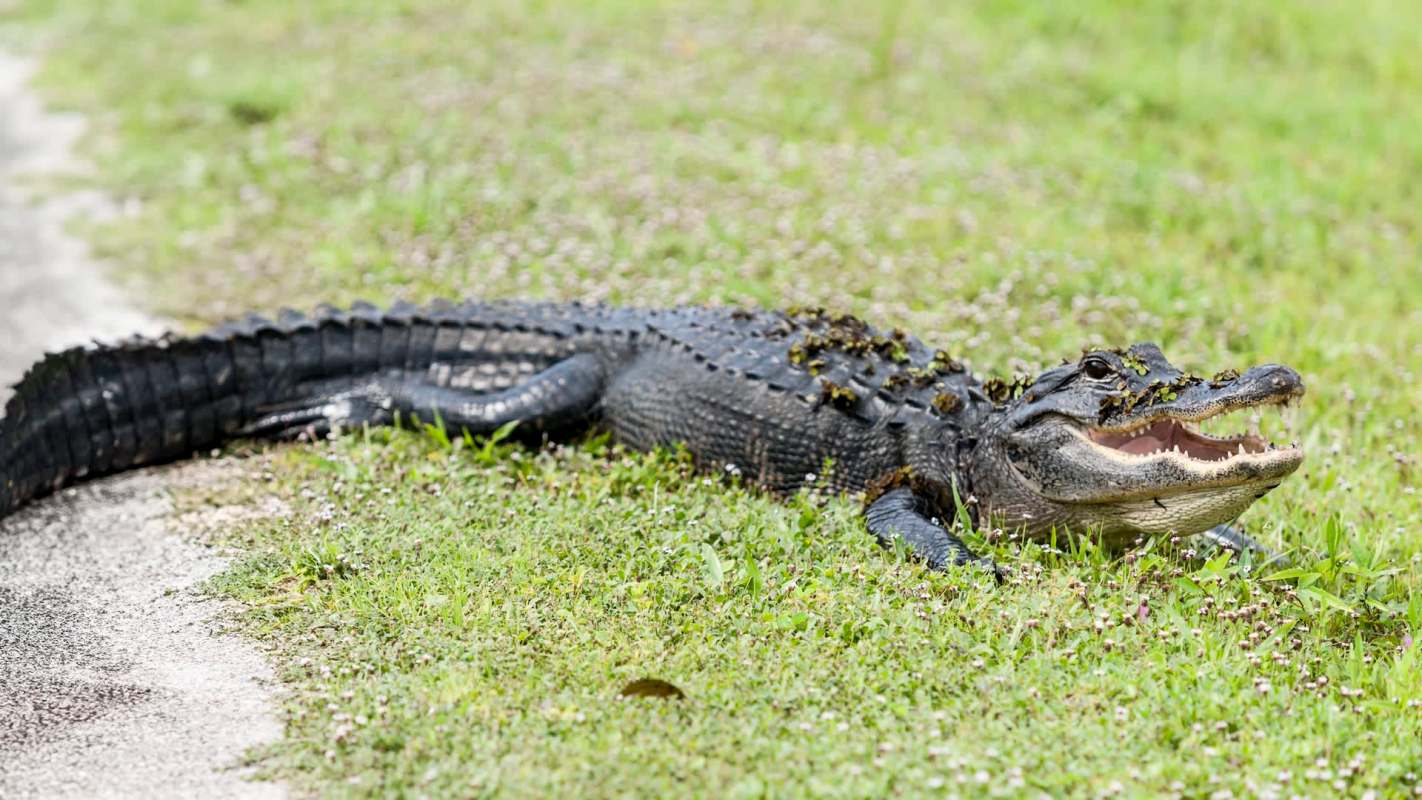
Videos from a Hollywood golf course have turned a roughly five-foot American crocodile into an unlikely South Florida attraction, with the reptile seen wandering from one green to another, as NBC6 reports.
For golfers and nearby residents, the reptile is a striking sight. For wildlife watchers, it is also a reminder that animals are increasingly navigating spaces humans have reshaped.
What happened?
NBC6 reported that the sightings are centered on Orangebrook Golf & Country Club, near Hollywood Boulevard and Interstate 95.
Employees and golfers told the station that the crocodile keeps moving around the property rather than staying in one area, appearing near hole 3 on one day and hole 8 on another.
NBC6 said the 36-hole course sits alongside two neighborhoods, where residents have recently filmed the crocodile crossing the greens. Some told the outlet it has at times come within about 50 feet of their homes.
Fellow local station WPLG Local 10 captured the croc in motion for its own segment.
TCD Picks » Quince Spotlight
💡These best-sellers from Quince deliver affordable, sustainable luxury for all




In the footage, the crocodile appears calm and unhurried as it crosses manicured grass designed for golfers, not wildlife.
Why does it matter?
The sighting reflects a broader reality in Florida that wild animals often end up in close contact with people when development overlaps with their habitat.
A golf course bordered by neighborhoods, roads, and water features can look like usable territory for a reptile trying to move through the landscape.
Sightings like this can cause alarm, especially because many people mistake crocodiles for alligators. In this case, golfers said the animal usually runs off when a person gets within about 100 yards, according to the outlet.
In South Florida, the American crocodile population has grown to around 2,000 animals, according to NBC6, up from several hundred in the 1970s before the species was listed as endangered. The animals are currently classified as threatened.
Their recovery marks a conservation success story, but it also means more people may encounter them in human-dominated spaces as human expansion has narrowed the boundary between neighborhoods and wildlife habitat.
What are people saying?
Kenny Szuch, a manager at Orangebrook Golf & Country Club, said he had previously gotten in touch with the Florida Fish and Wildlife Conservation Commission about the crocodile, according to NBC6.
"They literally said don't touch it, leave it alone," Szuch told the network. "When it gets about 8 feet contact us, we will come remove it and release it in the wild."
Golfers who spoke with NBC6 said the animal has not been a problem because it is skittish and tends to retreat.
Wildlife experts echoed that message to the station, saying American crocodiles are shy and not aggressive and will be happy to leave you alone if you do the same in return.

Get TCD's free newsletters for easy tips, smart advice, and a chance to earn $5,000 toward home upgrades. To see more stories like this one, change your Google preferences here.







