


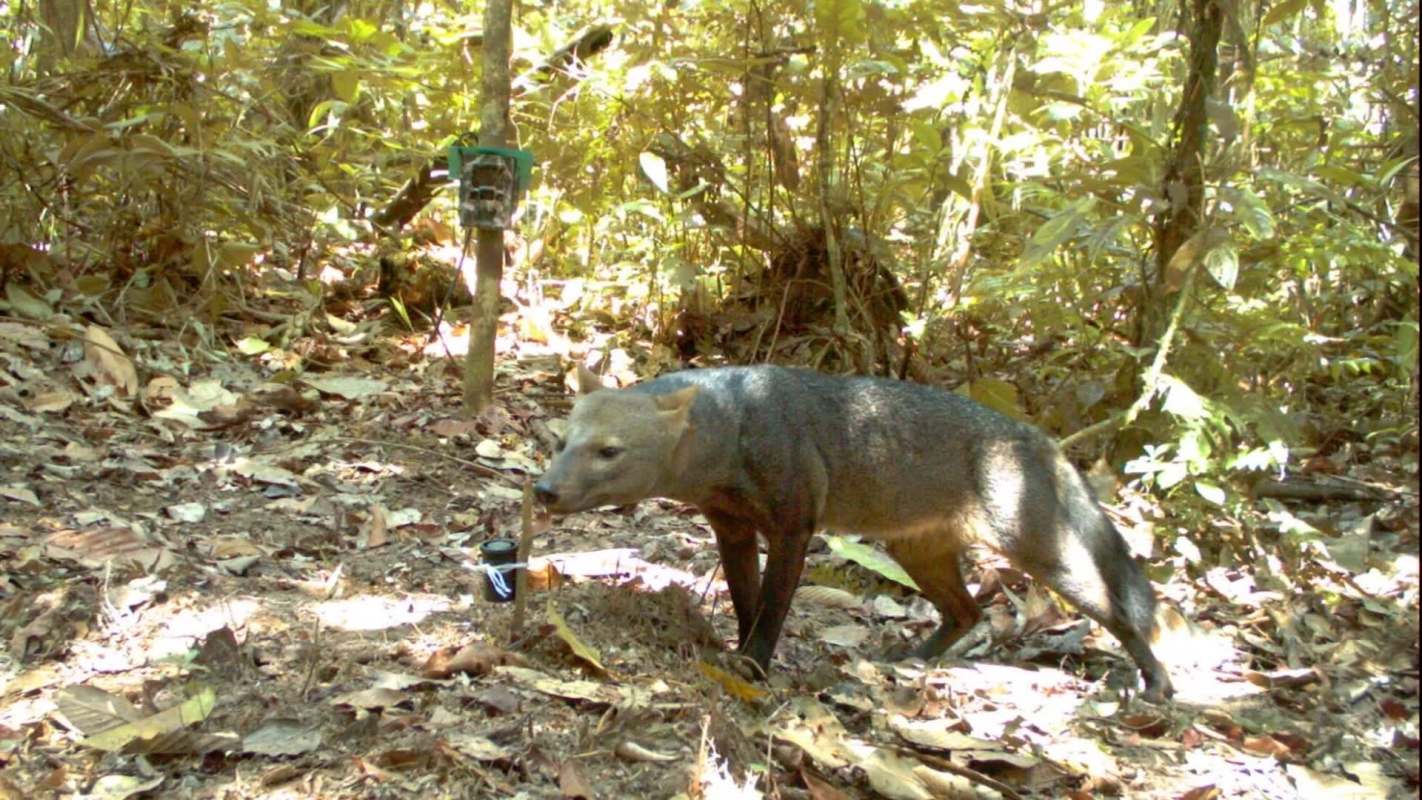
In remote parts of the Amazon forests of Bolivia and Peru lives a wild dog so rarely seen that it's known as the "ghost dog." For decades, this little-known species has avoided humans well enough to rank among the world's least-understood canids, as Popular Science details.
After a 25-year search, scientists now report in a study that the elusive animal may be doing better than earlier estimates suggested.
What's happening?
The new research published in Neotropical Biology and Conservation found that the short-eared dog, or Atelocynus microtis, may be much more abundant than researchers once feared. The conclusion is based on more than two decades of fieldwork, as the researchers explained in a news release.
Over a 25-year span, researchers carried out 34 camera-trap surveys in lowland parts of Bolivia and Peru. The effort produced 594 images of the species, giving scientists rare views of its dark coat, large head, short legs, small, round ears, and long bushy tail, including one you can see in a video posted by Popular Science.
Based on those photos and videos, the team estimated a population density of about 15 dogs per 38.61 square miles. That would make the species more numerous than jaguars in the same area, though still less abundant than ocelots, per the release. The study also found that activity peaks between 6 a.m. and noon.
"The most surprising aspect of the results was that despite being an almost mythical beast, short-eared dogs are much more abundant than we had imagined," the researchers declared in the release.
TCD Picks » Quince Spotlight
💡These best-sellers from Quince deliver affordable, sustainable luxury for all




Why does it matter?
Better data can lead to better conservation decisions, and those protections can benefit people as well as wildlife. Healthy Amazon ecosystems support biodiversity, regulate water cycles, and store vast amounts of planet-warming pollution.
The short-eared dog's behavior also helps explain why it has been so difficult to study. Despite having partially webbed paws, the species is described in the release as a "true forest specialist," favoring upland forests far from rivers. Combined with its secretive nature and sharp senses, that preference has helped keep it largely out of human view.
That mystery has fueled concern for years. If researchers rarely encountered the animal, it was easy to assume its population was dangerously low. While the new data do not mean the dog is abundant, they do suggest the species may be more resilient than expected.
Protecting habitat for a rare carnivore can also help preserve broader forest landscapes that support Indigenous stewardship, ecological stability, and local livelihoods.
What's being done?
Intensive camera trapping and remote sensing gave scientists a much clearer picture of where these animals live and how many may be out there.
The species was detected more often in national protected areas and in Indigenous territories than on unprotected land. That pattern suggests conservation rules and land stewardship are already having a measurable effect.
Expanding and effectively managing protected areas could be key to keeping the species secure. The findings also reinforce the value of supporting Indigenous communities whose territories often overlap with some of the most biodiverse parts of the Amazon.
"The most important management strategy is the protection of Amazonian forest canopy for which the creation and effective management of protected areas is the most important element, in combination with the sustainable management of Indigenous territories," the researchers concluded in the release.

Get TCD's free newsletters for easy tips, smart advice, and a chance to earn $5,000 toward home upgrades. To see more stories like this one, change your Google preferences here.






