


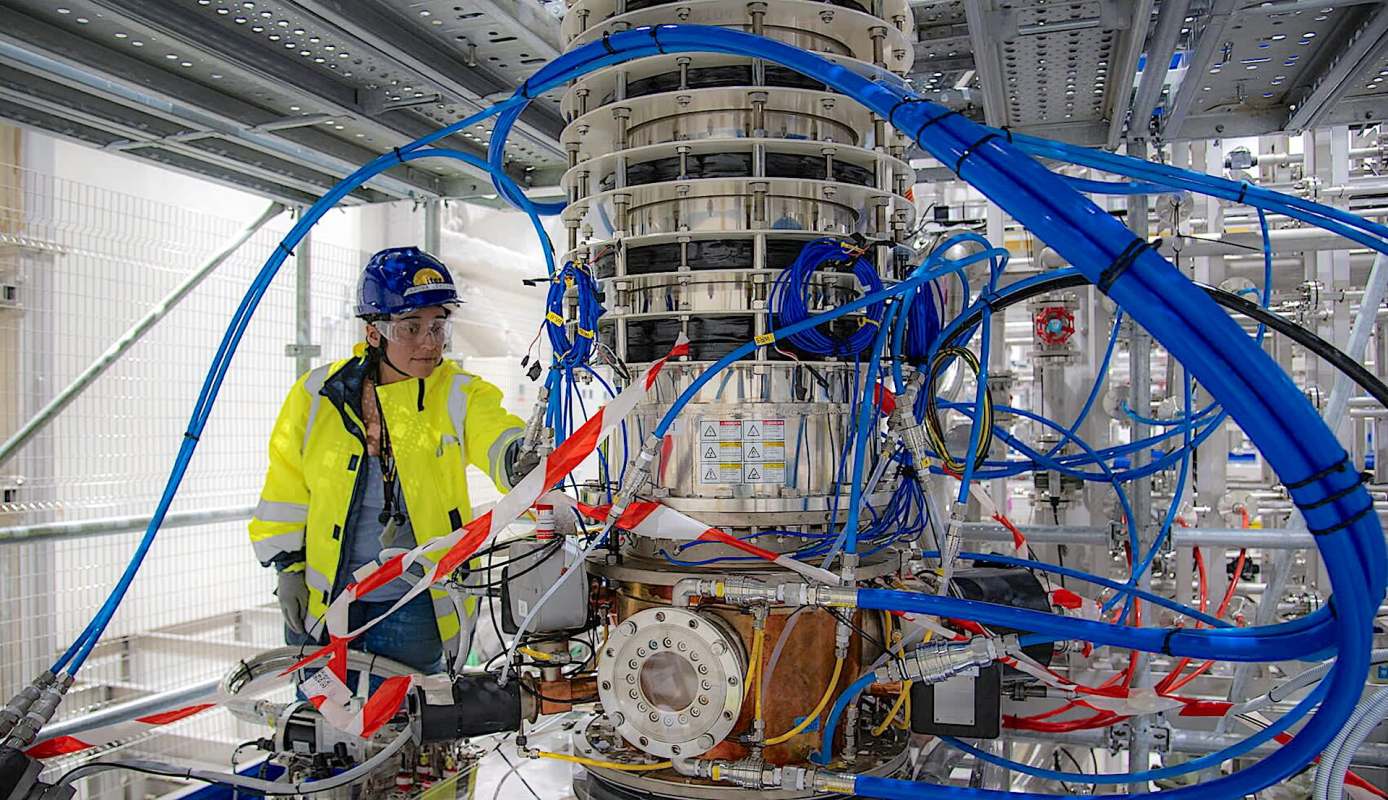
A United Kingdom company is working to develop powerful microwaves — supercharged versions of the kind in countertop appliances.
MuWave, a spinout from research by the United Kingdom Atomic Energy Authority, is upping wave power from gigahertz to terahertz to heat plasma in fusion reactors to temperatures greater than the sun's core, according to a government news release.
The work is geared to commercialize the high-powered microwave tech for fusion research, including the country's STEP prototype, which is set to go online by 2040. It's part of the pursuit of near-limitless energy without air pollution, radioactive waste, or meltdown risks. The latter two concerns are specific to common fission-based energy. But it will be years before fusion power is delivered to homes, as most research remains theoretical or at early stages.
For reference, fission splits atoms, while fusion combines them — both during particle collisions inside advanced reactors, per the U.S. Department of Energy.
To advance fusion, MuWave was awarded £450,000 ($616,000) from the UK Innovation and Science Seed Fund.
"By supporting MuWave at this early stage, we're showing how deep science know-how can be transformed into economic success and impact that reaches beyond the specialist world of fusion," UKI2S fusion portfolio investment lead Mark White said in the release.
TCD Picks » Quince Spotlight
💡These best-sellers from Quince deliver affordable, sustainable luxury for all




The microwaves are far more powerful than anything used to heat up a Hot Pocket.
Common microwave appliances operate at about 2.45 gigahertz. A terahertz is 1,000 times greater than a gigahertz, according to the University of California, which isn't involved with the MuWave project.
It's a promising tool that could help advance difficult and costly experiments. Experts at Real Clear Energy reported in 2021 that a fusion plant would cost 10 times more than a fission one, based on the tens of billions of dollars in research expenses needed for France's ITER fusion research. It's an experiment years in the making involving international experts.
ITER and labs around the world continue to reach new fusion benchmarks.
|
What's the most you'd pay per month to put solar panels on your roof if there was no down payment?
Click your choice to see results and speak your mind. |
 $200 or more 💰
 The report added that common fission is also criticized for its expense. However, there are about 440 reactors around the world that produce about 9% of the planet's electricity, according to the World Nuclear Association.
Nonprofit Green America listed radioactive waste, security, accident risk, and cost among 10 cons associated with nuclear fission. The critiques were part of a report touting solar and wind as more realistic electricity sources to meet surging demand. The opinion is backed by findings from the New York Financial Advisory firm Lazard, which found that wind and solar are the cheapest, fastest grid-level options to deploy.
Solar, unlike almost any other energy source, can also be leveraged by homeowners to reduce or eliminate utility bills via a rooftop array.
For their part, nuclear proponents downplay waste and accident risks as acceptable, considering the abundant, air pollution-free energy that's created. Smog generated by burning oil, coal, and gas for electricity is contributing to the planet's overheating, which is increasing the chances for life-threatending extreme storms, according to NASA.
In the meantime, electricity rates continue to rise. It's widely reported that U.S. bill increases are outpacing inflation.
If MuWave's research can help to secure affordable, reliable fusion power, the results could be game-changing for global energy. The team said that its tech can also be used for work in satellite communications, radar, geothermal drilling, and medical imaging.
"Securing our initial funding is a huge milestone for us. It validates the problem we're solving and the passion behind our solution," MuWave co-founder Helen Webster said.
Co-founder Steven Craig added, "Finalizing the spinout agreement … marks a pivotal moment for us."

Get TCD's free newsletters for easy tips to save more, waste less, and make smarter choices — and earn up to $5,000 toward clean upgrades in TCD's exclusive Rewards Club.






