


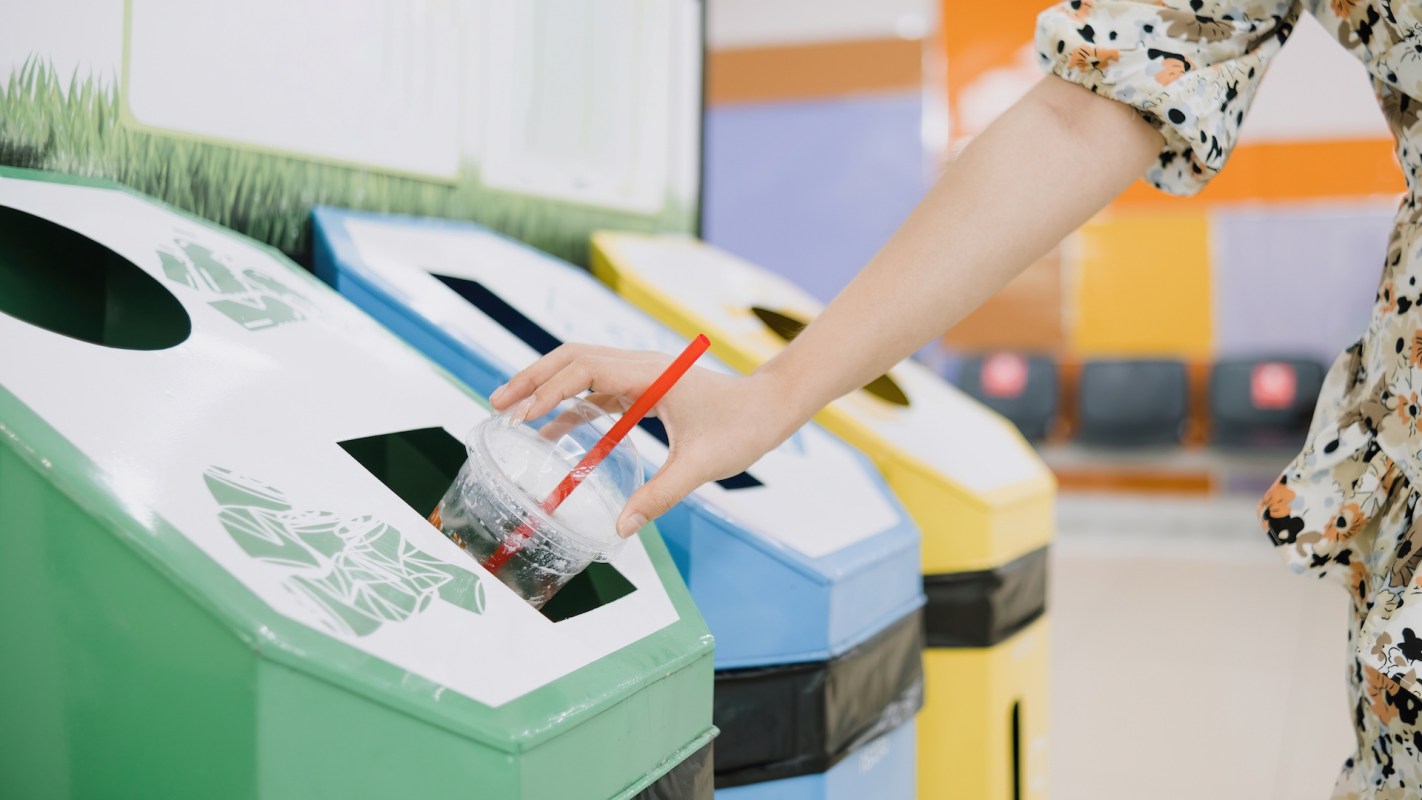
Globally, 496 million tons of plastic are produced each year and 267 million tons are wasted — or about the weight of 3.4 million adult blue whales.
A new study, published in Resources, Conservation, and Recycling, suggests artificial intelligence could solve one of recycling's most persistent problems by accurately identifying different types of plastic before they're processed.
Researchers from Washington and Puerto Rico found that pairing spectroscopy, a technique that analyzes how materials interact with light, with deep learning dramatically improves plastic sorting accuracy.
Recycling systems often struggle to distinguish between plastic types such as PET, HDPE, PVC, and polypropylene, especially when items are dirty, dyed, or mixed with additives. Those errors often lead to "downcycling," wherein plastics are reused in lower-value products rather than fully recycled.
To address the issue, the research team developed a machine-learning framework based on convolutional neural networks, which are often used in image processing models. Unlike traditional approaches with manual feature selection, CNNs can learn the chemical identifications of plastics directly from the spectroscopy data.
When trained on Raman scattering spectroscopy data from real recycling samples, the model achieved 100% accuracy in classifying six common consumer plastics. Researchers then tested the same approach using ATR-FTIR spectroscopy, a method widely used in industrial and field settings. That model reached 95% accuracy.
TCD Picks » Quince Spotlight
💡These best-sellers from Quince deliver affordable, sustainable luxury for all




The study also compared several analytical methods and found which types performed better at identifying consumer plastics versus marine debris, which is often highly degraded.
In real-world conditions, the CNNs accurately identified "dyed plastics, plastics containing additives, and plastics subjected to real-world environmental conditions and deterioration."
Researchers say the model's low computational demands make it suitable for real, automated, high-volume recycling facilities where speed and cost are crucial.
Better sorting could help reduce plastic waste that remains in the environment for centuries. Plastic water bottles can take 450 years to break down, while plastic straws can last 200 years.
|
What's the most you'd pay per month to put solar panels on your roof if there was no down payment?
Click your choice to see results and speak your mind. |
 $200 or more 💰
 Plastic production relies heavily on oil and gas, generating 3% of planet-warming pollution, and at the end of its lifecycle, whether in landfills, oceans, or beyond, plastic waste contributes to microplastic pollution that pollutes air and soil and threatens human health.
In the United States alone, roughly 40 million tons of plastic are thrown away each year, yet only 5% is actually recycled.
While this new technology could significantly improve recycling outcomes, researchers noted it works best alongside efforts to reduce plastic use altogether, such as choosing plastic-free options.
But this breakthrough doesn't stand alone; recent developments in plastic science and recycling include pyrolysis research to turn plastic into more valuable chemicals, plastic bottle-eating microorganisms, and iron trichloride to break down styrofoam safely.
According to the study's authors, the CNN-based model's ability to effectively identify a wide array of plastic waste types and conditions represents "a significant practical advancement for real-world applications" that could soon boost recycling rates and keep plastic waste out of landfills and ecosystems.

Get TCD's free newsletters for easy tips to save more, waste less, and make smarter choices — and earn up to $5,000 toward clean upgrades in TCD's exclusive Rewards Club.






