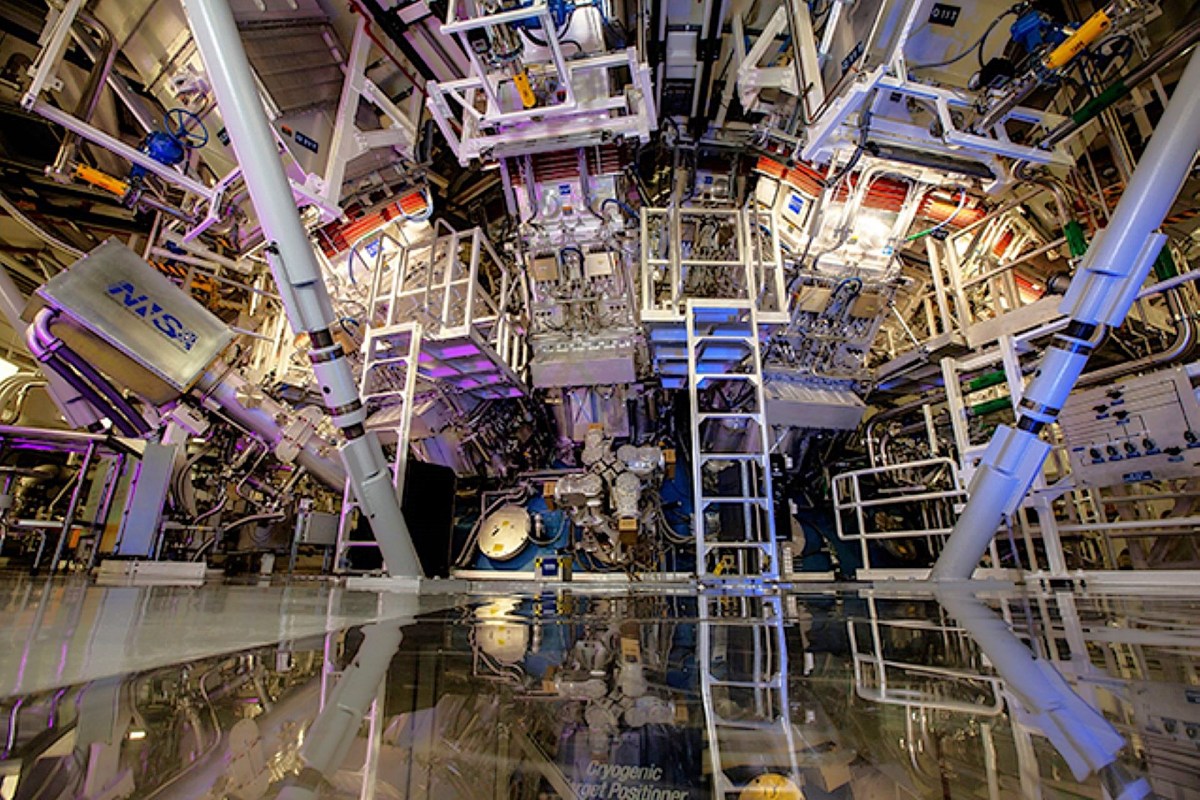
A laser-beam dream team has been assembled to advance nuclear fusion, the near-limitless energy source that is being researched in labs around the world.
The promising effort has pooled knowledge from scientists at the United States Lawrence Livermore National Laboratory (LLNL) and Germany's Fraunhofer Institute for Laser Technology, bringing together "heavyweights" of laser expertise, according to a news release.
If the effort is successful, the group could help usher in a new era of air pollution-free nuclear power — minus the long-lasting radioactive waste and meltdown risks of current nuclear energy production.
The rewards would be timely, as Americans are facing surging electricity rates that are rising faster than inflation as data center power demand strains the grid.
A big hurdle for fusion is affordably sustaining reactions that create more energy than they use.
"We are in the decisive decade for fusion energy," Fraunhofer professor Constantin Häfner said.
TCD Picks » Quince Spotlight
💡These best-sellers from Quince deliver affordable, sustainable luxury for all




The project, dubbed the International Cooperation on Next-gen Inertial Confinement Fusion Lasers, or ICONIC-FL for short, involves firing 15 powerful laser shots per second to ignite fusion fuel, which will be compressed and heated to more than 100 million degrees as part of a 24/7 energy-producing setup, per the release.
The laser concept is one of several fusion experiments underway in labs all over the planet that often use advanced chambers and magnetics to confine highly heated plasma.
Lasers represent a great opportunity, according to the experts.
"The transition from basic research to power plant development requires the rapid, robust development of rugged new laser systems," Häfner said.
|
Should we be pouring money into nuclear fusion technology? Click your choice to see results and speak your mind. |
 Yes — it'll pay off 👍
 The process of nuclear fusion combines atoms to form a larger one, while fission splits them.
Fission is commercially sustainable and is used in America's 50-some nuclear plants to power nearly 20% of the country's utility-scale electricity production, per the U.S. government. But fission leaves long-lasting radioactive waste and carries with it meltdown concerns — with historically rare but documented catastrophes.
Proponents maintain that the waste and other risks are justified by the energy rewards. For reference, U.S. plants make enough hazardous spent fuel to fill half of an Olympic-size swimming pool annually.
Contrary to popular representations, there are no caves filled with glowing drums of ooze, as the U.S. Department of Energy has noted.
For fusion's part, costs and technological hurdles are the main challenges to overcome. The Union of Concerned Scientists has also warned that the astounding power could be weaponized if used irresponsibly.
The LLNL successfully focused a stadium-sized laser system on a target the size of a pencil eraser in 2022, essentially imploding it. More energy was made from the shot than was delivered to the target — representing a breakthrough.
The science watchdogs of UCS took note of the great potential and possible danger of this achievement: "Defense research can never be fully disentangled," scientist Dylan Spaulding wrote for the Union of Concerned Scientists. "As with so many technological breakthroughs, the most powerful can also be the most destructive … it is up to us to choose how we use it."
The U.S./German laser experts are now running numerous simulations, examining amplifiers and other components of the ICONIC process to eliminate as many variables as possible before expensive physical testing begins. These simulations are paramount, per the release.
"We are laying the foundation for future power plants," Häfner said.
The potential for electricity production from fusion in the future is tremendous — though scientists also debate how long it will take to become practical.
And some experts point out that there are already technologies available to produce energy without pollution.
New York financial advisory firm Lazard considers solar and wind to be the cheapest and fastest energy sources to bring online to meet U.S. grid needs.
Home solar, meanwhile, is a way to achieve more energy independence individually. The Cool Down's Solar Explorer is a gateway to trusted partners with subscription and purchase options that work for homeowners on a budget, providing curated quotes, installer recommendations, and other information.
For its part, the combined fusion team of ICONIC-FL sees its work as a fitting response to overcome research obstacles with a hyper-focused attention to details, per the release.
"Even the smallest, unpredictable effects are significant," Fraunhofer project manager Johannes Weitenberg said.

Get TCD's free newsletters for easy tips to save more, waste less, and make smarter choices — and earn up to $5,000 toward clean upgrades in TCD's exclusive Rewards Club.