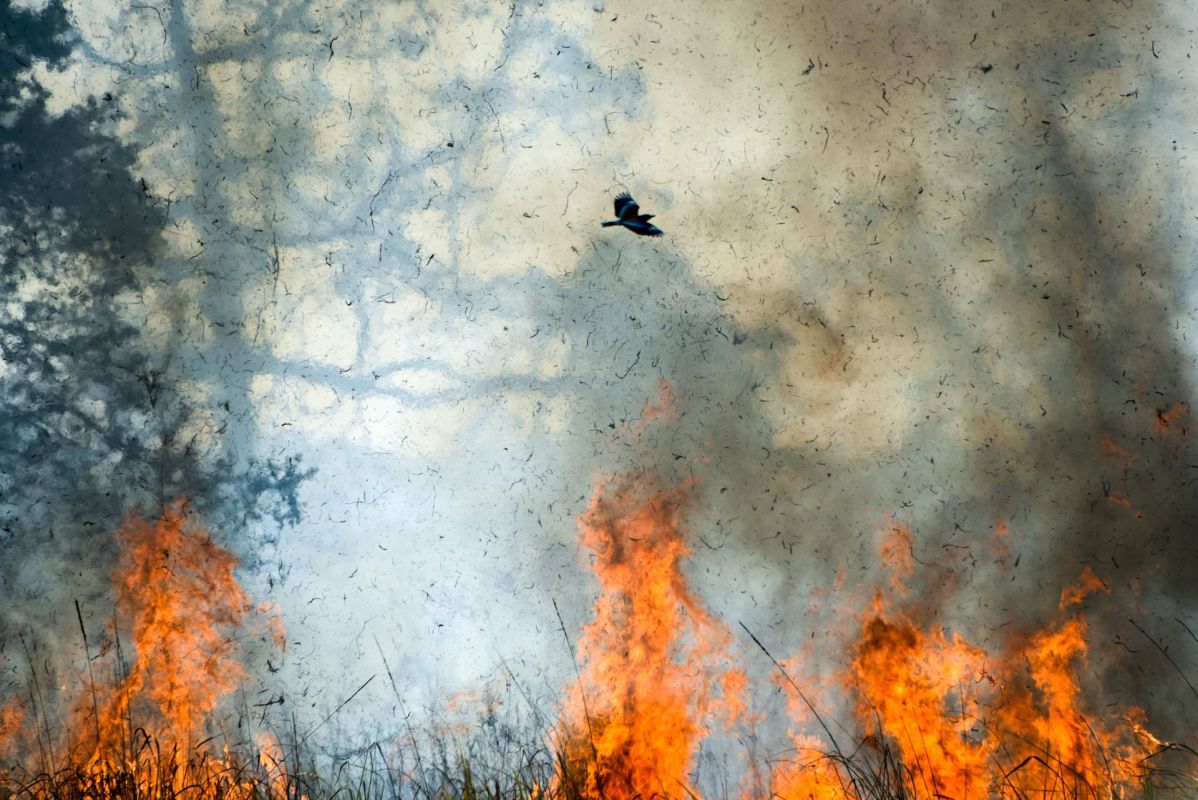
A study has found that wildfires are reducing migratory bird activity at stopover sites.
What's happening?
Led by Wieland Heim, a researcher of the Migration Ecology group at the University of Oldenburg, a team including Lara Hinninger, Sergei M. Smirenski, and Ramona J. Heim set out to find what effect wildfires are having on the migration patterns of birds.
The researchers wanted to focus on stopovers, places for birds to rest, eat, and seek shelter during their long migrations.
"Migratory birds rely on suitable stopover sites, and any changes at such sites could negatively affect their survival and population dynamics," the authors wrote in a study published in the journal Scientific Reports.
To study the effects of wildfires on migratory birds, the research team examined areas of Muraviovka Park in Russia.
"This wetland ecosystem along the Amur River serves as a crucial breeding and stopover site for almost 300 bird species," they said.
TCD Picks » Quince Spotlight
💡These best-sellers from Quince deliver affordable, sustainable luxury for all




Over five years, researchers studied 9,060 birds of 92 species that stopped in the park. They compared the data on birds at the stopover site one year after a wildfire and again four years later.
At the stopover sites in the park, they found a significant decrease in species richness, the number of different species in a given area, and abundance, the number of a specific species.
"We posit that reduced habitat and food availability after fire cause these effects," the study noted.
After a fire, there is less shelter and food needed for the birds to rest and refuel to continue on their journey.
|
Do you think humans are doing enough to protect endangered animals? Click your choice to see results and speak your mind. |
 Definitely 👍
 "While localized fires may allow birds to find alternative nearby stopover locations, large-scale fires could significantly impair migration success by reducing habitat quality across extensive areas," the researchers wrote.
"This may increase the fitness costs for migratory birds, e.g. due to increased settling costs or slower re-fueling, which could ultimately lead to reduced survival rates."
Why is this study important?
Much research into wildfires' effects on birds has focused on breeding habits.
"Many studies reveal reduced bird abundance and species richness in the weeks or months after a fire," the researchers wrote.
That makes the impact of wildfires on migration even more important.
"Evaluating the impact of fire-induced changes at stopover sites on bird diversity and abundance is essential to guide conservation efforts," the authors added.
Nearly 4 billion birds migrate every year, according to Cornell University. The Audubon Society observed that some travel as much as 49,000 miles during a round trip.
Even though some species of birds can fly up to 600 miles a day, per the American Bird Conservancy, they need to stop for rest and food for these long journeys.
With more frequent and intense wildfires as a result of human-caused global heating, the areas that birds can stop are becoming less suitable.
Even migration destinations have changed due to changes in climate and food scarcity.
"Birds, as indicators of ecosystem functioning, are sensitive to changes in their environment, especially to those affecting habitat structure and resource availability," the study said.
This makes tracking bird migration patterns an excellent way to judge the state of specific ecosystems.
What's being done about wildfires and protecting migratory bird stopovers?
According to the researchers, protecting bird stopover sites is vital, and the best way to do so is to control wildfires.
"By carefully managing fire extent and frequency, we can ensure a variety of suitable patches for migratory birds with different stopover habitat preferences," they wrote.
"Future research should focus on comparing the quality of burned and unburned stopover sites within the same year, particularly examining differences in stopover durations and fuel deposition rates. Such studies will provide crucial insights for effective conservation of stopover habitats in fire-prone regions."
By studying migration behaviors, researchers can learn where to focus their conservation efforts. This has led to some incredible feats, including establishing a new migration path for the northern bald ibis, a near-extinct species.
On an individual level, we can minimize the risk of wildfires affecting migratory birds by properly managing campfires and reducing our production of planet-warming pollution that increases global temperatures and exacerbates drought conditions.

Get TCD's free newsletters for easy tips to save more, waste less, and make smarter choices — and earn up to $5,000 toward clean upgrades in TCD's exclusive Rewards Club.