


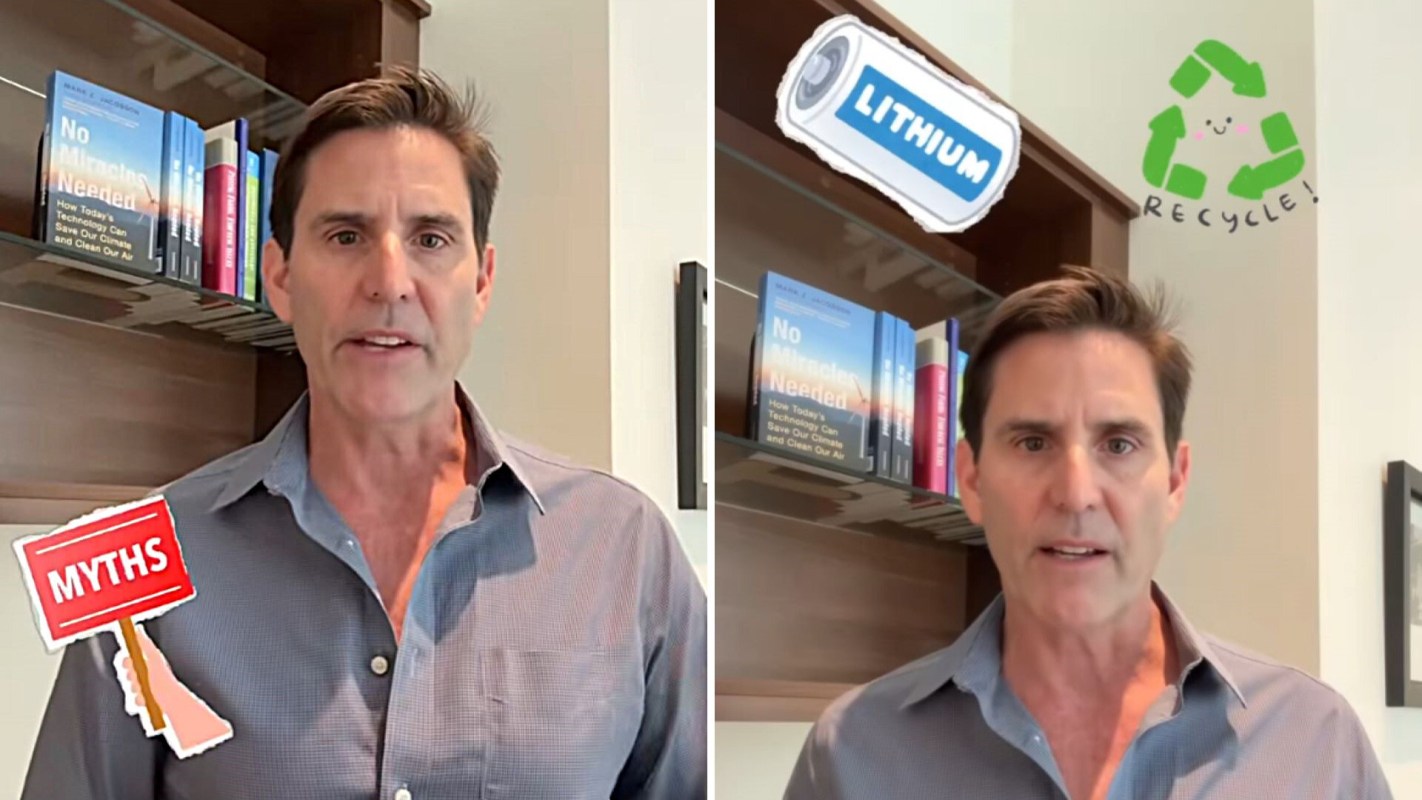
Mark Jacobson (@mzj2273), professor of civil and environmental engineering at Stanford University, posted a TikTok busting a common myth about lithium mining.
He starts by laying out the facts about planet-warming dirty fuels.
@mzj2273 Busting a myth about the mining needed for renewables versus fossil fuels #renewables #energy #mining #lithium #myth ♬ original sound - MZJ
"Worldwide, 15 billion tons of fossil fuels … are mined and then burned," he explains, "and the emissions from such burning deposits into our lungs, onto the ground, and into the water."
This results in five million air pollution-related deaths annually.
While electric vehicles, usually powered by lithium, stand as a clear alternative to dirty fuel-powered gas cars, many people doubt their safety. Skeptics often cite the environmental impact of lithium mining — and they're not wrong.
According to Green Match, the majority of lithium is extracted from brine water, which is pumped to the surface from beneath the earth and evaporated in ponds. This is an energy-intensive process that runs the risk of contaminating nearby freshwater sources.
TCD Picks » Quince Spotlight
💡These best-sellers from Quince deliver affordable, sustainable luxury for all




However, it's important to consider the entire picture, as Jacobson does. While these are concerns worth taking into account, lithium mining is still nowhere near as environmentally taxing as dirty fuels.
Jacobson compares dirty fuel mining with the environmental toll of mining precious metals. "Only 1.5 million tons per year of precious metals … are needed today," he says. "That's one ten-thousandth [of] the mass of fossil fuels mined yearly."
Even if we transitioned every car in the world from an ICE (internal combustion engine) to an EV, it would still be nothing compared to dirty fuels, as Jacobson says.
"That would require about 16 million tons of lithium," he explains, "which is about one one-thousandth the mass of fossil fuel material mined every year worldwide."
|
What is your biggest concern with EV batteries?
Click your choice to see results and speak your mind. |
 They're not efficient enough ⚡
 Since lithium batteries can last decades, there would be no need to mine lithium as regularly as dirty fuels. New methods of lithium extraction are being developed to combat this as well. Plus, lithium can be recycled even after its time as a battery is up. One team of researchers even found a way to recycle spent lithium batteries using fruit peels. No such method exists for non-renewable ICEs.
Commenters thanked Jacobson for taking the time to explore critical climate issues.
"Very nice explanation," one commenter said.
"Thank you so much for explaining this," another user said. "So many factors that are ignored."

Join our free newsletter for good news and useful tips, and don't miss this cool list of easy ways to help yourself while helping the planet.






