


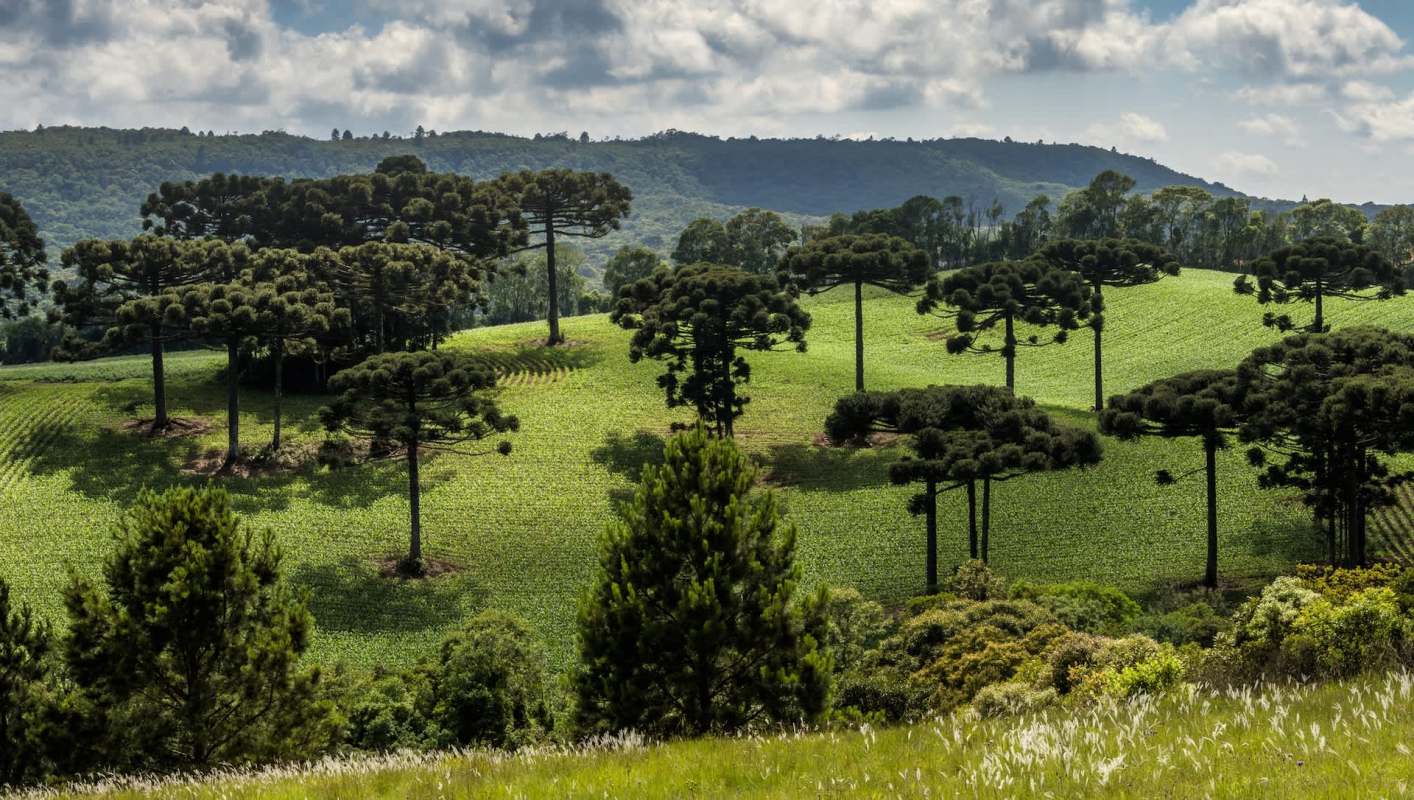
This past August, authorities in Brazil apprehended an Indigenous chief, arresting him for an alleged role in an illegal logging operation. As Mongabay reported the following month, Jose Carlos Gabriel and three other suspects were taken into custody by the country's Federal Police.
Gabriel, chief of eight villages in the Mangueirinha Indigenous Territory in the southern Paraná state, has been accused of being part of a criminal enterprise engaging in the illegal logging of the critically endangered Araucaria angustifolia.
Also called the Brazilian pine, Paraná pine, or Zág by the Xokleng people, the tree holds significant cultural and ecological value to locals, including multiple Tribes.
Xokleng activist Isabel Gakran, who, with her husband, founded the Instituto Zág to promote restoration of the tree to combat threats including logging, agriculture, and rising global temperatures, wrote at Think Landscape this summer about the tree's sacred interconnectedness with her people. "The Zág sustains us," Gakran said, noting the tree's nuts as a staple food, its conifers as a basket-making material, and its branches as a feature of a fire-based ritual.
Bruno Ferreira, a historian and member of the Kaingáng people, told Mongabay for an earlier report in 2022 of the tree's centrality to his own Indigenous culture. "It is our main plant, and its disappearance brings serious consequences," Ferreira said of the pine, a key to Kaingáng cuisine as well.
But the trees have suffered immensely from widespread destruction in Brazil, as huge swathes of forest were cleared in the 1970s and '80s to make way for other agricultural efforts. As of 2022, just 3% of the Paraná pine forest reportedly remained.
TCD Picks » Quince Spotlight
💡These best-sellers from Quince deliver affordable, sustainable luxury for all




The story of the Paraná pine highlights a persistent concern in rainforest conservation: Whether legal or not, deforestation can be seen as highly profitable. And in emerging economies, the promise of profit can be especially difficult to resist.
Due to their clandestine nature, accurately estimating the revenue generated by criminal enterprises can be challenging. However, citing Interpol statistics from 2019, the World Wildlife Fund previously suggested that, globally, the illegal wood trade might be valued at $50 billion to $150 billion annually, "making it the world's third-largest transnational crime."
This suggests that not only policymaking and law enforcement but also job creation may be key to conservation efforts. Strong policies are critical too, however. The previous president of Brazil, Jair Bolsonaro, oversaw record deforestation.
The investigation into Gabriel's alleged crimes has found an increase in deforestation sites since he assumed leadership of the territory in 2021. The criminal enterprise is said to have Indigenous and non-Indigenous members, though Gabriel has denied any involvement. According to a statement by the Federal Police, perpetrators will face stiff penalties if convicted:
|
Do you think America does a good job of protecting its natural beauty? Click your choice to see results and speak your mind. |
 Definitely 👍
 "Those investigated may be charged with crimes such as organized crime, illegal logging in a federally owned permanent preservation area, aggravated theft, and aggravated receiving stolen goods, the combined penalties for which may exceed 20 years' imprisonment."
As for reforestation efforts, Gakran said members of Instituto Zág, with support from the United Nations Development Programme, have planted more than 100,000 Paraná pine tree seedlings since 2017.

Join our free newsletter for good news and useful tips, and don't miss this cool list of easy ways to help yourself while helping the planet.







