


California and Texas get most of the attention when it comes to clean energy in America, but there's one state that has quietly become one of the largest solar and storage markets in the U.S.
In recent years, Nevada has built some of the largest clean energy projects in the country, with seven solar projects boasting more than 200 megawatts of capacity. Between now and 2030, another six are expected to come online.
Nevada's solar-plus-storage portfolio now includes several massive projects, including the Gemini Solar Hybrid facility. Completed in March 2024 with 690 megawatts of solar capacity and 380 megawatts of battery storage, it stands as one of the world's biggest solar-plus-storage plants. Not too far away, the Reid Gardner storage project adds another 220 megawatts of capacity.
According to Cleanview's project tracker, Nevada now hosts 66 utility-scale solar farms with a combined capacity of 5,285 megawatts. These megaprojects have helped Nevada become one of the largest solar markets in the U.S. — roughly 30% of the state's power capacity comes from utility-scale solar, more than any other state.
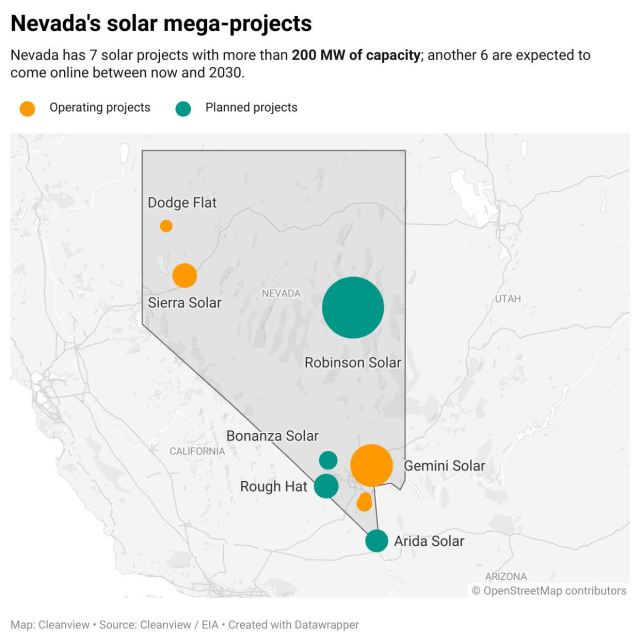
Chart Source: Cleanview's market intelligence platform
Why is solar and storage growing so quickly in Nevada?
The state has ideal conditions for solar deployment: abundant sunshine, and — critically — vast available federal land near major load centers like Las Vegas and Reno.
TCD Picks » Quince Spotlight
💡These best-sellers from Quince deliver affordable, sustainable luxury for all




This geographic advantage has enabled large solar farms with co-located batteries that achieve significant economies of scale. (It also creates significant risk going forward given the Trump administration's recent policy changes favoring older energy industries.)
Nevada's transformation from coal state to solar and storage leader has also been driven by some of the smartest, most supportive clean energy policies in the country.
In 2019, Nevada's legislature increased the state's renewable portfolio standard (RPS), jumping from 25% to 50% by 2030, with a goal to be 100% carbon-neutral by 2050. The utility NV Energy responded immediately with an ambitious plan to add 1,200 MW of solar and 590 MW of battery storage by 2023.
The law also included provisions discouraging fossil fuels, prohibiting new coal, and limiting gas expansion. This effectively nudged the utility to use batteries for reliability instead of the gas peakers that utilities have traditionally relied on.
Another key driver is Nevada's opportunity to export power to California. Developers can store surplus solar generation and export it across state lines during evening hours when California prices are high.
As part of the Western Energy Imbalance Market, Nevada has seen multiple days where evening power prices in California spiked above $1,000 megawatts an hour — creating lucrative opportunities for battery discharge.
|
Should the U.S. be investing more in battery production to catch up with China?
Click your choice to see results and speak your mind. |
 Absolutely 📈
 Lessons learned from the Silver State's Solar Boom
Nevada generated just under 30% of its electricity from utility-scale solar in 2024—three times the U.S. average. No state has a higher solar penetration rate, not even California.
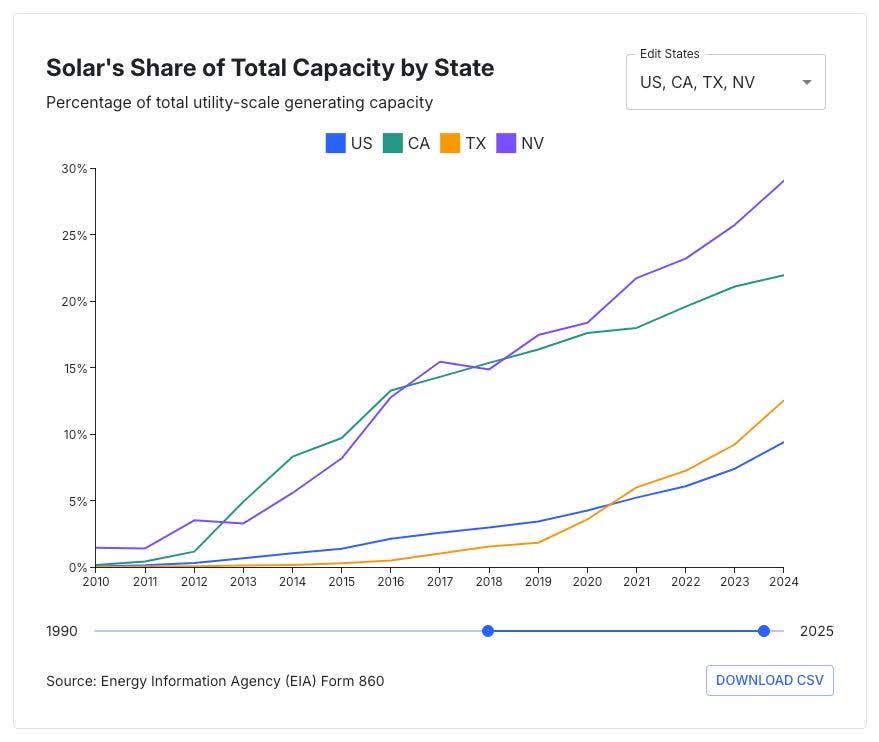
Chart Source: Cleanview's market intelligence platform
And its success scaling solar and storage provides reasons for optimism. Nevada's emergence as a battery storage leader follows a familiar pattern in America's energy transition. In the early 2010s, Iowa and Texas pioneered utility-scale wind development thanks to exceptional resources and supportive policies. A few years later, California and North Carolina led the country's initial solar boom.
Today, Nevada is playing that same pioneering role for battery storage. Its combination of high solar penetration, perfect geography, and smart policy frameworks has made it an early adopter of a technology that will soon become ubiquitous.
Nevada won't be the last storage success story. Just as wind spread from Iowa and Texas to Oklahoma and Kansas, and solar expanded beyond California to states like Arizona and Florida, battery storage will likely proliferate across the country. Nevada is simply an early adopter of a technology that is quickly becoming essential to America's clean energy future.
Michael Thomas is the founder of Cleanview, a platform that helps clean energy leaders track the energy transition in real-time, and the author of a newsletter about climate change, Distilled, that has been read by more than 50 million people. Follow Michael on LinkedIn here, where this post appeared in its original form, or subscribe to his newsletter here.

Join our free newsletter for good news and useful tips, and don't miss this cool list of easy ways to help yourself while helping the planet.






