


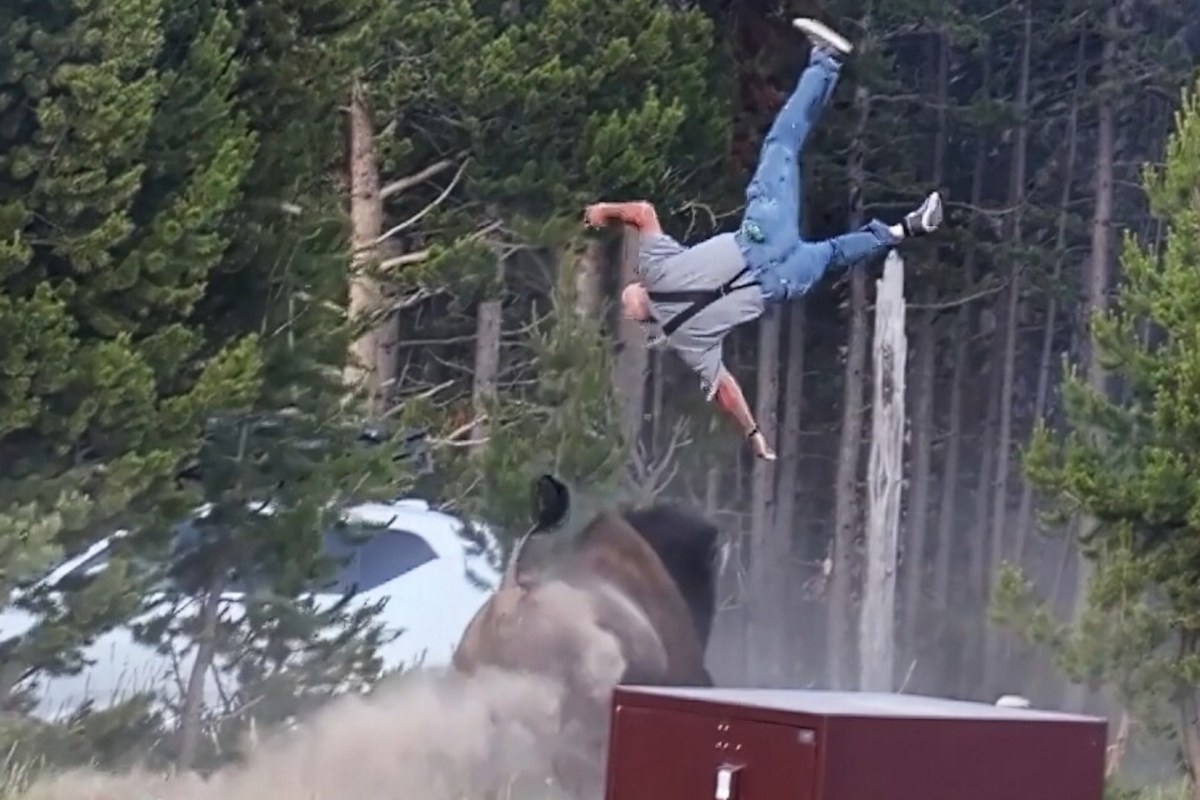
A frightening bison attack that dominated social media this weekend appears to be a clear-cut case of "wrong place, wrong time" for the grandpa who went airborne in spectacular fashion.
As KTVQ reports, the photographer who recorded the wild footage says the charge came after the unprovoked animal had already had several tense encounters in a campground.
What happened?
On Friday evening near Yellowstone National Park's Bridge Bay Campground, Bozeman photographer Mike MacLeod, a wildlife biologist by training, said he noticed a bull bison behaving in a way that stood out, according to the network.
By the time the bison moved toward a grandfather and grandson on a campground loop road, it had already confronted others, MacLeod told KTVQ. He said the animal first charged boys near a tent who were holding up their phones, then ran a young couple off from their campsite.
MacLeod relayed to KTVQ that the grandfather and grandson did not appear to be crowding the animal and were at a "very respectful distance."
"They were way further away than anyone else," he said to the outlet. "They were just enjoying the evening, stopped to take some pictures. And apparently that really agitated that bison, even that far away."
TCD Picks » Quince Spotlight
💡These best-sellers from Quince deliver affordable, sustainable luxury for all




In the video, the bison chases the man and hurls him upward. MacLeod said people nearby then rushed to help, per KTVQ. One person called 911, while others worked to get the animal away from the injured man.
Afterward, MacLeod said he learned that the victim had suffered a broken leg and needed surgery, the station noted. The man's first concern was the safety of his grandson, MacLeod told KTVQ.
The National Park Service is investigating the incident, and the station noted that it was Yellowstone's second reported bison-related injury this summer.
Why does it matter?
Because of their size alone, Yellowstone bison are dangerous animals, and they can sprint up to 35 mph. Summer breeding season can make them even more aggressive.
Conflicts with wild animals are often shaped by human behavior, including crowded campgrounds, roadside viewing, phones pointed at animals and a false sense of security.
Encounters become more dangerous when animals feel threatened, cornered, or overly accustomed to human presence. That overlap can carry life-changing consequences for both humans and animals.
MacLeod emphasized to KTVQ that people can get the wrong impression when risky acts around bison go unpunished. In this scenario, the tourists weren't even being reckless and still took the brunt.
"I think we take comfort watching other people do dumb things," MacLeod explained to the station. "So it couldn't be that unsafe. And it is. It is dangerous."
What can I do?
Give bison more space than you think you need. Yellowstone requires visitors to stay at least 25 yards away, but if an animal is staring, pawing, turning or moving unpredictably, backing away even farther is the safer choice.
In campgrounds and along park roads, that means resisting the urge to stop for a quick photo. Binoculars and zoom lenses are far safer than trying to edge closer on foot.
If a bison approaches, put a vehicle, building or other solid barrier between yourself and the animal if possible, and alert park staff or emergency responders. Running toward wildlife or trying to haze it should never be the response.
"We love Yellowstone because it's a wild place," MacLeod concluded to KTVQ. "And that's part of the real risk that we have of being around those wild animals."

Get TCD's free newsletters for easy tips, smart advice, and a chance to earn $5,000 toward home upgrades. To see more stories like this one, change your Google preferences here.







