


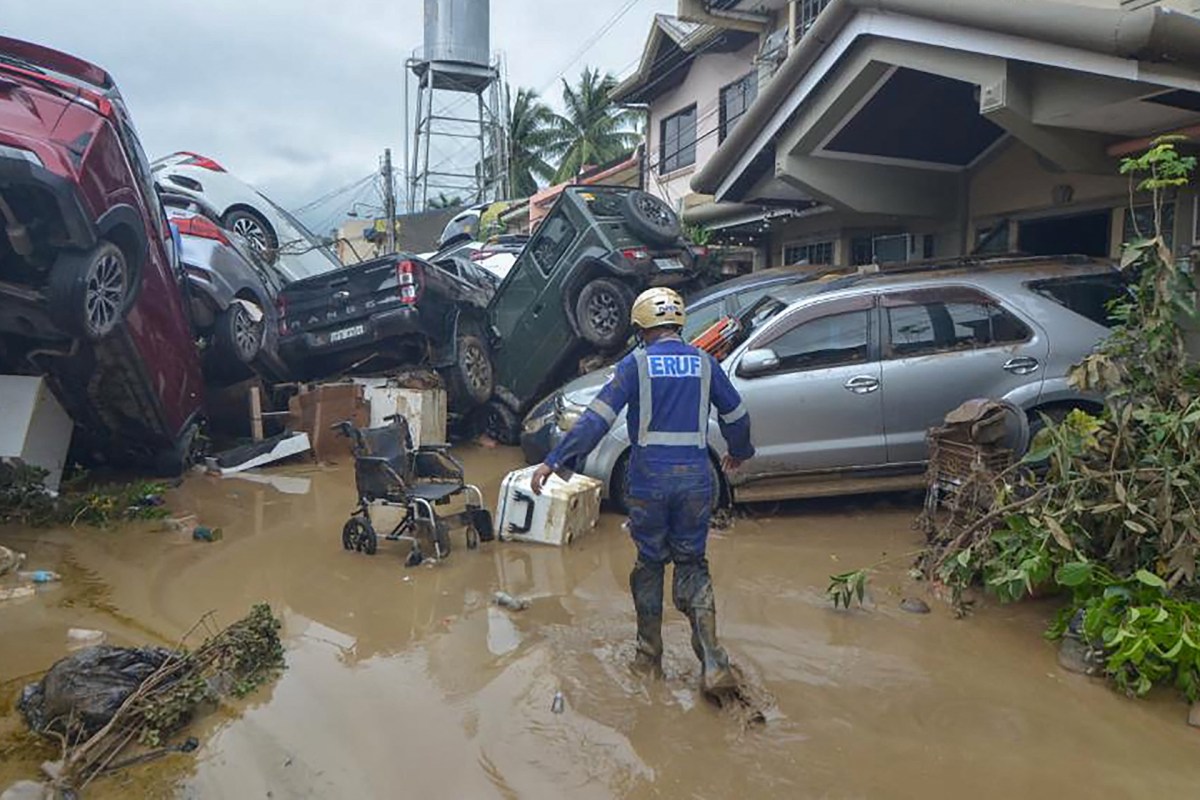
The death toll from Typhoon Kalmaegi climbed to at least 85 people early Wednesday. The powerful storm continued to whip up winds of over 80 mph even after making landfall early Tuesday in the Philippines.
The central island city of Cebu bore the brunt of the storm, resulting in at least 49 fatalities, among them six military helicopter crew members who died when their aircraft crashed on Mindanao during relief operations.
The majority of the deaths were due to drowning, as torrential rain flooded large parts of the country. A video posted on X showed the aftermath of flooding in Talisay City, Cebu, with parts of the area washed away.
This is the aftermath in Talisay City, Cebu, Philippines — the city looks almost completely washed away.
— Weather Monitor (@WeatherMonitors) November 4, 2025
At least 26 people have been killed, with estimated winds reaching 130 kph and gusts of up to 180 kph as Typhoon Kalmaegi (TinoPH) tore through the region. pic.twitter.com/UBs1Rk57fw
"This is the worst flood I've ever experienced," said 19-year-old Carlos Jose Lañas, a volunteer rescuer, per the BBC. "Almost all the rivers here in Cebu overflowed. Even emergency responders did not expect this kind of scenario."
Typhoon Kalmaegi's first landfall came around midnight in Silago, a town in the Southern Leyte province. It then ripped through other towns, including Borbon, Sagay City, and San Lorenzo, the Cebu Daily News reported.
Southeast Asia is now bracing for the impacts of this powerful storm. Several computer models predict Kalmaegi will intensify into a super typhoon, a tropical cyclone in the Pacific with sustained winds of at least 150 mph, the equivalent of a high-end Category 4 hurricane. The storm is moving northwest, headed toward the coast of Vietnam.
Scientists with World Weather Attribution found that the overheating planet supercharged the end of the 2024 typhoon season. Three of the six major storms that impacted the Philippines from late October through the middle of November made landfall as major typhoons. Researchers with WWA concluded that the warming world has raised the likelihood of such events.
"Using a statistical model, we find that in today's climate, warmed by 1.3 degrees Celsius, such an event is expected once every 15 (6.5-45) years," the authors said. "That is 25% more frequent than it would have been had we not burned fossil fuels. In a 2 C warmer climate from pre-industrial times, we expect at least three major typhoons hitting in a single year every 12 years (best estimate)."
Scientists say the power of the recent Hurricane Melissa, the strongest hurricane to ever make landfall in Jamaica, was also boosted by rising temperatures. "A 'Melissa' type hurricane at landfall is about four times more likely in the 2025 climate compared to a pre-industrial baseline," according to a new rapid attribution study.
Researchers with Imperial College London's Grantham Institute estimated that the warming climate increased Melissa's maximum wind speed by 7% and increased the storm's economic damage by 34%.
TCD Picks » Quince Spotlight
💡These best-sellers from Quince deliver affordable, sustainable luxury for all




|
Do you worry about the quality of the air inside your home?
Click your choice to see results and speak your mind. |
 Yes — often 😬
Join our free newsletter for good news and useful tips, and don't miss this cool list of easy ways to help yourself while helping the planet.
Cool Picks






