


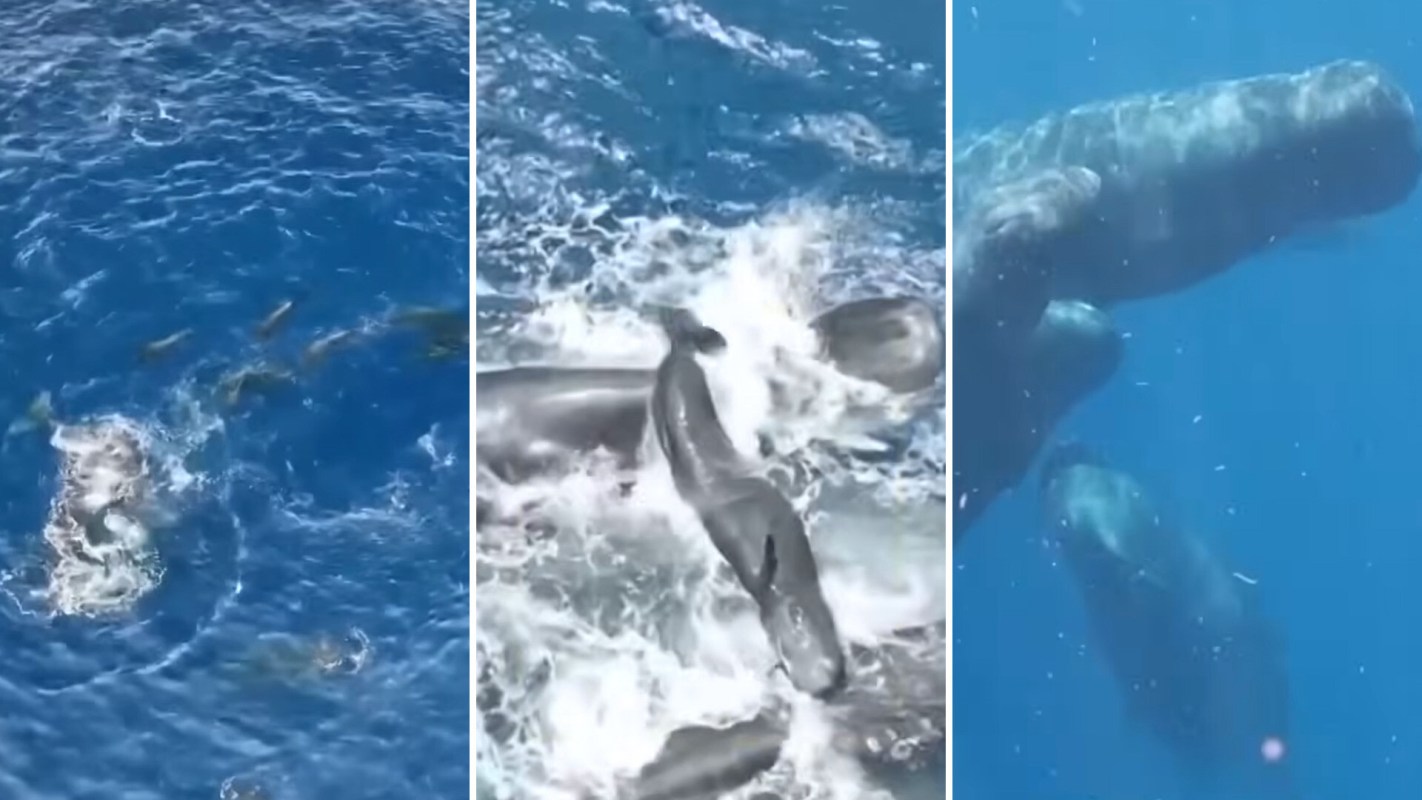
Extremely rare footage of a sperm whale birth has revealed the remarkable and selfless teamwork of the species to ensure a calf's survival.
On July 8, 2023, researchers captured a group of 11 sperm whales, including family members and non-relatives, aiding a mother whale near Dominica's coast.
Project CETI recently released the stunning footage on its Instagram account (@projectceti), showing the female whales assisting with the delivery and helping elevate the calf above the surface to ensure it wouldn't drown.
The Guardian reported on the scientists' observations and insights that were published in the journal Scientific Reports.
The rarity of what the experts saw was notable. A mere nine of the 93 species of cetaceans, which include whales, dolphins, and porpoises, have been seen by researchers giving birth.
Not only was witnessing the birth unusual, but the behaviors on display also captivated researchers. Scientists watched the whales for over five-and-a-half hours, with the birth lasting a little over half an hour.
The engagement of the 11 whales throughout the process revealed the significant role the community plays.
"This marks the first documentation of birth assistance in non-primates," Project CETI team member Shane Gero told the New Scientist, via The Guardian.
"It is fascinating to see the intergenerational support from the grandmother to her laboring daughter, and the support from the other, unrelated females."
Researchers suggested these behaviors can be traced back over 36 million years. They reflect evolutionary adjustments among cetaceans that remained in the water that enable calves to survive right after birth. Other cetaceans eventually shifted their life to the land.
TCD Picks » Quince Spotlight
💡These best-sellers from Quince deliver affordable, sustainable luxury for all




|
Which of these savings plans for rooftop solar panels would be most appealing for you?
Click your choice to see results and earn rewards to spend on home upgrades. |
 Save $1,000 this year 💸
 As one example, calves are born tail-first, so other whales prop them up to help them learn to swim and breathe. This represents another adaptation to ensure survival.
Insights like these are only possible through initiatives like Project CETI, which help shine a light on some of marine life's greatest mysteries.
New technologies, such as drones and audio devices, are allowing researchers to learn even more about how animals like dolphins and whales coordinate and communicate in remarkable ways.
The Guardian noted that after filming the birth, Project CETI didn't spot the pod and the newborn again until July 25, 2025. The fact that it had survived for over two years provided great hope that it's well on its way to adulthood.
As the video revealed, that achievement is undoubtedly a group effort.

Get TCD's free newsletters for easy tips to save more, waste less, and make smarter choices — and earn up to $5,000 toward clean upgrades in TCD's exclusive Rewards Club.
Cool Picks




