


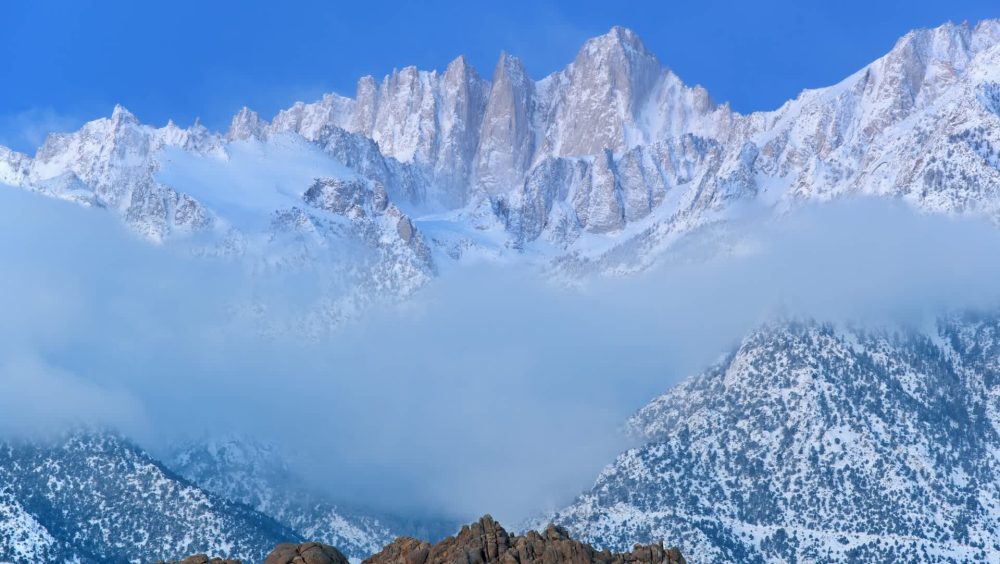
Recent stunning satellite imagery of the snowcapped Sierra Nevada reveals the expansion of snow to lower altitudes, covering parts of the southern section that were snow-free only 10 days prior. A series of atmospheric river-fueled storms slammed the higher elevations with snow measured in feet. The snow came at a crucial time, helping to make up for a lackluster start to winter for the region.
"Two weeks ago, on Feb. 9, the Sierra Nevada mountains held just 53% of their average historical snow level for that date," noted the Los Angeles Times. "By Sunday, the snowpack was at 73% of the typical level, per data from the California Department of Water Resources."
An unsettled weather pattern that developed after the first week of February along the West Coast pushed Pacific moisture onshore, where it was wrung out as rain in lower elevations but also ascended the mountains, falling as snow and stacking up to nearly 8 feet in harder-hit spots.
During the second week of February, several feet of snow piled up in the Sierra Nevada. The Sierra Snow Lab reported a one-day total of 25.6 inches, a two-day total of 54.9, a four-day total of 92.5, and an astonishing five-day total of 111 of new snow.
It was quite a comeback considering that only a couple of weeks ago, snowfall had fallen to about half the median accumulated snowfall for the location.
On Feb. 14, snowfall was just over 85 inches below the median accumulated snowfall through the middle of the month, according to the University of California, Berkeley's Central Sierra Snow Lab.
Just a week later, this winter's accumulated snowfall exceeded the median by more than 8 inches. The abundant snow even forced Yosemite National Park to close temporarily at one point because of treacherous travel conditions.
While the Sierra Nevada replenished its snowpack, several other states are still reporting a snow drought this month. A large portion of Colorado has less than 60% of its median 1991-2020 snow water equivalent, the amount of liquid water in the snowpack. Large sections of Utah are experiencing similar conditions, reporting snow water equivalent levels of 39% to 49% of the median.
An overall warm winter played a part in the snowfall deficits the Sierra Nevada experienced early in the season. The period of January through February, the first two months of meteorological winter, was the warmest such period on record for California, according to the National Centers for Environmental Information.
A warmer-than-average pattern will continue across the state through the weekend, with temperatures expected to climb by 5 to 20 degrees above normal.
TCD Picks » Upway Spotlight
💡Upway makes it easy to find discounts of up to 60% on premium e-bike brands





Scientists say our warming world will make it harder for the West to maintain its average snowpack levels. A 2018 analysis indicated that decades of declining snowpack have trimmed the West's snow-driven freshwater resources by 15% to 30% since 1955. The western U.S. ranks as a global hot spot for snow drought; a 2020 study found that snow drought duration increased by 28% over nearly four decades.
"With continued warming, the amount of water stored in snowpack is projected to decline further across the U.S. — especially in coastal southern Alaska and the mountain ranges of California and the Northwest," researchers with the nonprofit Climate Central said.
|
Which of these savings plans for rooftop solar panels would be most appealing for you?
Click your choice to see results and speak your mind. |
 Save $1,000 this year 💸
Get TCD's free newsletters for easy tips to save more, waste less, and make smarter choices — and earn up to $5,000 toward clean upgrades in TCD's exclusive Rewards Club.
Cool Picks






